
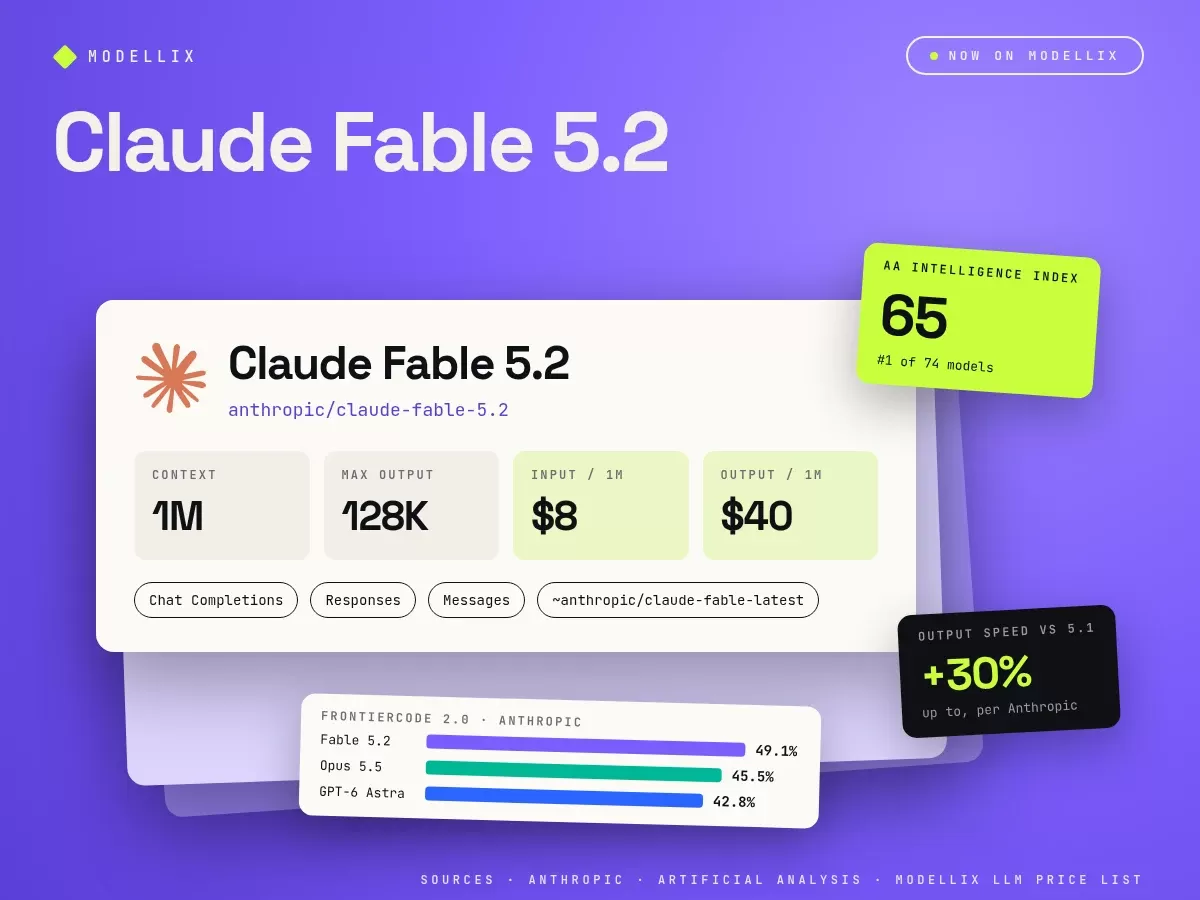
Anthropic released Claude Fable 5.2 on November 9, 2026, alongside Claude Mythos 5.2. Against Fable 5.1, the API price drops 20% to $8 input and $40 output per 1M tokens, output runs up to 30% faster, and the new model leads Claude Opus 5.5 on Anthropic's coding and agent benchmarks.
Anthropic still tells most teams to start with Opus 5.5 and move up to Fable when the scope calls for it. Below are the specs, the benchmark table with who ran each test, the changes that break Fable 5.1 code, and how to call the model. The open question for builders is which jobs justify twice the Opus 5.5 rate.
Claude Fable 5.2 at a Glance: Specs, ID and Price
| Spec | Claude Fable 5.2 |
|---|---|
| Developer | Anthropic |
| Release date | November 9, 2026 |
| API model ID | claude-fable-5-2 |
| Amazon Bedrock ID | anthropic.claude-fable-5-2 |
| Context window | 1M tokens, full window at the standard rate |
| Max output | 128K tokens |
| Input and output | Text and images in, text out |
| API price | $8 input, $40 output per 1M tokens. See Claude Fable pricing for cache, batch and fast mode |
| Fast mode | $16 input, $80 output per 1M tokens, up to 2.5 times the output speed |
| Thinking | Adaptive thinking always on, default effort high |
| Platforms | Claude API, Amazon Bedrock, Google Cloud Vertex AI, Microsoft Foundry, Claude Platform on AWS |
| Gateway access | Available on Modellix as anthropic/claude-fable-5.2 at $8 / $40, through Chat Completions, Responses and Messages |
| Retirement | Not before November 9, 2027 |
Source: Fable 5.2 model overview and the Anthropic announcement.
Try Claude Fable 5.2 on Modellix
- Live today at list price. Call
anthropic/claude-fable-5.2at $8 input and $40 output per 1M tokens, as shown on the LLM price list. - Keep your current SDK. The same model ID works through Chat Completions, Responses and Anthropic Messages. Change the base URL, API key and model ID.
- Compare models on one key. Send the same prompt to Fable 5.2 and Opus 5.5 by switching the model ID. Get an API key or jump to the setup steps.
Fable 5.2 vs Fable 5.1: Four Changes Builders Will Notice

Price and speed: 20% cheaper, up to 30% faster
Input falls from $10 to $8 per 1M tokens and output from $50 to $40. Cache hits drop from $0.25 to $0.20, so a long cached prompt gets cheaper on every call. Anthropic says output is up to 30% faster than Fable 5.1, and the new fast mode trades double the price for up to 2.5 times the output speed.
Benchmark jumps on long, multi-step tasks
The largest gains are on work that runs for hours. FrontierCode 2.0 rises from 32.4% to 49.1%, the Remote Labor Index from 17.9% to 41.3%, and RoboDojo Sim from 27.6% to 64.9%. Gains on shorter tests such as OSWorld 2.1 are smaller, from 83.5% to 89.3%.
Fewer unnecessary refusals
Fable models ship with safeguards for cybersecurity and biology. Anthropic reports about 55% fewer unnecessary blocks than Fable 5.1, with roughly 60% fewer in cybersecurity and 40% fewer in biology. Requests that the safeguards are built to stop are still blocked.
Migration notes for Fable 5.1 code
- Thinking is always adaptive. The default effort is
high. Lower it for routine calls to cut time and tokens. - Forced tool use returns an error.
tool_choiceset toanyor to a named tool returns HTTP 400. Useautoand describe the tool in the prompt. - Sampling parameters are out. Leave
temperature,top_pandtop_kout of the request. - Data retention is required. Fable 5.2 needs 30-day retention, and zero data retention is not available by default.
- Claude Code needs version 2.1.321 or later to select the model.
Claude Fable 5.2 Benchmarks: Nine Scores and Who Ran Them
Every score below comes from Anthropic's launch table, run by Anthropic with safeguards on. Fable models use the highest effort unless the footnote says otherwise.
| Benchmark | What it measures | Fable 5.2 | Fable 5.1 | Opus 5.5 |
|---|---|---|---|---|
| FrontierCode 2.0 | Agentic coding, merge-ready changes | 49.1% | 32.4% | 45.5% |
| FrontierSWE v2 | Agentic software engineering | 69.9% | 56.3% | 62.3% |
| AutomationBench | Business workflow automation | 51.4% | 31.4% | 42.5% |
| Terminal-Bench-Science 0.1 | Agentic scientific research | 74.6% | 52.6% | 58.7% |
| OSWorld 2.1 | Computer use | 89.3% | 83.5% | 87.2% |
| Humanity's Last Exam, with tools | Expert reasoning | 74.2% | 65.6% | 67.7% |
| Chartography | Chart reading, no tools | 73.4% | 44.8% | 64.4% |
| Remote Labor Index | Paid freelance projects | 41.3% | 17.9% | 21.3% |
| RoboDojo Sim | Simulated robot control | 64.9% | 27.6% | 39.4% |
Source: Anthropic announcement. Competitor scores are Anthropic's own runs, not the other labs' published numbers.

The independent check from Artificial Analysis
Artificial Analysis runs its own suite. Fable 5.2 at Max effort scores 65 on the Intelligence Index v5.0.1, first of 74 models, against 59 for Opus 5.5 and 57 for GPT-6 Astra. It is also the most expensive to run: $26.54 per index task, against $10.04 for Opus 5.5 and $6.24 for GPT-6 Astra.
Anthropic makes a narrower cost claim. At High effort, Fable 5.2 scores 45.3% on FrontierCode, matching the best Opus 5.5 result at about half the cost per task.
What Can You Build With Fable 5.2? Four Official Use Cases
These are Anthropic's own examples. Results from developers and creators who used the model on their own projects follow in the next section.
- Long agentic coding and migrations. FrontierSWE v2 and FrontierCode 2.0 measure multi-hour engineering tasks, and these are where the lead over Opus 5.5 is widest.
- Orchestrating other agents. In an internal test, more than 1,000 subagents coordinated by Fable 5.2 ran for eight days and produced an operating system that boots. Anthropic suggests using Fable as an advisor or orchestrator that plans and checks work done by cheaper models.
- Research and formal math. Anthropic reports that 1,000 agents formalized Fermat's Last Theorem in 30 hours.
- Computer use. An 89.3% score on OSWorld 2.1 puts Fable 5.2 ahead of every model in the launch table for operating desktop software.
What Early Testers Report: Hands-On Results From the First Two Days
The results in this section are self-reported by the people who ran them. Each report is linked below.

Video, animation and 3D scenes
Chinese AI writer Khazix ran about ten tasks on an Ultra plan in the Claude desktop app, mostly at Xhigh effort. He reports that a 40 to 60 second tribute video with original music took about an hour and was usable on the first attempt.
His longest task, a 3D web page of the Apple store in Jing'an, Shanghai, took about 2.5 hours. About an hour of that went to reading press coverage and viewing more than 100 photos of the real store.
Claire Vo of Lenny's Newsletter built an animated marketing video from one tweet and a brand book, and a working 3D typewriter in one shot. Matt Shumer reports a voxel engine with destruction physics that runs in a browser tab.
Taste is the weak spot in these reports. Vo still prefers Opus 5.5 for web design, and Shumer says it matched his style only after he showed it many examples.
Code review and agent coordination
Limited Edition Jonathan ran 79 scored runs across nine job types against Opus 5.5, Codex and Grok. In a code review with five known defects, Fable 5.2 found three or four at every effort setting, while Opus 5.5 found two.
On most other jobs the models tied. As coordinator of his agent fleet, Fable 5.2 completed 61 jobs a day against 11 for Opus 5.5 in the same role.
Effort: High is usually enough

Jonathan found that nothing above High did better on his hardest jobs, and Shumer runs most work at Low or Medium. Artificial Analysis shows the same curve. Fable 5.2 at Low scores 54, above Opus 5.5 at High, and Max adds three points over High for 2.6 times the time.
Tone and refusals
Khazix found Fable 5.2 more direct than Fable 5.1 and willing to reject his plan for a better one. Shumer saw the other side of the safeguards: it refused a routine product change until a privacy policy update went live.
What a heavy session uses on a Claude plan
Khazix reports that his ten Xhigh tasks over about four hours took his Ultra weekly usage from 70% to 94%. According to the Claude Help Center, Max, Ultra and Team premium seats can spend up to 50% of weekly limits on Fable models at no extra cost.

Pro and Team standard seats normally pay for Fable with usage credits, and the Free plan has no Fable access. For the launch, Pro and Team standard seats can use Fable inside their weekly limits, up to 50%, until November 16, 2026, 11:59 pm PT, with one reset for eligible subscribers.
Max, Ultra and Team premium seats get one to three resets, depending on how long they have paid, that expire March 8, 2027. A reset restores weekly usage spent on Fable models and, if the account has a five-hour limit, refills that window. Details and eligibility are in the Claude Fable 5.2 launch offers article.
Fable 5.2 vs Opus 5.5 vs Mythos 5.2
Fable 5.2 vs Opus 5.5: when twice the price pays off
Opus 5.5 costs $4 input and $20 output per 1M tokens, half of Fable 5.2. On Artificial Analysis the gap per task is wider, 2.6 times, because Fable at Max thinks longer: 46.4 minutes per index task against 25.1 for Opus 5.5.
| Job | Better pick | Why |
|---|---|---|
| Daily coding, edits, reviews of small diffs | Opus 5.5 | Close scores at half the price |
| Multi-hour agent runs, large refactors | Fable 5.2 | Widest benchmark lead, FrontierSWE 69.9% vs 62.3% |
| Planning and checking work for other agents | Fable 5.2 | Anthropic's recommended advisor role |
| Motion graphics, video, 3D scenes | Fable 5.2 | Khazix, Vo and Shumer builds |
| Web page and UI design | Opus 5.5, or Fable with strong references | Vo and Shumer on taste |
| High-volume extraction or classification | Neither | A smaller model such as Claude Haiku 5.5 costs a fraction |
On Modellix, anthropic/claude-fable-5.2 and anthropic/claude-opus-5.5 share one API key and one request format, so moving a job between the two is a change to the model field.
For a deeper comparison of the two families, read the Claude Fable vs Opus decision guide.
Fable 5.2 vs Mythos 5.2: same model, different safeguards
Mythos 5.2 is built on the same base model with the cybersecurity and biology safeguards removed. Specs and prices match Fable 5.2. Access is limited to organizations approved through the Cyber Verification Program or the Life Sciences Verification Program, and Enterprise customers can reach it inside Claude Security.
Anthropic reports 89.6% on CVE Rediscovery and 76.3% on CyScenarioBench for Mythos 5.2. Most developers cannot call it, so Fable 5.2 is the version to plan around.
How to Use Claude Fable 5.2 Through the Anthropic API
Install the official SDK, set ANTHROPIC_API_KEY, and call the Messages API with the model ID:
import anthropic

client = anthropic.Anthropic()

message = client.messages.create(
    model="claude-fable-5-2",
    output_config={"effort": "high"},
    max_tokens=16000,
    messages=[{"role": "user", "content": "Plan a migration of this service to Postgres 18."}],
)
for block in message.content:
    if block.type == "text":
        print(block.text)
On Bedrock, use anthropic.claude-fable-5-2. Set output_config.effort in Messages requests, as in the official effort guide. Effort is the main cost control. Artificial Analysis measured 62 points at High effort in 17.6 minutes per task, against 65 points in 46.4 minutes at Max. Start at the default and raise it only for the hardest runs.
To call Fable 5.2 through Modellix with the same SDK, point the client at https://llm.modellix.ai, swap in your gateway API key and set model to anthropic/claude-fable-5.2. The setup steps are in the next section.
Call Fable 5.2 and Other Models With One API Key

- Keep your existing SDK. Use the Anthropic or OpenAI client and change only the base URL and API key.
- Choose a model for each step. Use Fable for planning and switch the model ID for lower-cost execution.
- Audit each call. Request logs separate uncached input, output, cache reads and cache writes.
Claude Fable 5.2 is available on Modellix under the model ID anthropic/claude-fable-5.2, with the same ID working on Chat Completions, Responses and Anthropic Messages. The alias ~anthropic/claude-fable-latest now points to Fable 5.2, so clients that use it switched without a code change.
| Model | Model ID | Input per 1M | Output per 1M | Cache read per 1M |
|---|---|---|---|---|
| Claude Fable 5.2 | anthropic/claude-fable-5.2 |
$8 | $40 | $0.20 |
| Claude Opus 5.5 | anthropic/claude-opus-5.5 |
$3.60 | $18 | $0.18 |
| Claude Sonnet 5.5 | anthropic/claude-sonnet-5.5 |
$1.80 | $9 | $0.09 |
| Claude Haiku 5.5 | anthropic/claude-haiku-5.5 |
$0.09 | $0.45 | $0.009 |
Haiku prices in this table are for prompts up to 100K tokens; larger prompts use its higher input-context tier.
Prices from the Modellix LLM price list, read November 10, 2026. Fable 5.2 is listed at Anthropic's rates, and the Opus, Sonnet and Haiku rows show 10% off.

The Anthropic SDK needs only two environment variables. The base URL has no /v1 suffix:
export ANTHROPIC_API_KEY="mdlx-xxxxxxxx"
export ANTHROPIC_BASE_URL="https://llm.modellix.ai"
import anthropic

client = anthropic.Anthropic()  # reads ANTHROPIC_API_KEY and ANTHROPIC_BASE_URL

message = client.messages.create(
    model="anthropic/claude-fable-5.2",
    max_tokens=16000,
    messages=[{"role": "user", "content": "Plan a migration of this service to Postgres 18."}],
)
for block in message.content:
    if block.type == "text":
        print(block.text)
OpenAI SDK clients use https://llm.modellix.ai/v1 with the same model ID. Claude Code takes the same two variables. Setup for each client is in the LLM API guide.
Claude Fable 5.2 is live on Modellix
Create an API key and call anthropic/claude-fable-5.2 at $8 input and $40 output per 1M tokens through Chat Completions, Responses or Anthropic Messages. Switch the model ID to run the same prompt on Opus 5.5, Sonnet 5.5, Haiku 5.5 or another provider's model.
Try Claude Fable 5.2Claude Fable 5.2 FAQ (2026)
Is Claude Fable 5.2 worth it?
For multi-hour agent work, motion graphics and hard planning, early testers report useful results. At Max effort, Artificial Analysis measures about 2.6 times the cost per task of Opus 5.5. Keep everyday work on the cheaper model and evaluate Fable for planning and review.
When was Claude Fable 5.2 released?
Anthropic released Claude Fable 5.2 and Claude Mythos 5.2 on November 9, 2026. Anthropic's docs say the model will not be retired before November 9, 2027.
How much does Claude Fable 5.2 cost?
$8 per 1M input tokens and $40 per 1M output tokens, 20% below Fable 5.1. Cache hits cost $0.20, batch halves both rates, and fast mode doubles them. The full rate card is in our Claude Fable pricing guide.
Is Fable 5.2 better than Opus 5.5?
On Anthropic's benchmarks it leads Opus 5.5 on all nine tests, and Artificial Analysis scores it 65 against 59. It also costs about 2.6 times more per index task. Anthropic recommends Opus 5.5 for most coding and knowledge work.
What is the difference between Claude Fable and Claude Mythos?
Mythos 5.2 is Fable 5.2 without the cybersecurity and biology safeguards. Price and specs are the same. Only organizations approved through Anthropic's verification programs can use Mythos.
What is the Claude Fable 5.2 context window?
One million tokens of input with up to 128K tokens of output. The full window is billed at the standard rate, with no long-context surcharge.
Can I use Fable 5.2 in Claude Code?
Yes, on version 2.1.321 or later. Max, Ultra and Team premium seats can use up to 50% of their weekly limits on Fable. Pro and Team standard seats use usage credits outside the temporary launch offer.
Is Claude Fable 5.2 free?
No. The Free plan has no Fable access. Pro and Team standard seats can use Fable within 50% of their weekly limits until November 16, 2026, 11:59 pm PT, then return to usage credits.
Does a Fable reset raise my usage limits?
No. A reset restores the weekly usage spent on Fable models and refills the five-hour window if your account has one. Your limits stay the same. Claim an eligible reset under Settings, then Usage.
Can I call Fable 5.2 without an Anthropic account?
Yes. Bedrock, Vertex AI and Microsoft Foundry carry it, and an LLM gateway such as Modellix offers anthropic/claude-fable-5.2 at the same $8 and $40 per 1M tokens on one key with other providers' models.
Is Claude Fable 5.2 available on Modellix?
Yes. The LLM price list shows Claude Fable 5.2 as anthropic/claude-fable-5.2 at $8 input, $40 output and $0.20 cache read per 1M tokens. The alias ~anthropic/claude-fable-latest points to the same model. Create a key on the API key page and call it through Chat Completions, Responses or Anthropic Messages.
Does Fable 5.2 accept temperature or top_p?
No. Leave temperature, top_p and top_k out of requests. Thinking is adaptive and controlled through the effort setting.
Sources: hands-on results are self-reported by the four authors linked above. Plan terms come from the Claude Help Center. Anthropic announcement, Fable 5.2 model overview, Claude API pricing and Artificial Analysis, all read November 10, 2026. Benchmark scores are as published by Anthropic. Gateway prices come from the LLM price list linked above.
Related articles
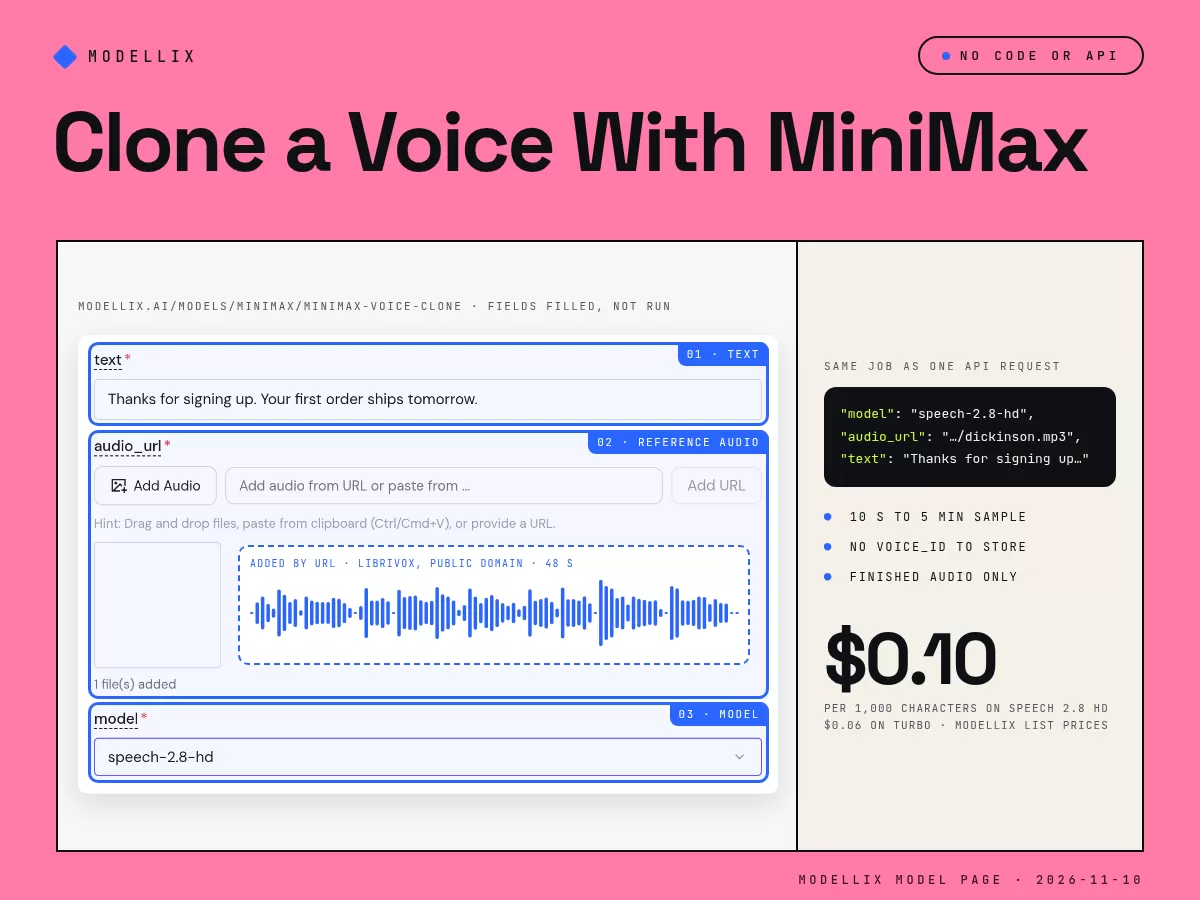
MiniMax Voice Clone: How to Clone a Voice (App, API, 2026)
Clone a voice with MiniMax in the web app, through the API, or in one request. Sample rules, costs, free credits, settings, and consent rules explained.
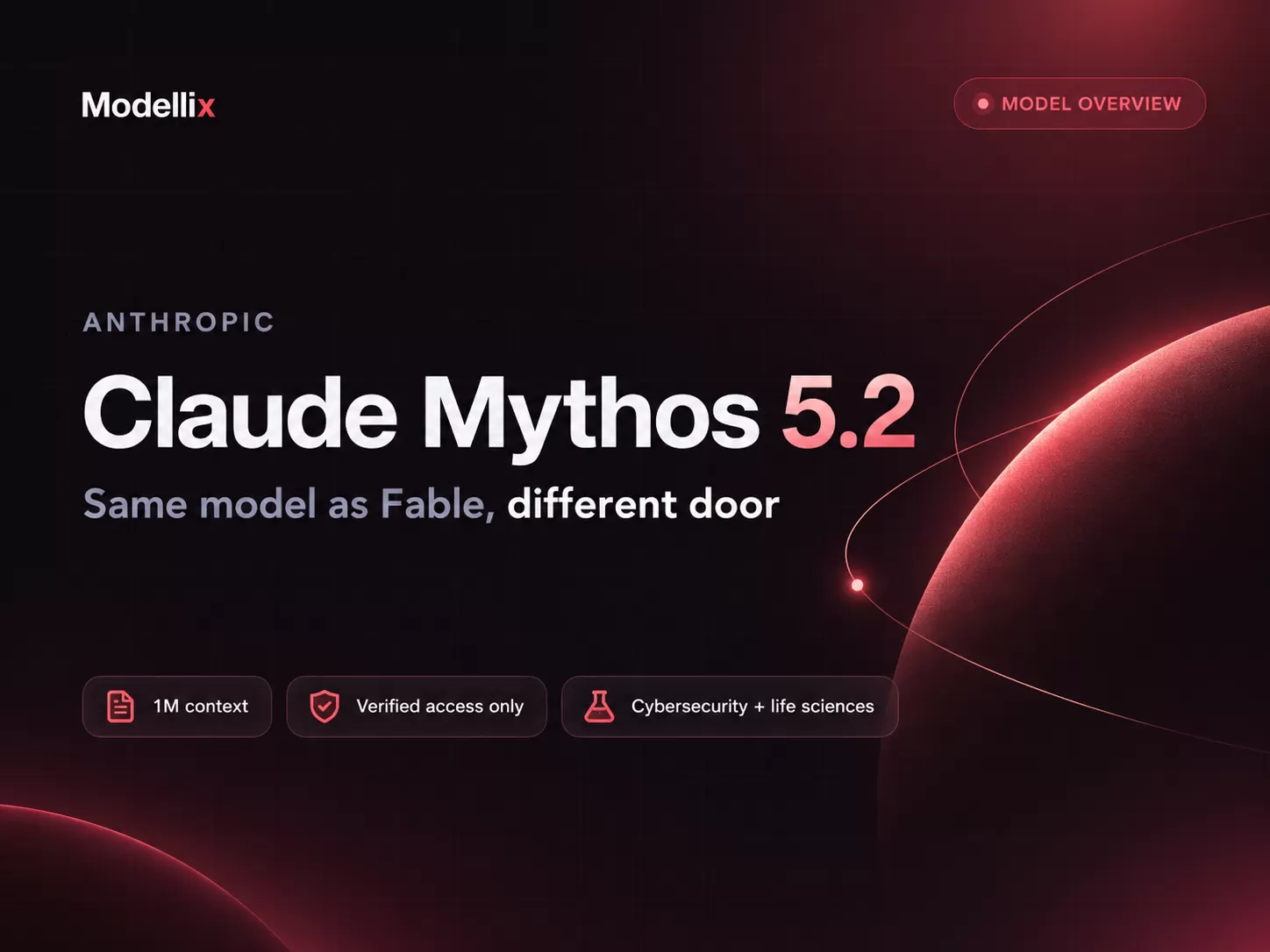
Claude Mythos 5.2: Capabilities, Access & Pricing
Claude Mythos 5.2 is the same model as Fable 5.2, minus some safeguards, and only verified organizations can use it. Here's what it does, what it costs, and who can apply.
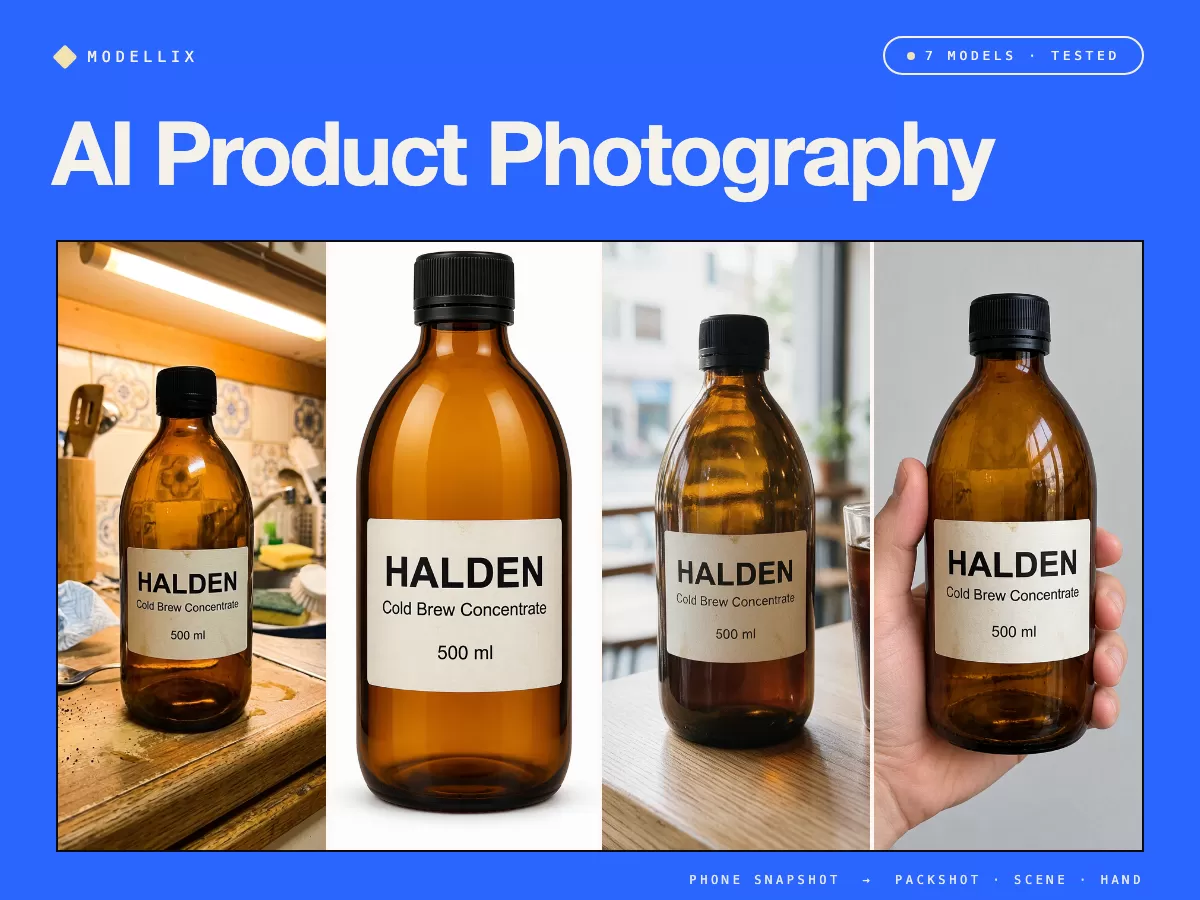
AI Product Photography: 7 Image Models Tested on One Product
We tested seven AI image models on the same product for packshots, lifestyle scenes, and hand shots. Compare color, labels, framing, speed, and actual cost.

AI Commercial Generator [Tested]: 4 Ways to a 15s Ad
One product, one 15-second commercial, four AI routes. See every spot, what each cost, the lighting prompts that held, and what broke.