
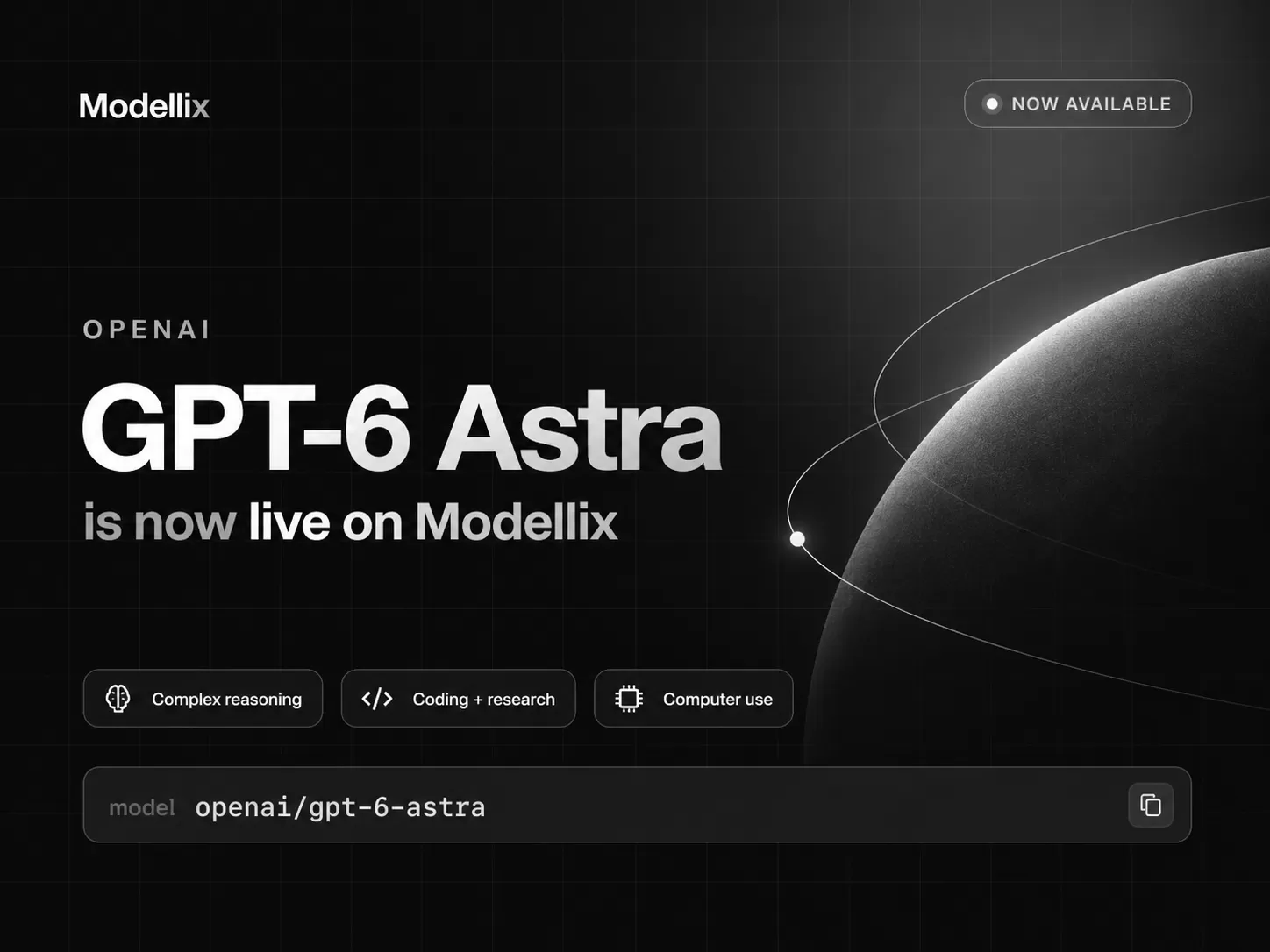
GPT-6 Astra is OpenAI's flagship model, released on September 3, 2026. OpenAI calls it "the most intelligent and aligned model in the world," and it is the top tier above GPT-6 Sol and GPT-6 Luna.
It is built for "the hardest end-to-end work": computer use, long coding sessions, research, and document work. It lists at $10 per million input tokens and $50 per million output tokens.
Astra wins most of OpenAI's own charts, but not all of them. Claude Fable 5.1 costs the same and still leads on some knowledge benchmarks. This page covers where the lead is real, and how to call the model.
GPT-6 Astra at a Glance
| GPT-6 Astra | |
|---|---|
| Position | First and top GPT-6 model; Sol and Luna followed as cheaper tiers |
| Released | September 3, 2026 |
| Best for | Computer use, hard coding tasks, long-context research, professional documents |
| Price | $10 input / $50 output per 1M tokens ($1 cached) |
| Context window | 1,050,000 tokens, up to 128,000 output tokens |
| Reasoning effort | low, medium (default), high, xhigh, max (no none) |
| Input types | Text and images in, text out |
| Where to use it | ChatGPT paid plans, OpenAI API, Microsoft Azure, AWS Bedrock |
| Model ID | gpt-6-astra on OpenAI, openai/gpt-6-astra on Modellix |
| Safety checks | Some security-related tasks trigger extra checks; in the API, a flagged task stops |

GPT-6 Astra Benchmarks
Scores are from OpenAI's launch post, at maximum reasoning effort.
| Benchmark | What it measures | Astra | GPT-5.6 Sol |
|---|---|---|---|
| OSWorld 2.0 offline | Long computer-use workflows | 72.6% | 65.7% |
| ScreenSpot-Pro | Finding UI elements on screen | 92.7% | 76.9% |
| Terminal-Bench 4.0 | Multi-step terminal tasks | 57.9% | 37.3% |
| AutomationBench | Business workflows across tools | 41.4% 2.3x | 18.1% |
| DeepSWE 1.1 | Software engineering in real repos | 74.1% | 72.7% |
| MRCR v2, 512K to 1M | Retrieval deep in long context | 96.3% | 73.8% |
| ARC-AGI-3 | Solving unfamiliar interactive puzzles | 99.9% 12.8x | 7.8% |
The biggest jumps are in computer use, terminal work, and long-context retrieval. Plain coding moved less: DeepSWE went up 1.4 points.
OpenAI also reports speed. On OSWorld 2.0, Astra averaged about 40 minutes per task against 75 minutes for GPT-5.6 Sol.
GPT-6 Astra vs Claude Fable 5.1
Both models list at $10 input and $50 output per million tokens. That makes this the comparison most teams actually face.
| Benchmark (OpenAI's table) | GPT-6 Astra | Claude Fable 5.1 |
|---|---|---|
| Terminal-Bench 4.0 | 57.9% | 55.8% |
| DeepSWE 1.1 | 74.1% | 67.4% |
| AutomationBench | 41.4% | 31.4% |
| FrontierMath Tier 4 | 97.6% | 87.8% |
| Humanity's Last Exam (with tools) | 57.2% | 65.0% |
| Artificial Analysis Intelligence Index | 61.2 | 65.7 |
Astra leads on agentic and coding work. Fable 5.1 leads on broad knowledge and the composite index.
A second chart points the same way. In SpaceXAI's Grok 4.7 launch post, GDPval puts Fable 5.1 at 1,735 Elo and Astra at 1,542, below both Grok models tested.
Price is not identical either. Cached reads cost $1.00 per million on Astra and $0.25 on Fable 5.1, so cache-heavy agents pay up to four times more for reused context on Astra. Our GPT-6 Astra pricing breakdown works through that math.
When Is Astra Worth It Over Sol?
Astra costs five times as much as GPT-6 Sol per token. Its lead is largest where a task runs long and a mistake is expensive.
- Computer use: 72.6% on OSWorld 2.0 against Sol's 60.5%.
- Very long context: strong retrieval between 512K and 1M tokens.
- Open-ended work where the model has to decide what to check.
On shorter, well-scoped jobs, Sol often gets there first. OpenAI's own AutomationBench chart shows Sol at xhigh beating Astra at low effort for about a quarter of the cost per task.
A practical rule: run the task on Sol, and move only the failures to Astra. For bulk work, look at GPT-6 Luna instead.
What Can You Build with GPT-6 Astra
Astra belongs in products where a task runs long, touches real systems, and a mistake is expensive.
- Migration review assistant. In a developer portal, an engineer describes a schema change and Astra drafts the SQL plus the assumption most likely to change the result (see the test below).
- Front-end QA agent. Astra operates the browser, clicks through a staging site, and reports what broke, which is where its OSWorld lead matters.
- Due-diligence reader. Contracts and filings up to a million tokens go in, and the output is a list of risks with the passages they came from.
- Template-bound documents. Board decks and spreadsheets that must follow a company template, which OpenAI calls out as an Astra strength.
What we saw in a small test
We gave openai/gpt-6-astra a PostgreSQL 16 orders table with paid_at, shipped_at, and cancelled_at columns, and asked it to add and backfill a status column.
Astra opened with one line stating its assumption: cancelled beats shipped, shipped beats paid, and new rows default to pending. It then returned one transaction with the column, a CASE backfill, a default, NOT NULL, and a CHECK constraint.
We checked the backfill logic on five sample rows and each landed on the expected status. Run the full migration on a copy of your data before production. The call took about 46 seconds, most of it reasoning.
How to Use GPT-6 Astra
In ChatGPT, Astra is on Plus, Pro, Business, and Enterprise plans. Enterprise admins have to switch it on.
In the API, you can call it directly on OpenAI as gpt-6-astra, or through an OpenAI-compatible gateway such as Modellix, where it is openai/gpt-6-astra. Three things to plan for:
- No
noneeffort. The lowest setting islow, so every call carries some reasoning tokens. - Fast mode runs up to twice as fast at twice the price.
- Security-adjacent prompts can stop. Build a fallback path if your product touches vulnerability work.
The example below uses the OpenAI Python SDK with Modellix. Create a key in the Modellix console, then change two lines from a standard OpenAI setup: base_url and the model name. To call OpenAI directly instead, drop base_url and use gpt-6-astra.
import os
from openai import OpenAI

client = OpenAI(
    base_url="https://llm.modellix.ai/v1",
    api_key=os.environ["MODELLIX_API_KEY"],
)

resp = client.responses.create(
    model="openai/gpt-6-astra",
    reasoning={"effort": "high"},
    input="Plan the migration from our monolith's orders module to a separate service. "
          "State every assumption that could change the plan.",
)
print(resp.output_text)
Try GPT-6 Astra with One API Key for Every Model
Astra is the model you escalate to, which means it never runs alone. The cheaper tiers, a Claude comparison, and whatever image model your product uses all end up on separate accounts and bills.
However, the Modellix key from the example above covers that whole stack. It also reaches GPT-6 Sol, GPT-6 Luna, Claude Fable 5.1, Gemini, and Grok, so "Sol first, Astra for the failures" is a one-string change to model.
Same tokens, lower bill
OpenAI's official API pricing lists GPT-6 Astra at $10 per million input tokens and $50 per million output tokens. For one call with 8,000 input tokens, 8,000 output tokens, and no cache, that is about $0.48 on OpenAI and $0.432 on Modellix, as the Modellix LLM calculator shows below.

| Calls at 8,000 in + 8,000 out | OpenAI direct | Modellix | Saved |
|---|---|---|---|
| 1,000 | $480 | $432 | $48 |
| 10,000 | $4,800 | $4,320 | $480 |
| 100,000 | $48,000 | $43,200 | $4,800 |
| 1,000,000 | $480,000 | $432,000 | $48,000 |
At 1,000 calls with that mix, Modellix bills $48 less than OpenAI direct. At 100,000 calls the gap is $4,800. This is a price comparison at the same billed token counts, not a quality benchmark, and it stays inside the 272K input tier.
One API for every model
Run GPT-6 Astra next to every other model on one key
GPT-6 Astra, Sol, and Luna, plus Claude, Gemini, Grok, DeepSeek, and Qwen. Switching models is a change to the model string.
OpenAI Chat Completions and Responses, plus Anthropic Messages. Works with the OpenAI and Anthropic SDKs, Codex, Claude Code, Cursor, and OpenCode.
GPT-6 and Claude models bill 10% under the vendor list price on the current rate card. Pay as you go, no subscription.
Every call is logged with tokens and cost, and can be tagged by end user, so you can see what an escalation actually cost.
Pin a fixed model ID for evaluations, or use a -latest alias that moves to the newest release.
The same account also calls image, video, and audio generation models through the Modellix media API.
The same key also runs image and video models. Once Astra has drafted and checked a launch brief, GPT Image 2 can produce the hero image and Seedance 2.0 a short clip from it.
Pin openai/gpt-6-astra for evaluations, or use ~openai/gpt-astra-latest to pick up future Astra releases without a code change.
Try GPT-6 Astra
Create a Modellix key, run Astra on the task that fails on Sol, and compare cost per request in the logs.
Get API KeyRelated articles
GPT-6 Luna: Pricing, Context Window & How to Use It
GPT-6 Luna costs $0.10 per 1M input tokens with a 1.05M context window. See workload costs, Luna vs Sol, what changed from GPT-5.6, and how to call it.
GPT-6 Sol: Pricing, Benchmarks & When to Use It
GPT-6 Sol costs $2/$10 per 1M tokens, half of GPT-5.6 Sol. See what its benchmarks measure, real workload costs, and when to pick Sol over Luna or Astra.
Claude Opus 5.5: Release Date, Pricing & How to Use It
Explore Claude Opus 5.5 release details, pricing, 1M-token context, adaptive thinking, and key API changes, plus a first-use example on Modellix.
Grok 4.7: Release Date, Pricing & How to Use It
Grok 4.7 launched September 21, 2026 at $2/$6 per 1M tokens with a 500K context window. See what changed for coding and long tasks, then try it via API.