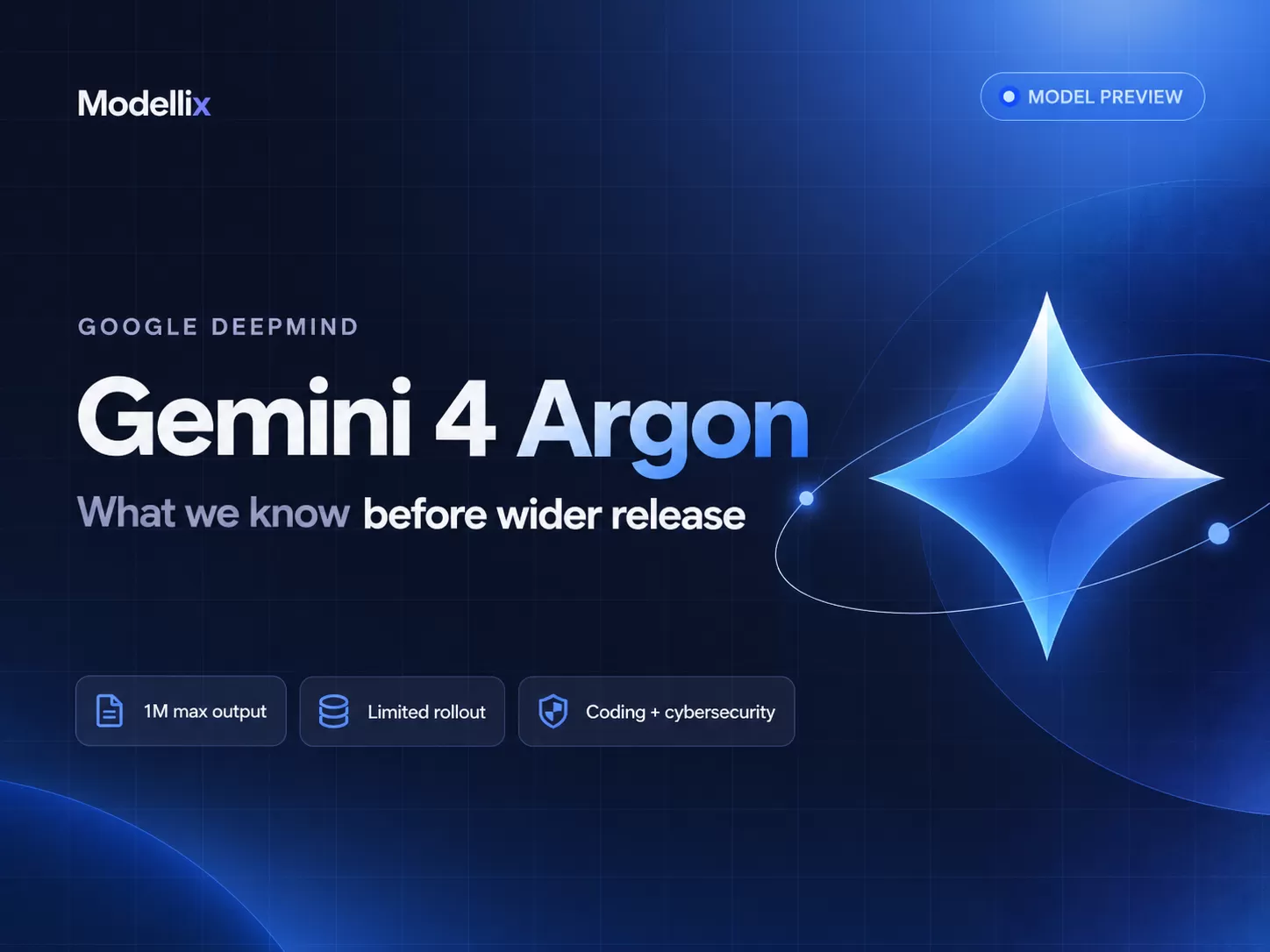
Google has unveiled Gemini 4 Argon, though most of us will have to wait a little longer to try it.
Google announced the model in September 2026, starting with a limited rollout to cyber defenders in its Fairwind Program. While paid API users and Google AI Ultra members are next in line, Google is keeping the exact public release date under wraps for now.
Designed as a heavyweight reasoning engine, Argon features a massive 1-million-token output capacity—making it a powerhouse for repository-scale coding, complex data analysis, and autonomous vulnerability fixes. Here is an early breakdown of what makes Argon worth watching.
Gemini 4 Argon at a Glance

| Item | Current status |
|---|---|
| Provider | Google DeepMind |
| Announced | September 30, 2026 |
| Current access | Limited testers, including approved Fairwind partners |
| Wider developer access | Planned; no date announced |
| Main areas highlighted by Google | Software engineering, professional knowledge work, defensive cybersecurity |
| Maximum output | 1 million tokens |
| Public API details | Model ID and separate input context limit not yet published |
| Our last checked | October 9, 2026 |
What Is Gemini 4 Argon Built to Do?
You probably know Argon as the inert noble gas on the periodic table, unreactive, steady, and completely unbothered. Google might want to take that stability and turn it into stamina with this frontier model.
Its announcement focuses on work that takes more than a quick answer: investigating a codebase, carrying out multi-step research, or finding and fixing a security issue. Google also says Argon's maximum output has increased to one million tokens, up from the previous 64,000-token limit (That is an output limit, not a claim about its input context window.) A larger output ceiling gives an agent more room to work, but it can also leave teams with more code, claims, and decisions to review.
Google's announcement points to three main areas:
-
Deep coding & debugging: Tracing bugs across files, writing fixes, and testing them. In one internal project, Google says Argon agents replaced 32,000 lines of SIMD code in a Rust video decoder. The updated decoder ran 2.7 times faster than the earlier Rust version while producing identical output.
-
Knowledge & document work: Digging through dense legal or financial docs, analyzing complex charts, and processing long-form video content.
-
Defensive cybersecurity: Spotting software vulnerabilities, verifying them, and drafting patches before threats get out of hand. Google is starting with trusted cyber defenders through the Fairwind Program. It says Wiz is already using Argon through its Scan for Good initiative and that the model uncovered a critical vulnerability in healthcare software in one early case.
What matters more than a longer response is whether Argon can stay useful as a task moves from investigation to revision to verification. Google's benchmarks offer an early look at that, while broader developer testing still lies ahead.
What Do the Early Benchmarks Show?
Google reports several results across coding, business workflows, multimodal understanding, and security. Four useful markers from Google's announcement (2026) are:
| Benchmark | Google-reported result | What it measures |
|---|---|---|
| DeepSWE v1.1 | 77.9% | Long-running, real-world software engineering tasks |
| AutomationBench | 51.3% | End-to-end execution of business tasks |
| LVBench | 91.7% | Understanding long videos |
| CWE-bench v1 | 68% | Fixing software security vulnerabilities |
A third-party view points in a similar direction. Artificial Analysis gave Gemini 4 Argon (High) a score of 53 on Intelligence Index v4.3.2, placing it among the stronger models in the comparison below.

Taken together, the results point to the same theme: Argon appears strongest when a task requires sustained work across code, business processes, multimodal evidence, or security—not simply a better answer to a single prompt.
The four Google scores above are vendor-reported, and the test setups matter. Google's evaluation methodology says the results use the highest thinking setting unless noted otherwise. Once more developers can run their own tests, we'll have a better sense of how Argon performs in everyday work.
How Does Gemini 4 Argon's Announced Price Compare?
Here is how Argon's announced introductory rate sits alongside two earlier Gemini models. Prices are in USD per million input / output tokens, using standard API rates.
| Price source | Gemini 3.8 Flash | Gemini 3.1 Pro | Gemini 4 Argon Preview |
|---|---|---|---|
| Google official | $0.75 / $3.75 | $2 / $12 | $2 / $10 (announced introductory rate) |
| Modellix | $0.75 / $3.75 | $1.80 / $10.80 | Not yet listed |
The Gemini 3.1 Pro rates shown reflect the standard tier for prompts under 200K tokens, as longer context window requests cost more. Meanwhile, Gemini 3.8 Flash’s introductory rate runs through December 31, 2026. For Argon, Google offers a discounted introductory price—along with a 95% discount on cached inputs—before rates eventually double to $4/$20 per million tokens (no end date has been set yet). Keep in mind, these token prices reflect raw compute costs, not direct comparisons of model capability.
One API for every model
Run Gemini next to every other model on one key
GPT-6 Astra, Sol, and Luna, plus Claude, Gemini, Grok, DeepSeek, and Qwen. Switching models is a change to the model string.
OpenAI Chat Completions and Responses, plus Anthropic Messages. Works with the OpenAI and Anthropic SDKs, Codex, Claude Code, Cursor, and OpenCode.
GPT-6 and Claude models bill 10% under the vendor list price on the current rate card. Pay as you go, no subscription.
Every call is logged with tokens and cost, and can be tagged by end user, so you can see what an escalation actually cost.
Pin a fixed model ID for evaluations, or use a -latest alias that moves to the newest release.
The same account also calls image, video, and audio generation models through the Modellix media API.
What Happens Next?
Going forward, we’re keeping a close eye out for Argon's public launch date, API docs, and real-world dev feedback. We'll keep this page updated as new details drop.
In the meantime, the AI space isn't standing still! While Argon is in closed beta, you can already build with the latest frontier models on Modellix, whether you want to run Google's existing gemini-3.8-flash, or dive into newly launched powerhouses like claude-opus-5.5 and gpt-6.1-sol.
Build with the Latest Models Today!
Don't just wait for Argon, get your API key in seconds and start building with Claude Opus 5.5, GPT-6.1 Sol, and more.
Get API KeyRelated articles
Claude Opus 5.5: Release Date, Pricing & How to Use It
Explore Claude Opus 5.5 release details, pricing, 1M-token context, adaptive thinking, and key API changes, plus a first-use example on Modellix.
Grok 4.7: Release Date, Pricing & How to Use It
Grok 4.7 launched September 21, 2026 at $2/$6 per 1M tokens with a 500K context window. See what changed for coding and long tasks, then try it via API.
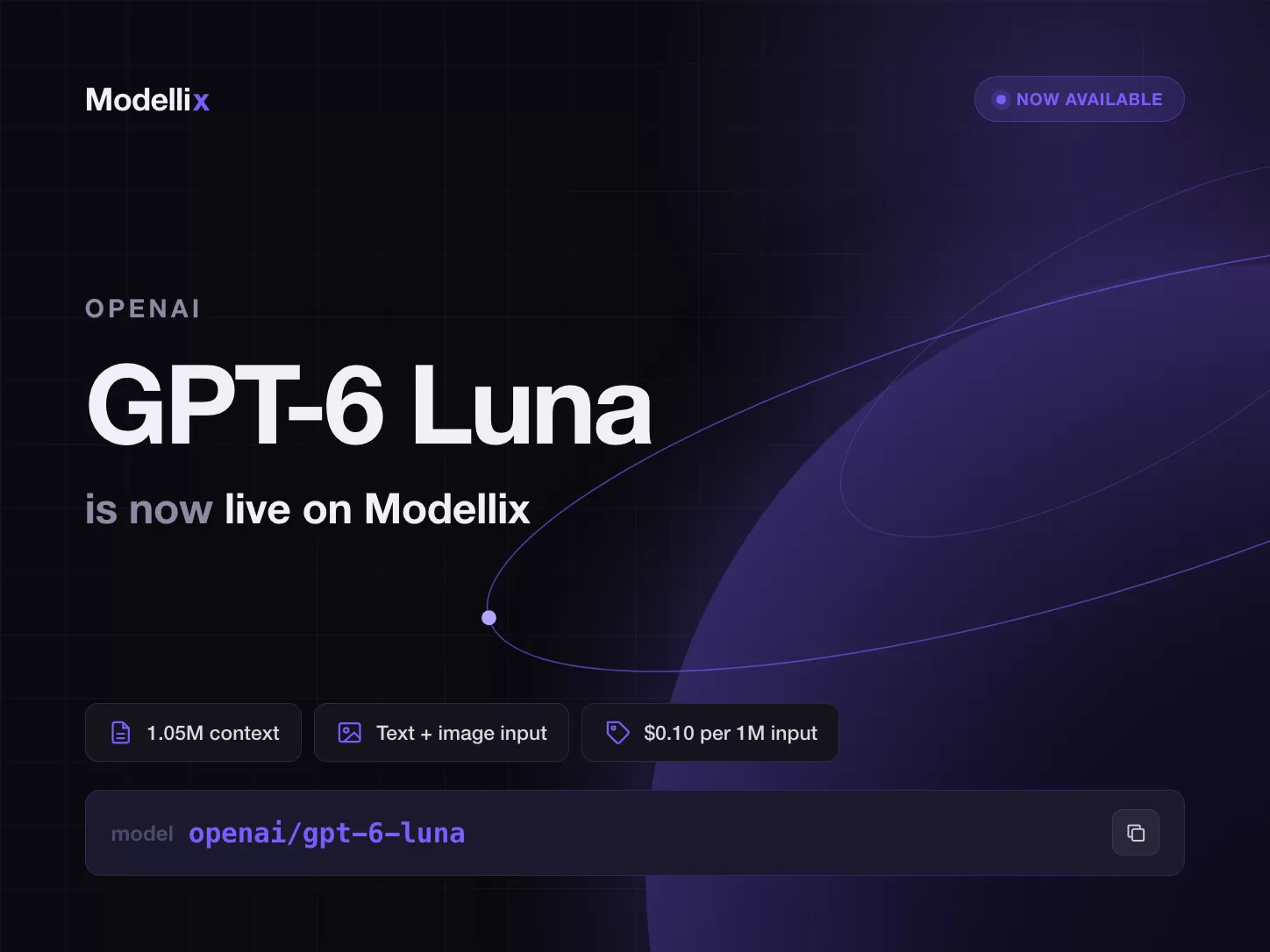
GPT-6 Luna: Pricing, Context Window & How to Use It
GPT-6 Luna costs $0.10 per 1M input tokens with a 1.05M context window. See workload costs, Luna vs Sol, what changed from GPT-5.6, and how to call it.
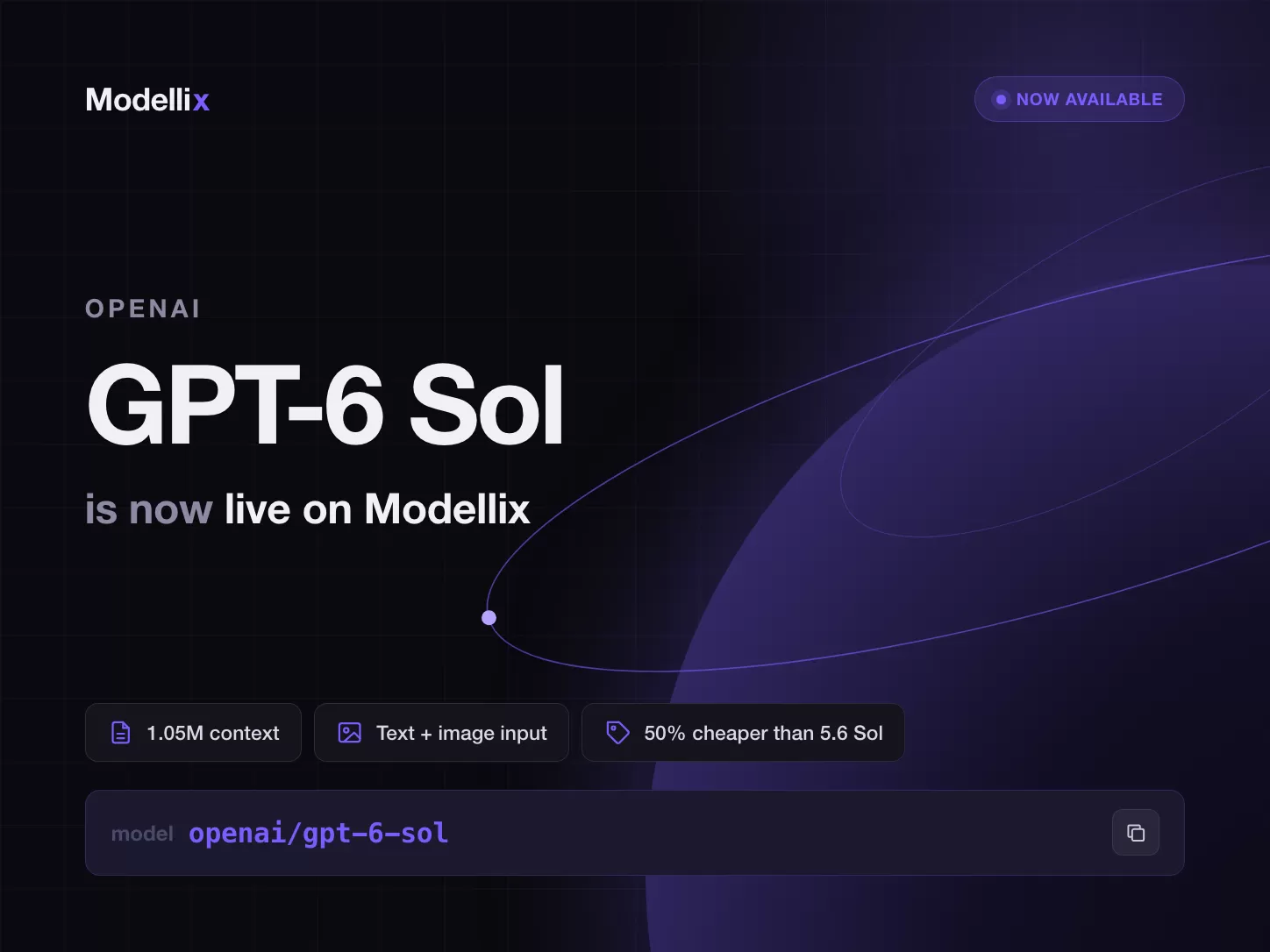
GPT-6 Sol: Pricing, Benchmarks & When to Use It
GPT-6 Sol costs $2/$10 per 1M tokens, half of GPT-5.6 Sol. See what its benchmarks measure, real workload costs, and when to pick Sol over Luna or Astra.