On this page
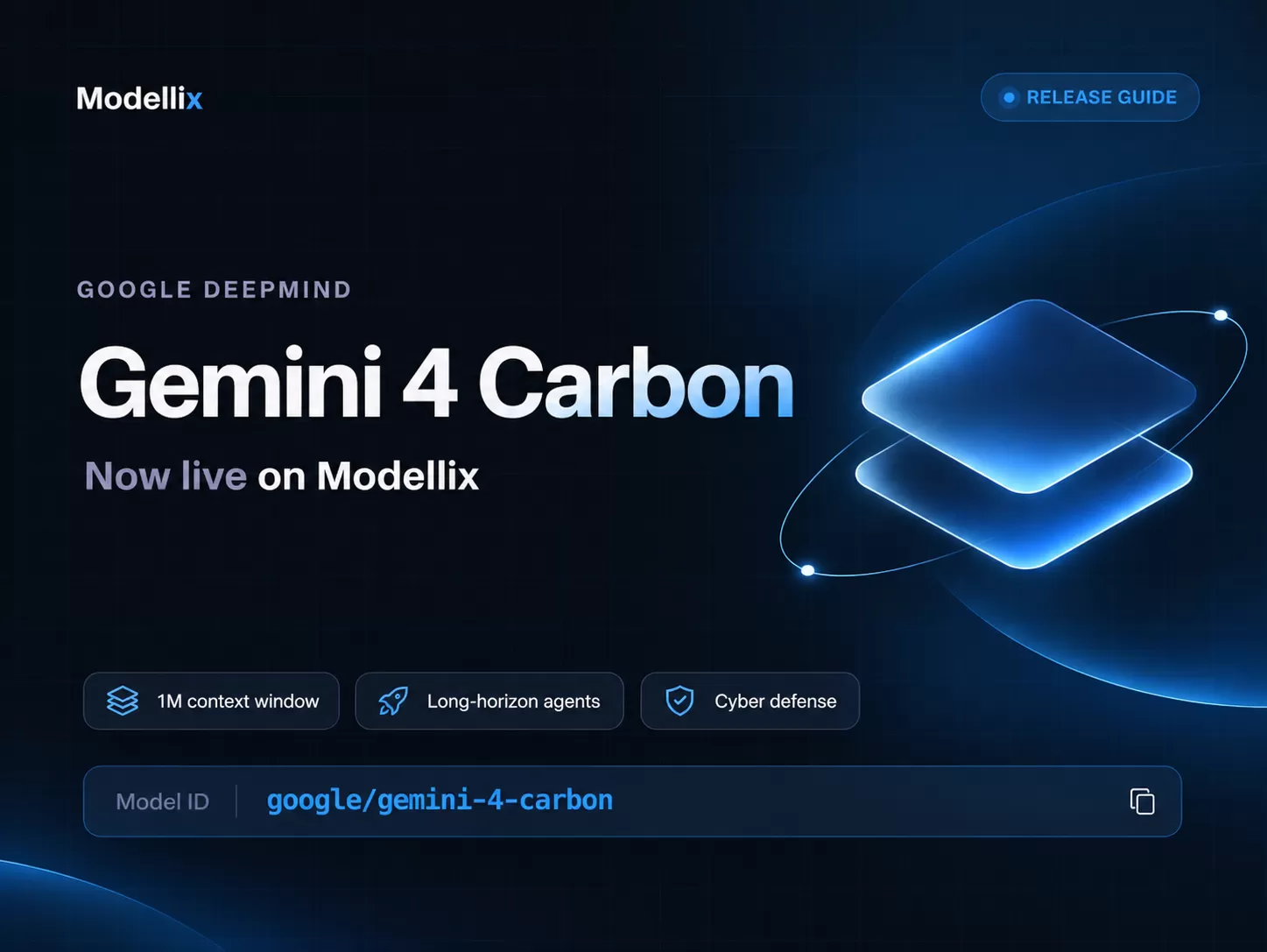
google/gemini-4-carbon.
Google announced Gemini 4 Carbon on October 28 and opened it to every paying developer just 13 days later. That's a fast turnaround for a model Google calls its strongest yet.
The pitch is pretty clear. Carbon is meant for the work that falls apart halfway through: long agent runs, bugs buried deep in a big codebase, and security work. You can now call it on Modellix too, so we gave it a small bug to fix and checked the answer ourselves.
Here's what's new, what it costs (and why December 1 matters), how our quick test went, and a request you can copy.
Gemini 4 Carbon at a Glance
| Item | Details |
|---|---|
| Provider | |
| Generally available | November 10, 2026 |
| Good at | Long-running agent work, multi-step engineering, cyber defense |
| Inputs and outputs | Text, images, video, audio, and PDFs in; text out |
| Context window / max output | 1,048,576 tokens / 65,536 tokens by default |
| Thinking levels | Low, medium, high |
| Google API model ID | gemini-4-carbon |
| Google price until Nov 30 | $2 per million input tokens / $10 per million output tokens |
| Google price from Dec 1 | $4 / $20 per million tokens 2x price |
| Modellix model ID | google/gemini-4-carbon |
| Modellix price | $2 / $10 per million tokens, same as Google's current rate |
| Last checked | November 16, 2026 |

How We Got Here: A Quick Timeline
| Date | What happened |
|---|---|
| October 28, 2026 | Google announces Gemini 4 Carbon. Early access goes to a small group of cyber defenders in its Fairwind Program |
| November 10, 2026 | General availability: the Gemini API and Gemini for business for paying developers and enterprises, plus a rollout to Google AI Ultra subscribers in the Gemini app |
| November 12, 2026 | Gemini 4 Carbon goes live on Modellix |
| December 1, 2026 | Google's introductory price ends, and rates double to $4 / $20 |
What's New in Gemini 4 Carbon
Google puts Carbon above Gemini 4 Argon in the lineup. Here's what stands out:
- Long, multi-step work. Google's main pitch is sustained agentic workflows, where the model keeps going over many steps without losing track. Think root-causing and patching a subtle bug across a large codebase, or digging into low-level systems code.
- Security work. Carbon is built to find, validate, and fix vulnerabilities. That's why the first people to get it were cyber defenders.
- More thinking, more tokens. You can pick a low, medium, or high thinking level. Google says Carbon uses more tokens than Argon, and thinking tokens count as output. So a short answer can still come with a surprisingly big output bill. Keep
highfor the hard problems. - Text out only. Carbon reads text, images, video, audio, and PDFs, but it only writes text. No image or audio generation, no Live API, and no explicit context caching. It's also not on the Gemini API free tier.
Benchmark Snapshot
These are vendor-reported numbers from Google's announcement. We haven't reproduced any of them.
| Benchmark | Gemini 4 Carbon | What it measures | Worth knowing |
|---|---|---|---|
| Artificial Analysis Intelligence Index v5.0 | 59 (#1) | Overall intelligence across many evals | Third-party index, as cited by Google |
| SEC-bench Pro | 88.2% | Finding vulnerabilities | Evaluated without guardrails |
| ExploitGym | 54.8% | Exploiting vulnerabilities | Evaluated without guardrails |
| CWE-bench | 71.0% | Patching vulnerabilities | Evaluated without guardrails |
| WebDev Arena | 1768 Elo (#4) | Building web apps, judged by people | +89 Elo, per Google |

One thing to keep in mind about the cyber scores: Google ran those evals without guardrails. They show what the raw model can do, not necessarily what you'll see with safety filters switched on.
What We Saw in a Quick Test
Since Carbon's big selling point is fixing tricky bugs, we gave it a small one. The function below is supposed to merge overlapping ranges. It works most of the time, but it cuts off part of the range when one interval sits fully inside another. We sent the function and the failing test to google/gemini-4-carbon with this prompt:
The test test_contained_intervals fails for the Python function below. Find the root cause and fix it. Keep the documented behavior: touching intervals merge, the result is sorted by start, and the input list is not modified. Reply with one sentence explaining the root cause, then the full corrected function in a single Python code block. Do not claim to have run the tests.

def merge_intervals(intervals):
    """Merge overlapping closed intervals.

    Touching intervals such as (1, 3) and (3, 5) merge. The result is sorted
    by start, and the input list is not modified.
    """
    if not intervals:
        return []
    ordered = sorted(intervals)
    merged = [list(ordered[0])]
    for start, end in ordered[1:]:
        last = merged[-1]
        if start <= last[1]:
            last[1] = end
        else:
            merged.append([start, end])
    return [tuple(pair) for pair in merged]

def test_contained_intervals():
    assert merge_intervals([(1, 10), (2, 3), (4, 5)]) == [(1, 10)]
Here's what Carbon sent back:
The function unconditionally overwrites
last[1]withendupon finding an overlap, which shrinks the merged interval when a subsequent interval is completely contained within it rather than keeping the larger end value.
def merge_intervals(intervals):
    """Merge overlapping closed intervals.

    Touching intervals such as (1, 3) and (3, 5) merge. The result is sorted
    by start, and the input list is not modified.
    """
    if not intervals:
        return []
    ordered = sorted(intervals)
    merged = [list(ordered[0])]
    for start, end in ordered[1:]:
        last = merged[-1]
        if start <= last[1]:
            last[1] = max(last[1], end)
        else:
            merged.append([start, end])
    return [tuple(pair) for pair in merged]
We didn't just take its word for it. We ran the patched function against our five unit tests, then threw 3,000 random cases at it and compared every result with a brute-force answer.
| Measurement | What we saw |
|---|---|
| Request | One non-streaming request, HTTP 200 |
| Found the real cause? | Yes. It spotted that the end gets overwritten instead of extended |
| Unit tests passed | 5 / 5 |
| Random cases passed | 3,000 / 3,000 |
| Time to answer | 90.2 seconds |
| Input / output tokens | 297 / 284 (incl. 78 thinking) |
| Cost | About $0.003 |
Our quick take: Carbon found the real bug in one sentence and changed exactly one line, and the fix held up against everything we threw at it. The slow part was the wait: about 90 seconds for a short answer. Carbon had only been out for a few days, so launch-week load may have played a part. Time it on your own tasks before you put it in anything interactive.
What This Means for Modellix Users
You can call Carbon with the Modellix API key you already have. Just use the fixed model ID google/gemini-4-carbon. Stick with the fixed ID when you want results you can repeat. There's no latest alias for Carbon yet: ~google/gemini-pro-latest still points to google/gemini-3.1-pro.
Already using google/gemini-4-argon? Switching is basically a one-line change. Google gave Carbon the same introductory price as Argon, but Carbon tends to use more tokens. So before you move everything over, compare the cost per task, not just the price per token.
To get a feel for the bill: a job with 1M input tokens and 200K output tokens costs $4 at Google's introductory rate and $8 from December 1. On Modellix, at today's $2 / $10 rate, the same job costs $4.
One API for every model
Run Gemini 4 Carbon next to every other model on one key
GPT-6 Astra, Sol, and Luna, plus Claude, Gemini, Grok, DeepSeek, and Qwen. Switching models is a change to the model string.
OpenAI Chat Completions and Responses, plus Anthropic Messages. Works with the OpenAI and Anthropic SDKs, Codex, Claude Code, Cursor, and OpenCode.
GPT-6 and Claude models bill 10% under the vendor list price on the current rate card. Pay as you go, no subscription.
Every call is logged with tokens and cost, and can be tagged by end user, so you can see what an escalation actually cost.
Pin a fixed model ID for evaluations, or use a -latest alias that moves to the newest release.
The same account also calls image, video, and audio generation models through the Modellix media API.
How to Try Gemini 4 Carbon on Modellix
Google models on Modellix use the OpenAI-compatible Chat Completions endpoint, https://llm.modellix.ai/v1/chat/completions (the Responses API works too; the Anthropic Messages API doesn't). Set your MODELLIX_API_KEY environment variable, and you can send the same request we tested:
curl -sS https://llm.modellix.ai/v1/chat/completions \
  -H "Authorization: Bearer $MODELLIX_API_KEY" \
  -H "Content-Type: application/json" \
  -d '{
    "model": "google/gemini-4-carbon",
    "max_tokens": 16384,
    "messages": [{"role": "user", "content": "<paste the prompt above>"}]
  }'
FAQ
What's the Gemini 4 Carbon model ID?
It's gemini-4-carbon on Google's Gemini API and google/gemini-4-carbon on Modellix.
How much does Gemini 4 Carbon cost?
Google charges $2 per million input tokens and $10 per million output tokens through November 30, 2026. From December 1, that goes up to $4 and $20. Thinking tokens count as output. On Modellix, it's $2 / $10 right now, the same as Google's current rate.
Can Gemini 4 Carbon generate images or audio?
No. It can read text, images, video, audio, and PDFs, but it only writes text.
Is there a free way to try Gemini 4 Carbon?
Not on the Gemini API, since Carbon isn't on the free tier. On the consumer side, it's rolling out to Google AI Ultra subscribers in the Gemini app.
Start Building with Gemini 4 Carbon
The best way to size up Carbon is to hand it a bug you already understand and see if it finds the real cause, not just a quick patch. Check current pricing in the Modellix model catalog, grab your API key, and try the fixed model ID on your own code.
Put Gemini 4 Carbon to the Test
Tackle hard debugging and multi-step agent runs with a 1M-token context window—at the $2 / $10 intro rate before prices double on December 1. Grab your Modellix API key and run google/gemini-4-carbon on your own codebase.