
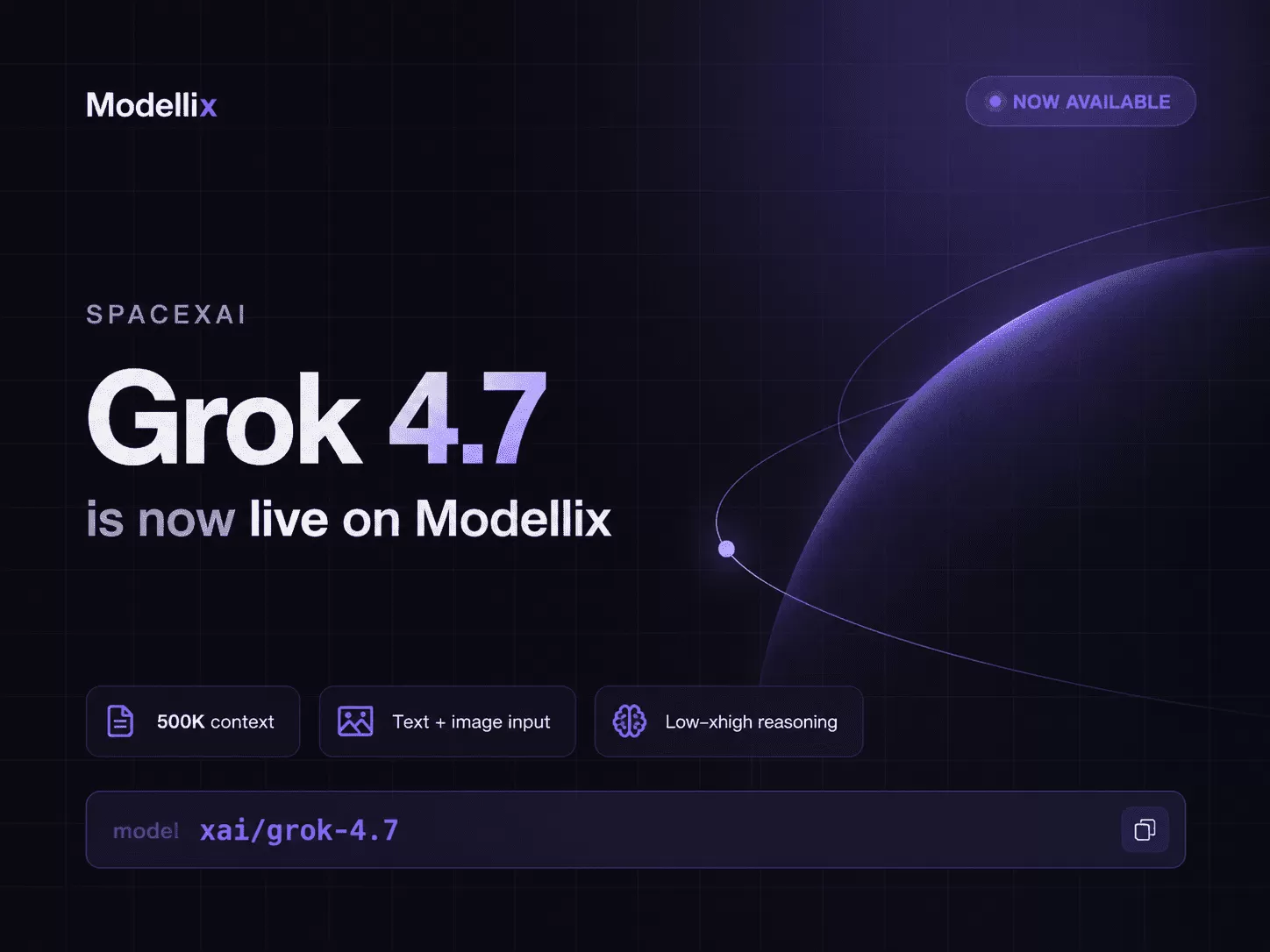
Grok 4.7 is officially live on Modellix under the model ID xai/grok-4.7. SpaceXAI released it on September 21, 2026, at the same price as Grok 4.6: $2 per million input tokens and $6 per million output tokens.
Whether you're debugging complex codebases, orchestrating agentic workflows, or tackling deep knowledge tasks through the Modellix LLM gateway, SpaceXAI positions Grok 4.7 for longer, multi-step work.
If your day-to-day work involves asking an AI to investigate tricky problems, cross-check its own logic, and deliver human-reviewable results, this is the Grok model to test.
Grok 4.7 at a Glance
| Grok 4.7 | |
|---|---|
| Released | September 21, 2026 |
| Price | $2 input / $6 output per 1M tokens ($0.50 cached); $4 / $12 above 200K tokens |
| Context window | 500,000 tokens |
| Reasoning effort | low, medium, high (default), xhigh |
| Model ID | xai/grok-4.7 on Modellix |
What's New in Grok 4.7
Longer coding and agent tasks
In its launch notes, SpaceXAI says Grok 4.7 uses a larger base model than Grok 4.6 and a longer reinforcement learning run focused on tasks that can take hours. That matters for work with several stages, such as tracing a bug, proposing a change, and checking whether the fix addresses the original failure.
Checking its own work
SpaceXAI says Grok 4.7 is better at double-checking its work. When a test fails, a useful response explains the likely cause and flags what still needs checking. That gives a developer something concrete to review before accepting a fix.
500K context and reasoning controls
Under the hood, Grok 4.7 has a 500,000-token context window, takes text or image input, and returns text. The official model documentation also describes function calling, structured outputs, and reasoning effort settings from low to xhigh.
Requests above 200K tokens bill at a higher rate, so long prompts cost twice as much per token.

What Can You Build with Grok 4.7
One application is a debugging assistant that takes faulty code and expected behavior, then returns a diagnosis, a proposed fix, and tests a developer can run. We tested the model step in that workflow through the Modellix LLM gateway using xai/grok-4.7.
We sent a faulty JavaScript median function, function median(a){a.sort();return a[a.length/2]}, and specified two expected results: [2, 10, 3] should return 3, and [1, 3, 5, 7] should return 4. Grok 4.7 identified three main bugs: the default string-based sort, a fractional index for odd-length arrays, and the missing average for even-length arrays. It also flagged that sort() changes the input array.
The model came back with a revised function that copies the array before sorting, handles odd and even lengths, and checks for empty input. We ran it locally: the two specified cases returned 3 and 4, the original array stayed unchanged, and an empty array raised an error.
This single call shows one component of a debugging assistant working on a small, verifiable task. A larger codebase or autonomous agent workflow would need its own evaluation.
What This Means for Modellix Users
If you already use the Modellix LLM gateway, you can try Grok 4.7 with your existing API key by setting model to xai/grok-4.7. The ~xai/grok-latest alias currently points to 4.7 too, but it will move when a newer Grok model arrives. Use the fixed ID when you want repeatable tests; the API guide covers request paths and logs.
One API for every model
Run Grok 4.7 next to every other model on one key
GPT-6 Astra, Sol, and Luna, plus Claude, Gemini, Grok, DeepSeek, and Qwen. Switching models is a change to the model string.
OpenAI Chat Completions and Responses, plus Anthropic Messages. Works with the OpenAI and Anthropic SDKs, Codex, Claude Code, Cursor, and OpenCode.
GPT-6 and Claude models bill 10% under the vendor list price on the current rate card. Pay as you go, no subscription.
Every call is logged with tokens and cost, and can be tagged by end user, so you can see what an escalation actually cost.
Pin a fixed model ID for evaluations, or use a -latest alias that moves to the newest release.
The same account also calls image, video, and audio generation models through the Modellix media API.
Try Grok 4.7 on Modellix
Here is a minimal Chat Completions request using the published Modellix model ID. Set API_KEY to a Modellix key before running it:
curl -sS "https://llm.modellix.ai/v1/chat/completions" \
  -H "Authorization: Bearer ${API_KEY}" \
  -H "Content-Type: application/json" \
  -d '{
    "model": "xai/grok-4.7",
    "messages": [{
      "role": "user",
      "content": "Fix this JavaScript function and explain the bugs: function median(a){a.sort();return a[a.length/2]}. Include tests for [2,10,3] -> 3 and [1,3,5,7] -> 4."
    }]
  }'
Start Building with Grok 4.7
Ready to see how it performs? The best way to evaluate Grok 4.7 is on a real task your team already knows inside out. Run a quick test via the gateway, inspect how it handles edge cases and verification, and see if it fits your production workflow.
👉 Explore Grok 4.7 on Modellix to grab your endpoint key and start building.
Try Grok 4.7
One key covers Grok 4.7 and every other model on the gateway. Create it in the console and send your first request.
Get API KeyRelated articles
Grok API Keys: Two Ways to Get One and Call Grok 4.6
Two legitimate ways to get a Grok API key: the xAI console, or a gateway key with no xAI account. Auth headers, rates, and 401 fixes.
Claude Opus 5.5: Release Date, Pricing & How to Use It
Explore Claude Opus 5.5 release details, pricing, 1M-token context, adaptive thinking, and key API changes, plus a first-use example on Modellix.
GPT-6 Luna: Pricing, Context Window & How to Use It
GPT-6 Luna costs $0.10 per 1M input tokens with a 1.05M context window. See workload costs, Luna vs Sol, what changed from GPT-5.6, and how to call it.
GPT-6 Sol: Pricing, Benchmarks & When to Use It
GPT-6 Sol costs $2/$10 per 1M tokens, half of GPT-5.6 Sol. See what its benchmarks measure, real workload costs, and when to pick Sol over Luna or Astra.