
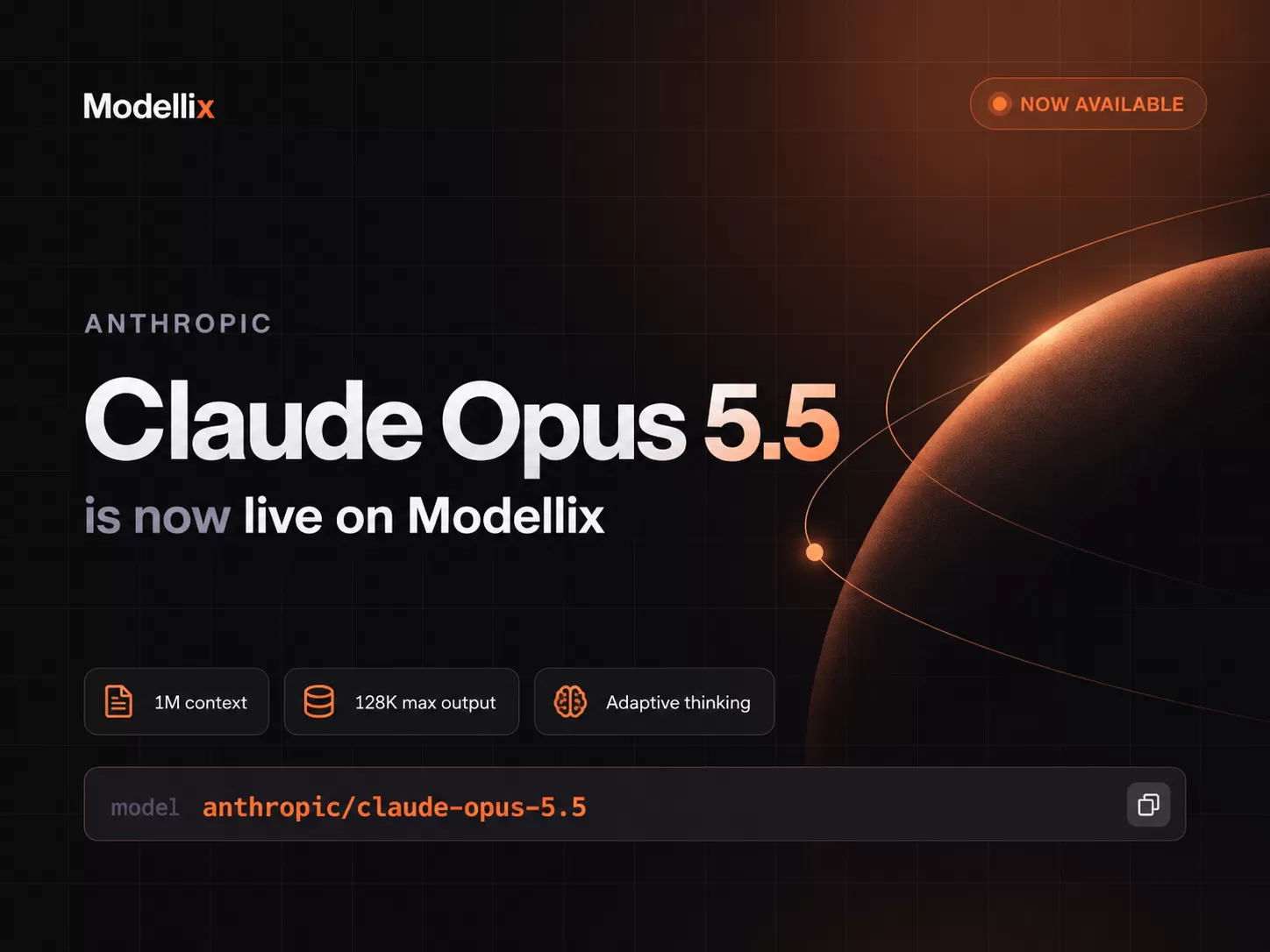
Claude Opus 5.5 launched on September 22, 2026, and it is now listed on Modellix as anthropic/claude-opus-5.5, currently priced at $3.60 per million input tokens and $18 per million output tokens.
When you're running complex agentic workflows (like fixing a tricky multi-service bug), lower token rates are nice, but what actually moves the needle is efficiency: how many turns does the model need to land on a working fix?
Here’s a quick breakdown of what’s new in Opus 5.5 and how to start testing it via the gateway.
Claude Opus 5.5 at a Glance
According to Anthropic’s release announcement, Opus 5.5 reduces typical token-billed workload costs by about 40% compared with Opus 5 at default settings. Your mileage may vary depending on your setup, so try it on the day-to-day tasks your team already knows well.
Here’s a quick snapshot of the key specs and pricing before you swap out your current model ID:
| Field | Release details |
|---|---|
| Release date | September 22, 2026 |
| Primary workloads | Extended agentic coding and knowledge work |
| Context window | 1M tokens |
| Maximum standard output | 128K tokens |
| Input → output | Text and images → text |
| Thinking | Adaptive, always on |
| Default effort | medium |
| Anthropic API model ID | claude-opus-5-5 |
| Modellix gateway model ID | anthropic/claude-opus-5.5 |
| Anthropic input / output price | $4 / $20 per million tokens |
| Current gateway input / output price | $3.60 / $18 per million tokens |
Specifications and upstream rates are documented in Claude Platform’s model overview. Gateway rates follow the current Modellix catalog; recheck them before deployment.
The context window and output limit serve different purposes. A large context window provides room for source material, while the output limit caps a response. Neither establishes that an agent will finish a complex project correctly without external checks.
What’s New in Claude Opus 5.5
Lower Prices and Better Task Efficiency
Anthropic’s standard input and output rates are 20% below Opus 5’s $5/$25 per million tokens. Cache reads fall from $0.50 to $0.20 per million tokens, a 60% reduction. The release announcement also reports output generation more than 30% faster than Opus 5.
Anthropic’s 40% savings estimate comes from lower rates and fewer tokens per task. For your own workflow, it helps to look at what it costs to get a working result. A cheap call can lose its appeal when you have to keep retrying it.
Reasoning Is Always On
According to Claude Platform’s technical release notes, adaptive thinking cannot be disabled. The default effort is now medium, rather than Opus 5’s high.
Since thinking is now always active, it’s worth trying your existing prompts with the new default effort. Give the output budget enough headroom for both the reasoning and the final answer, then adjust effort based on how the results look.
Clearer Communication During Complex Work
Anthropic reports clearer writing and more natural communication from Opus 5.5. For engineering teams, evaluate this through the output you actually review: a patch explanation, an investigation report, or a list of unresolved questions.
Pro tip: Ask the model to lay out what changed, why, and which tests it actually ran. That gives reviewers something concrete to work with, and you can run the suite yourself to check the result.
API Changes to Check Before Switching
The technical release notes identify several compatibility changes:
- Disabled thinking and manual thinking budgets are rejected.
- Forced tool choices using
anyor a namedtoolare rejected. - Thinking blocks are bound to the model and conversation, affecting replay and model switching.
- The older
computer_20251124tool is rejected on the Claude API and Google Cloud.
These are upstream API behaviors. Verify how your gateway and client handle the features you use. An existing agent may need changes beyond replacing its model ID.
What Can You Build with Opus 5.5?
A repository migration assistant is a useful starting application. Give it the relevant files, the new interface contract, and a clear boundary for edits. Ask it to identify affected callers, propose a patch, and explain which checks would establish that behavior remains correct.
Begin with a smaller component before granting broader repository access. For example, an inclusive upper bound can produce an off-by-one error:
def get_item(items, index):
    if 0 <= index <= len(items):
        return items[index]
    return None
What We Saw in a Small Test
We tested this function using anthropic/claude-opus-5.5, requesting a repair and four assertions without claiming execution.
Opus 5.5 identified that index == len(items) raises IndexError, changed the upper comparison to <, and kept negative indices returning None. Its corrected function was:
def get_item(items, index):
    if 0 <= index < len(items):
        return items[index]
    return None
The model stated that it had not run the tests. We independently executed its assertions for an empty list, a valid index, an index equal to the list length, and a negative index. All four passed, alongside 45 additional integer boundary cases. We also reproduced both original IndexError cases.
| Measurement | Observed result |
|---|---|
| Runs / outcome | One non-streaming request; HTTP 200 |
| Client elapsed time | 11.08 seconds, including connection and response transfer |
| Gateway processing duration | 10.598 seconds, as reported in the request log |
| Input / output usage | 145 / 745 tokens |
| Cache reads / writes | 0 / 0 tokens |
| Estimated token cost | $0.013932, about 1.39 US cents |
The estimate uses the listed $3.60/$18 per million input/output tokens: (145 × 3.60 + 745 × 18) / 1,000,000. Output usage includes 80 reported thinking tokens; these are already included in the 745 output tokens. The dollar figure is calculated from returned usage and published rates, rather than a verified invoice amount.
This small boundary-check test gives us a clear, verifiable example of how Opus 5.5 handled these edge cases. Trying it on your own repo will give you a better feel for how it handles larger tasks.
How to Try Claude Opus 5.5 on Modellix
Use a platform-issued API key and the Anthropic Messages endpoint. The LLM API guide documents POST /v1/messages, Bearer authentication, and the required max_tokens field. The following request body and protocol headers match the successful test above; the recorded run also used a log-filtering header to isolate its billing record.
Set MODELLIX_API_KEY in your local environment, then send:
curl -sS "https://llm.modellix.ai/v1/messages" \
  -H "Authorization: Bearer ${MODELLIX_API_KEY}" \
  -H "Content-Type: application/json" \
  -H "anthropic-version: 2023-06-01" \
  -d '{
    "model": "anthropic/claude-opus-5.5",
    "max_tokens": 4096,
    "messages": [{
      "role": "user",
      "content": "Review this Python function for a boundary bug. Return a corrected function and four assert statements covering an empty list, a valid index, an index equal to the list length, and a negative index. Preserve its other behavior. Do not claim to have executed the tests.\n\ndef get_item(items, index):\n    if 0 <= index <= len(items):\n        return items[index]\n    return None"
    }]
  }'
Use the fixed ID for repeatable evaluations. The currently listed alias, ~anthropic/claude-opus-latest, routes to Opus 5.5 but can change target with future releases. When reading Messages responses, select blocks by their type, since thinking may precede text.
Same tokens, lower bill
Anthropic lists Opus 5.5 at $4 per million input tokens and $20 per million output tokens. For one call with 8,000 input tokens, 8,000 output tokens, and no cache, that is about $0.192 on Anthropic and $0.1728 on Modellix.
| Calls at 8,000 in + 8,000 out | Anthropic direct | Modellix | Saved |
|---|---|---|---|
| 1,000 | $192 | $172.80 | $19.20 |
| 10,000 | $1,920 | $1,728 | $192 |
| 100,000 | $19,200 | $17,280 | $1,920 |
| 1,000,000 | $192,000 | $172,800 | $19,200 |
At 1,000 calls with that mix, Modellix bills $19.20 less than Anthropic direct. This is a price comparison at the same billed token counts, not a quality benchmark.
One API for every model
Run Claude Opus 5.5 next to every other model on one key
GPT-6 Astra, Sol, and Luna, plus Claude, Gemini, Grok, DeepSeek, and Qwen. Switching models is a change to the model string.
OpenAI Chat Completions and Responses, plus Anthropic Messages. Works with the OpenAI and Anthropic SDKs, Codex, Claude Code, Cursor, and OpenCode.
GPT-6 and Claude models bill 10% under the vendor list price on the current rate card. Pay as you go, no subscription.
Every call is logged with tokens and cost, and can be tagged by end user, so you can see what an escalation actually cost.
Pin a fixed model ID for evaluations, or use a -latest alias that moves to the newest release.
The same account also calls image, video, and audio generation models through the Modellix media API.
Ready to give it a spin?
The best way to judge Opus 5.5 is to run it on a task your team already knows inside out and compare the results.
👉 Explore Claude Opus 5.5 on Modellix to check current pricing and grab your API endpoint.
Try Claude Opus 5.5
Create a Modellix key, run Opus 5.5 on a task your team already knows, and compare cost per request in the logs.
Get API KeyRelated articles
Grok 4.7: Release Date, Pricing & How to Use It
Grok 4.7 launched September 21, 2026 at $2/$6 per 1M tokens with a 500K context window. See what changed for coding and long tasks, then try it via API.
GPT-6 Luna: Pricing, Context Window & How to Use It
GPT-6 Luna costs $0.10 per 1M input tokens with a 1.05M context window. See workload costs, Luna vs Sol, what changed from GPT-5.6, and how to call it.
GPT-6 Sol: Pricing, Benchmarks & When to Use It
GPT-6 Sol costs $2/$10 per 1M tokens, half of GPT-5.6 Sol. See what its benchmarks measure, real workload costs, and when to pick Sol over Luna or Astra.
GPT-6 Astra: Benchmarks, vs Fable 5.1 & How to Use It
What GPT-6 Astra is, when it was released, what its benchmarks measure, where Claude Fable 5.1 still beats it, and how to call it through an API.