
A text to video API buyer is usually deciding between two paths: call one famous model directly, or build a router that can move prompts across several video models as quality, price, and availability change. The second path wins when the product needs predictable cost, fallback models, job logs, and a way to retrieve MP4 outputs without manual download steps.
Ahrefs data pulled for this article shows why the query is worth a BOFU page rather than another generic model roundup: text to video api has 150 monthly searches in the US, 400 globally, KD 3, and $3.00 CPC. Related buyer terms include free text to video api, text to video ai api, best text to video api, and text to video api pricing. The SERP is thin enough that a practical, developer-first page can compete if it answers integration, pricing, and trial-to-production questions directly.
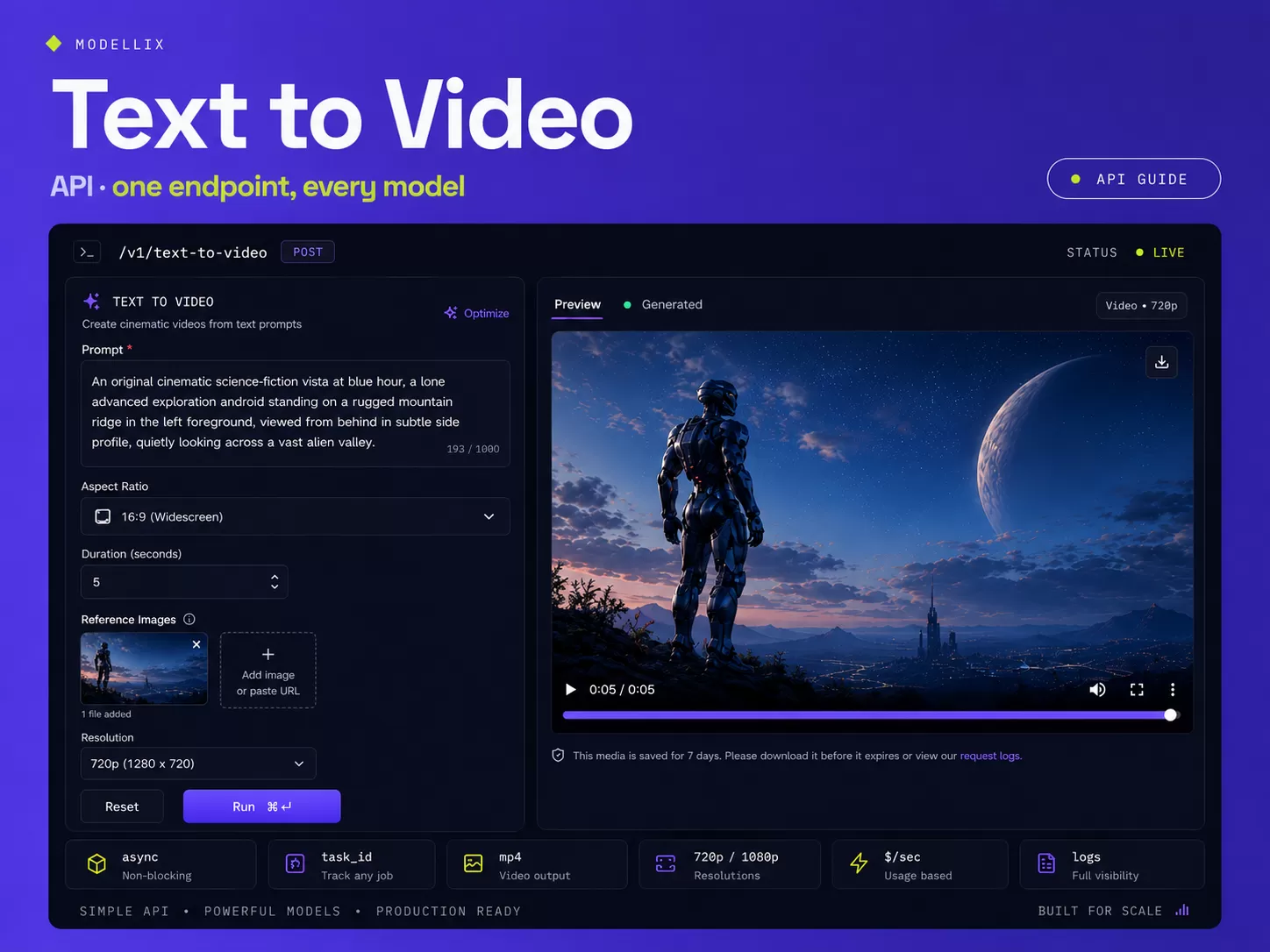
Text to Video API Explained: 4 Production Requirements
A text to video API turns a written prompt into a generated video through a programmatic endpoint. In production, the useful version is asynchronous: submit a generation task, poll status, retrieve the MP4 or media URL, then store the asset before temporary links expire.
Four requirements matter more than demo quality:
| Requirement | Why it matters | What to verify before launch |
|---|---|---|
| Async lifecycle | Video jobs take longer than image or text calls | Task ID, status states, retry rules, result expiry |
| Model routing | No single model is best for every prompt | T2V, I2V, native audio, duration, resolution, fallback |
| Cost logging | Output seconds and resolution drive spend | Price per second, failed job policy, discard rate |
| Asset retrieval | The product needs durable files | MP4 URL, poster generation, CDN copy, metadata logs |
The short answer: choose a text to video API only after you know how it behaves after the prompt is submitted. A good API is measured by task observability, pricing predictability, and how cleanly it lets your app switch models when the first choice fails or becomes too expensive.
5 Model Routes Compared for Video Apps
The model route should match the job, not the marketing name. Ahrefs shows video generation api has a stronger traffic potential than the exact text-to-video phrase, but its parent topic is pulled toward veo 3. That means buyers compare model names, yet still need a production routing answer.
| Route | Best fit | What to test |
|---|---|---|
| Veo 3.1 style premium T2V | Cinematic baseline, executive review, brand demos | Duration caps, resolution rules, prompt adherence |
| Kling V3 style motion | Social clips, storyboard movement, creator tools | Motion control, camera movement, prompt complexity |
| Seedance style short-form video | UGC ads, fast variants, reference-led creative | Image-to-video support, variant consistency |
| Wan style cost-performance | High-volume short clips and iteration loops | Per-second cost, 720p vs 1080p quality, audio support |
| Hailuo style physics | Product motion, human movement, cinematic camera cues | Physical realism, task time, failure handling |
Use the Best AI Video Generation APIs 2026 benchmark when you need model-by-model examples. Use this page when your next decision is integration: how to put text-to-video behind a real product workflow.

Modellix collection
Compare Text-to-Video Models With One Brief
Run the same campaign concept across text-to-video models and review motion, prompt adherence, and usable cost.
Good first tests: Seedance 2.0 T2V Wan 2.7 T2V Veo 3.1 Lite T2V
Explore the collectionHow to Test a Text-to-Video API in 30 Seconds
Every method starts with a Modellix account. Sign in with email, Google, or GitHub, add credit, and pay only for what you generate. There is no subscription.
Create your Modellix account →
Method 1: Playground
No code. Open the Kling V3 T2V model page, paste a prompt, and review the clip in your browser.

Method 2: API, Through Your Coding Agent
Paste this into Claude Code, Codex, or Cursor. One sentence and one API key are all your agent needs: change the model name and docs link, and the same prompt batch-generates assets with any model on Modellix.
My Modellix API key is mdlx-••••••••••••••••••••••••. Read https://docs.modellix.ai/get-started/index.md and https://docs.modellix.ai/kling/kling-v3-t2v.md, then use Kling V3 T2V to generate one 5-second 16:9 clip for each prompt in prompts.txt. Poll each task until it finishes and save the MP4 files to ./clips.
Swap the masked key for your own from the Modellix console. Treat it like a password and share it only with agents you trust. The API guide covers the raw request format.
Method 3: Skill
Install the Modellix skill once. After that, your agent finds the right model and request fields by itself.
npx skills add https://github.com/Modellix/modellix-plugin --skill modellix
Use the Modellix skill to generate a 5-second clip with Kling V3 T2V, then download it to ./clips.
Setup for each agent host is in the Skill guide.
Method 4: CLI
For scripts and scheduled jobs. One command submits the task, waits, and prints the result URL.
npm install --global modellix-cli
export MODELLIX_API_KEY="your_api_key"

modellix-cli model run --model-slug kling/kling-v3-t2v \
  --body '{"prompt":"A red panda walks through a bamboo forest at dawn, slow tracking shot"}' \
  --wait --timeout 15m --quiet
For batches, put one request per line in a JSONL file and run modellix-cli model batch. See the CLI guide.
Developer Workflow: 3 Step Async Video Generation
This section is for developers who are ready to move beyond Playground testing and wire text-to-video into a backend service. If you only need a manual test, use the quickstart guide first; if you need automation, the async submit, poll, and retrieve pattern below is the production path.
Video generation APIs should be wired as jobs, not blocking HTTP calls. Modellix documents the same submit, poll, retrieve pattern across supported media models, which makes it easier to move from one model family to another without rewriting the service layer.
Step 1: Submit the Prompt
curl --request POST \
  --url https://api.modellix.ai/api/v1/alibaba/wan-2.6-t2v/async \
  --header 'Authorization: Bearer YOUR_API_KEY' \
  --header 'Content-Type: application/json' \
  --data '{
    "prompt": "A cinematic product shot of a running shoe rotating on a glass platform, soft studio light, slow camera push",
    "duration": 5,
    "size": "1920*1080"
  }'
The response should return a task_id, not an MP4 immediately. Store that task ID with your user ID, prompt hash, selected model, and expected budget.
Step 2: Poll With Backoff
Poll the task result endpoint with exponential backoff. Treat statuses as three groups:
| Status group | Examples | Product behavior |
|---|---|---|
| Running | pending, processing |
Show progress and continue polling |
| Fixable | invalid_input, content_policy, missing_parameter |
Stop and ask for corrected input |
| Final | success, failed |
Retrieve output or surface a recoverable error |
For user-facing products, do not let the browser own the whole workflow. Put polling in a backend job or queue so refreshes, mobile sleep, and flaky networks do not lose the result.
Step 3: Retrieve and Store
On success, the result payload should include a media resource URL, format, duration metadata, and task timing. Copy the file to your own storage if it needs to survive beyond the provider's temporary result window.
The practical minimum log record is:
task_id- model slug
- prompt hash
- input references
- output resource URL
- status timeline
- cost estimate
- final asset location
Pricing Explained: Seconds, Resolution, and Discard Rate
Most AI video APIs charge by output seconds, by request, or by GPU time. For text-to-video, per-second billing is the easiest to forecast if you know clip length and resolution.
| Cost driver | How it changes the bill | Production advice |
|---|---|---|
| Duration | A 10 second clip usually costs about twice a 5 second clip | Default to the shortest clip that proves the idea |
| Resolution | 1080p often costs more than 720p | Use 720p for drafts, 1080p for accepted renders |
| Discard rate | Rejected or low-quality outputs raise cost per usable clip | Track accepted outputs, not just completed jobs |
| Model tier | Premium models can cost more but reduce review time | Compare cost per usable clip, not headline price |
| Retries | Blind retries multiply failures | Retry transient API errors, not bad prompts |
Modellix pricing is public by model, and video generation is priced in USD per second for to-video models. That makes the first estimate simple: model rate times output seconds, then add your expected discard rate.
Free Text to Video API Explained: What It Usually Means
Search demand includes free text to video api, but free usually means one of three things:
- trial credits for testing
- a playground that does not allow production API volume
- a limited model route with lower resolution, shorter duration, or slower queueing
Free is useful for proving request shape. It is not enough for production planning. Before you build the feature, verify rate limits, billing thresholds, result retention, commercial terms, and whether the provider can support your target concurrency.
When One API Key Beats Direct Model Integrations
Direct model APIs are fine when your product only needs one model and that model is stable. A unified media API becomes more useful when you need model routing, fallback behavior, shared billing, and one async job layer across text-to-video, image-to-video, image generation, and audio.
Use a unified route when:
- Your product compares Veo, Kling, Wan, Seedance, and Hailuo on the same prompt.
- Your UI offers both text-to-video and image-to-video.
- Your team needs job-level cost logs for every generation.
- Your roadmap changes models faster than engineering wants to rewrite integrations.
- You need one key, one dashboard, and one result schema for multiple providers.
Stop comparing from a spreadsheet. Run one video now.
Modellix routes text-to-video jobs across media models with one API key and request logs. Fund one short test, then automate the route only if its output and cost fit your workflow.
Text to Video API FAQ
What is a text to video API?
A text to video API is a programmatic endpoint that accepts a written prompt and returns a generated video through an async task. The production flow usually returns a task ID first, then lets your app poll until the result includes an MP4 or media resource URL.
What is the best text to video API for developers?
The best text to video API depends on the route you need. Use a premium model for cinematic quality, a motion-focused model for creator clips, a cost-performance model for batch ideation, and a unified API when your product needs several routes behind one workflow.
Is there a free text to video API?
Some providers offer trial credits or free playground access, but free tiers are rarely enough for production video generation. Before relying on one, check duration caps, resolution caps, rate limits, result retention, and whether commercial use is allowed.
How much does a text to video API cost?
Most production video APIs charge by output seconds, by request, or by GPU time. For per-second pricing, estimate cost as model rate times clip length, then adjust for resolution and discard rate. Modellix lists current model pricing publicly, including USD per second for video generation models.
How do I integrate text-to-video into an app?
Create a backend endpoint that submits a prompt to the provider, stores the returned task ID, polls with backoff, retrieves the result URL, copies the asset to your storage, and reports final status to the user. Do not make the frontend wait on one long blocking request.
Sources Checked for This Guide
- Official Modellix docs for REST API setup, task results, pricing units, and current models.
- Ahrefs US keyword and SERP data for
text to video apiandvideo generation api, pulled June 25, 2026.
Build with the latest AI models
Explore image, video and audio models through one API.
Start buildingRelated articles
Best AI Video Generation APIs 2026: Pricing, Speed & Tests
Compare 10 AI video generation APIs (Veo 3.1, Kling V3, Seedance, Wan 3.0, Hailuo) with real MP4 tests, per-second prices, and clip-length limits.

Image Manipulation API Guide: 7 Production Workflows Compared
Compare image manipulation APIs for generative editing, product photos, resizing, background changes, and repeatable business image workflows.
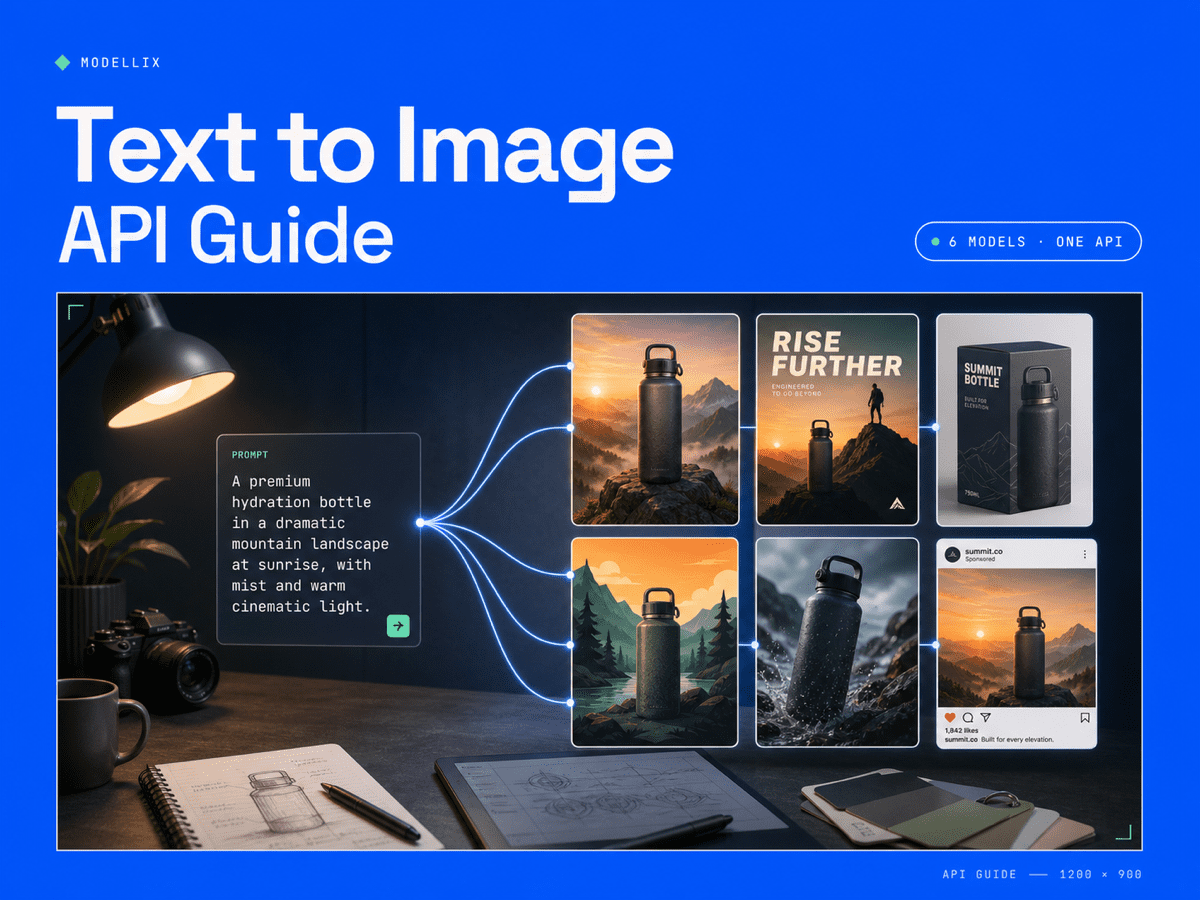
Text to Image API Guide: 6 Production Models Compared
Compare text to image API models, async workflows, costs, and production controls for ads, product assets, and automated creative pipelines.
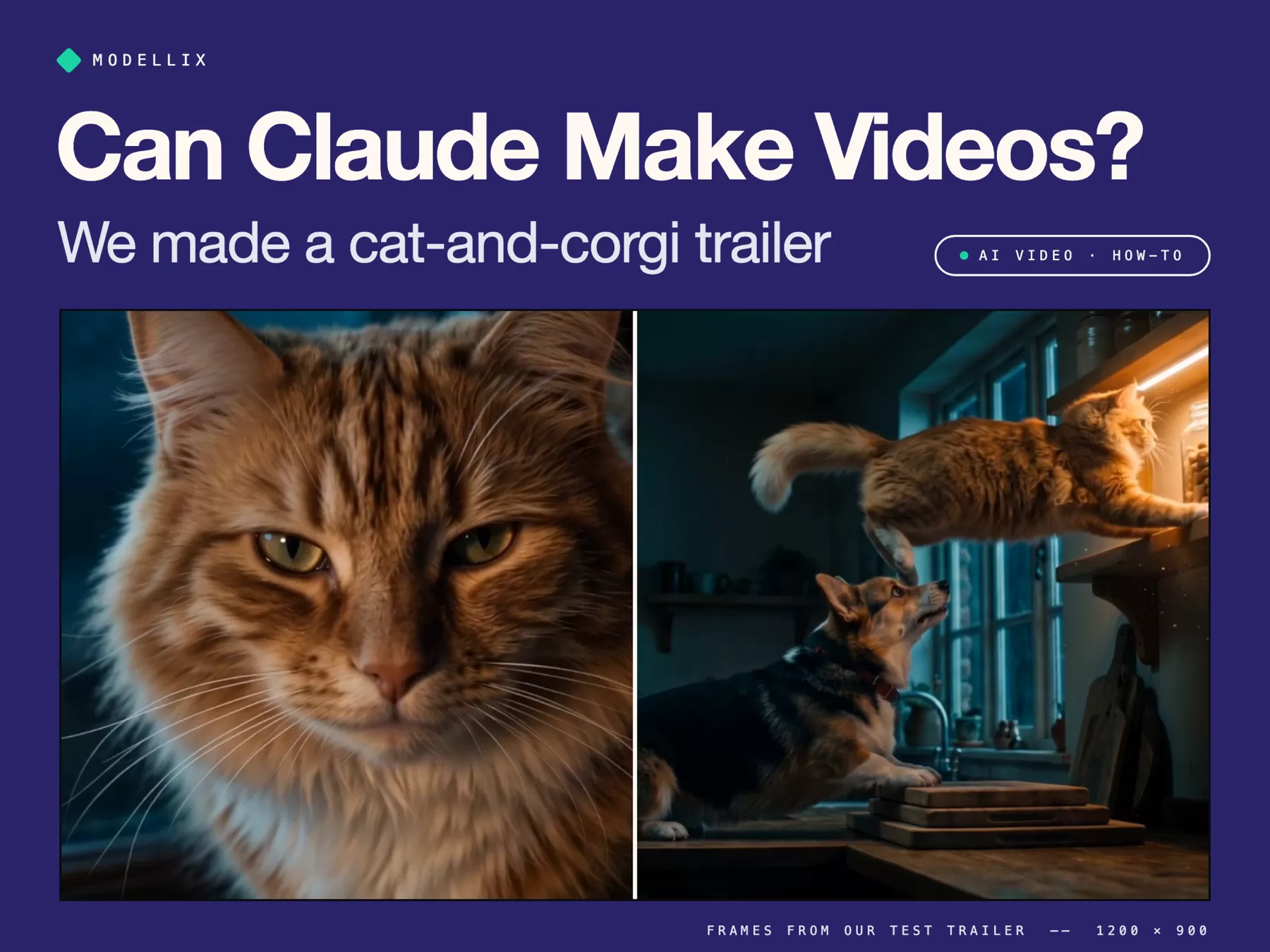
Can Claude Make Videos? 3 Ways That Work [Tested]
Can Claude make videos? Not on its own. We made a 33-second cat-and-corgi movie trailer with Claude Code: Remotion, HyperFrames, and AI video models.