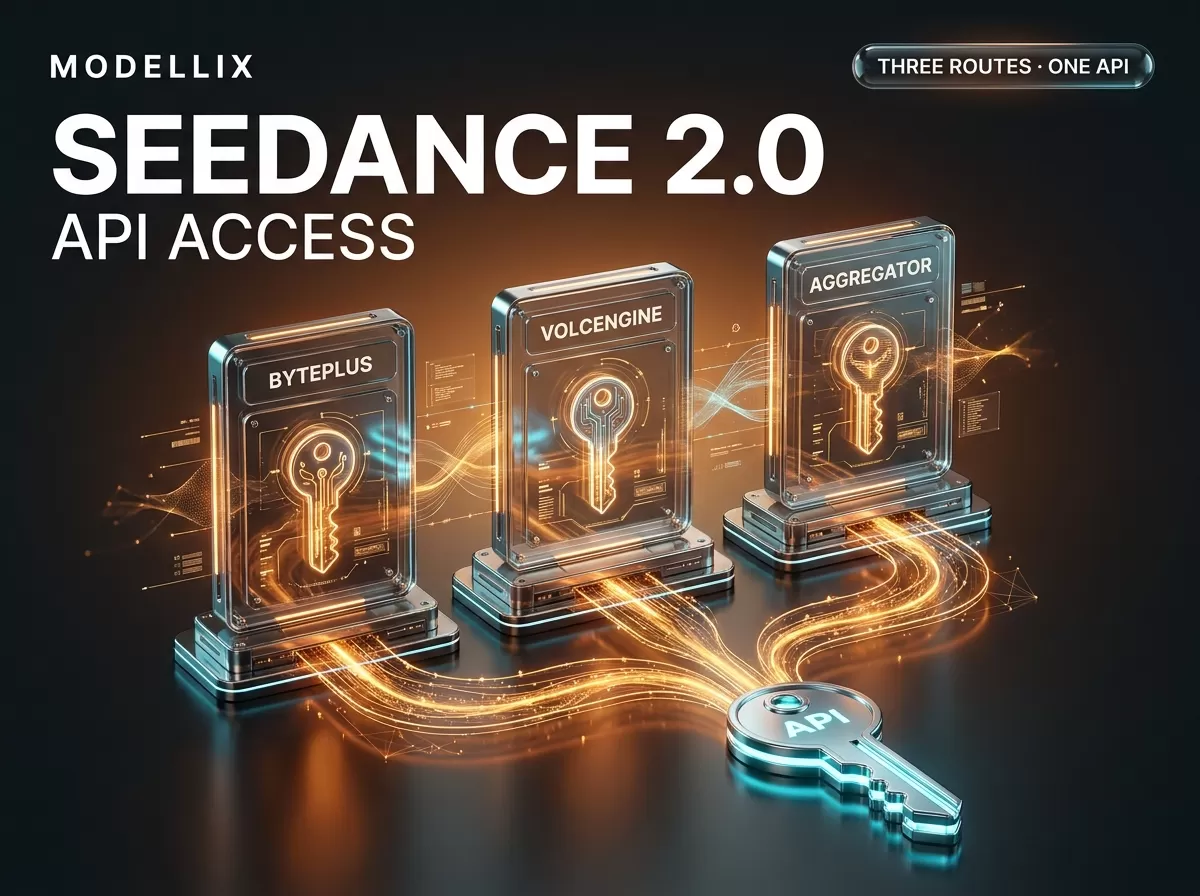
The short answer: three doors to Seedance 2.0 API access
Yes, Seedance 2.0 has an official API, and no, getting access is not the same as signing up. ByteDance serves Seedance 2.0 through two official clouds — BytePlus ModelArk for international users and Volcengine Ark inside mainland China — and both gate the models behind an activation step: a funded balance (above USD 30 on BytePlus, at least 200 CNY on Volcengine) or a purchased resource pack. A third route skips that entirely: aggregator APIs, including Modellix, expose the same Seedance 2.0 models behind one key with no activation, billed per second of generated video.
For a developer outside mainland China, the practical answer to “how to access Seedance 2.0 API” is usually one of two doors: the official BytePlus ModelArk route (real activation friction, per-token billing, direct vendor relationship) or an aggregator (key in minutes, per-second billing, no balance or resource-pack requirement). This guide walks both paths end to end — requirements, endpoints, model IDs, working code, and what a minute of video actually costs as of August 2026. One definitional note before the steps: “Seedance 2.0 access” in consumer videos means the Dreamina app; this article is about the API, and the two are unrelated accounts.
Modellix is an aggregator and has a commercial interest in the aggregator route looking good. The requirements, prices, and code below come from first-party pages fetched on August 17, 2026, so you can verify every claim — and the honest conclusion includes when you should choose the official route instead.
What “access” actually requires: activation, not signup
The step that trips up most developers is not the account — it is model activation. On the official platform, a fresh BytePlus account cannot call Seedance 2.0 out of the box. The official API reference states that you must have a BytePlus account balance greater than USD 30, or a purchased Seedance resource pack with available quota, before the models can be activated (Create a video generation task, accessed August 17, 2026). The domestic Volcengine route applies the same structure: the Seedance 2.0 tutorial requires an account balance of at least 200 CNY or a purchased resource pack before you can enable the models (Doubao Seedance 2.0 系列教程, accessed August 17, 2026), and the platform’s activation, usage, and cancellation rules spell out the details.
| Route | What you need before the first call | Where you do it |
|---|---|---|
| BytePlus ModelArk (international) | BytePlus account; balance > USD 30 or Seedance resource pack; API key; activate the model | API keys page + Model activation in console |
| Volcengine Ark (mainland China) | Volcengine account; balance ≥ 200 CNY or resource pack; API key; enable the model | Console API key management + model management |
| Aggregator API (e.g. Modellix) | Sign-up + API key; no activation, no balance minimum | Provider console |
Aggregators exist precisely because of that gate: they pre-license the models, so the key works the moment you create it. That difference — activation friction vs no activation — is the real “access” story for this model, and it matters more than the per-second price for most evaluations.
Once activated, the model IDs are the next thing to get right. As of August 2026 the official international IDs for the 2.0 series are dreamina-seedance-2-0-260128 (Seedance 2.0), dreamina-seedance-2-0-fast-260128 (2.0 Fast), and dreamina-seedance-2-0-mini-260615 (2.0 Mini), per the BytePlus Seedance 2.0 series tutorial. ByteDance rotates these IDs when a model is updated, so read the model ID from configuration — never hard-code it into your application.
Route 1: BytePlus ModelArk (international) — step by step
This is the official international path, operated by ByteDance’s BytePlus arm out of the ap-southeast-1 region. It needs no China-region account, which is the direct answer to the frequent “how to access Seedance 2.0 in the USA?” question: yes, US developers use BytePlus ModelArk, not Volcengine. The steps:
- Create a BytePlus account and top up your balance above USD 30, or purchase a Seedance resource pack. Without one of the two, the activation step below will refuse.
- Generate an API key on the API key management page.
- Activate the models in the console’s model management. This is the step the marketing pages skip: the official tutorial states you cannot activate Seedance 2.0 series models otherwise.
- Call the API. The base URL is
https://ark.ap-southeast.bytepluses.com/api/v3, and video generation is an asynchronous task — submit, then poll.
A complete text-to-video job with the official Ark SDK (byteplussdkarkruntime), following the request shape in the official tutorial linked above:
1 | import os |

Figure: the submit–poll–retrieve lifecycle that every Seedance 2.0 route uses — the official API and aggregator endpoints wrap the same async shape.
The same call in REST terms — what a curl client sends — is POST https://ark.ap-southeast.bytepluses.com/api/v3/contents/generations/tasks with a Bearer header, then GET .../tasks/{id} until the status is succeeded or failed. The response’s content.video_url is time-limited — download the output when it lands. The 2.0 series’ omni-reference mode accepts multimodal input beyond plain text: up to 9 reference images, up to 3 reference videos (2–15s each), and up to 3 reference audio clips, with roles like reference_image / reference_video / reference_audio in the content array, plus first_frame / last_frame roles for image-to-video — which is how teams keep character consistency across shots. Audio-only (and text-plus-audio) input is not supported on the 2.0 series — when you include audio, you must also provide at least one reference image or video. Note that uploading reference images or videos containing real human faces is not allowed directly; portrait use cases go through the platform’s asset library (asset://<ASSET_ID>).
One honest caveat for individual developers: community reports (e.g. the Reddit thread ranking for this exact query) say official access can involve business registration or verification in practice. That is community experience, not a line I can cite from official docs — but it matches the pattern of enterprise-oriented cloud onboarding, and it is a real reason developers evaluate the aggregator route.
Route 2: Volcengine Ark (mainland China) — who it is for
The domestic route is Volcengine Ark (火山方舟), ByteDance’s China cloud. Its Seedance 2.0 tutorial (linked in the requirements table above) requires a Volcengine account with a balance of at least 200 CNY or a resource pack, an API key from the console, and an explicit model-enablement step before the first call. The API surface mirrors BytePlus (same contents/generations/tasks semantics, domestic endpoints and console).
Choose this route only if your infrastructure or compliance requirements sit inside mainland China. For everyone else it adds nothing BytePlus does not already provide — and BytePlus is the officially documented international door. If a Chinese-language operational guide is more useful to your team, the activation, usage, and cancellation rules doc linked above is the canonical reference for the domestic path.
Route 3: an aggregator API — one key, no activation
Aggregator platforms license Seedance 2.0 from ByteDance and resell access behind their own REST endpoints. The trade-off is the mirror image of the official route: zero activation friction, per-second billing through a middle layer, and no direct vendor relationship. A Seedance 2.0 API key from an aggregator works the moment you create it — no balance top-up, no model activation. Modellix is one such aggregator (we run it, and we benefit if you pick this route — the comparison below is the same one we would run against a competitor). Signing up, creating a key, and calling the model is the whole setup:
1 | import time |
Treat both snippets as a starting skeleton, not a copy-paste production module — verify response field names against the current docs for the model ID you actually use.
The lifecycle is the same submit–poll–retrieve shape as the official route, just flattened: submission returns data.task_id plus a ready-to-poll data.get_result.url. The per-model request schema is published on each model page — for example the Seedance 2.0 T2V model page — and pricing is public per call. Modellix carries the 2.0 series as T2V, I2V, and V2V routes plus Fast and Mini tiers, all behind the same key; the ByteDance provider hub lists the current set, and our guide to running multiple AI video models behind one API key explains the workflow trade-off that motivates.
Official vs aggregator: the honest comparison
The decision is not “who is cheaper” — it is “which wrapper fits your constraints.” The two sides bill in different units and carry different obligations, so compare matched columns before you compare numbers:
| Dimension | Official: BytePlus ModelArk | Aggregator (e.g. Modellix) |
|---|---|---|
| Billing unit | Per token (estimated from resolution × duration) | Per second of generated video |
| Activation | Balance > USD 30 or resource pack; model activation in console | None — key works immediately |
| Account setup | Cloud account, key management, activation steps | Sign-up + API key |
| Regional split | Volcengine (CN) vs BytePlus (international), separate accounts | One account, no regional split |
| Key scope | ByteDance/Volcengine models only | Many providers behind one key |
| Output contract | Official docs define resolution, duration, watermark rules | Platform’s per-model schema mirrors the model’s contract |
When the official route is the better trade: you are all-in on ByteDance models at serious volume and want the per-token economics to work in your favor; you need direct vendor support and a contractual relationship with ByteDance’s cloud; or you have compliance reasons to hold that relationship yourself. The activation investment is a one-time cost, and at scale it is the most direct line to the model owner.
When an aggregator wins: you are evaluating Seedance 2.0 alongside other video models; you want to move from signup to first output in minutes, not through a balance top-up and activation; or you need one billing relationship across several providers. You pay for that convenience in the per-second rate and in being one layer removed from the vendor.
Neither framing supports a blanket “aggregator is cheaper” claim — the sections below show why unit prices only compare when every parameter matches.
What Seedance 2.0 video actually costs (August 2026)
Video APIs bill by the second of generated output, so the practical cost of a job is rate × duration at the resolution you request. Two sets of numbers matter, and they are different billing contracts.
Official promo rates. ByteDance is running a limited-time discount on the 2.0 series from August 7 to September 7, 2026 (14:00 UTC+8 both ends): Seedance 2.0 mini at 40% of list price and Seedance 2.0 fast at 75% of list price, for both 480p and 720p output. For 720p, the official page quotes approximately USD 0.03/second for mini and USD 0.09/second for fast (same official API reference cited above, accessed August 17, 2026). The base Seedance 2.0 model supports up to 4K output (10-bit H.265) while fast and mini cap at 720p — resolution headroom is part of what the list price difference buys.
Aggregator rates (Modellix). The following per-second ranges were read from the live model pages on August 17, 2026 (the range spans the supported resolutions):
| Model route | Modellix per-second price (accessed 2026-08-17) |
|---|---|
| seedance-2.0-t2v | $0.0805–$0.8970/sec |
| seedance-2.0-i2v | $0.0805–$0.8970/sec |
| seedance-2.0-fast-t2v | $0.0690–$0.1380/sec |
| seedance-2.0-mini-t2v | $0.0460–$0.0920/sec |
| seedance-2.5-t2v (for reference) | $0.1184–$0.2656/sec |

Dated snapshot, August 17, 2026. Official promo prices from the BytePlus API reference; aggregator prices from the Modellix model pages. Rates change — re-check before committing budget.
The honest reading of that table: the official promo window makes the official 720p fast tier look very aggressive (about USD 0.09/s), while Modellix’s Mini tier starts lower per second on paper. But the two columns are different contracts — official billing is per token with a promo window that expires September 7, 2026, and aggregator billing is per second with no activation. A “cheapest Seedance API” verdict depends on the exact model tier, resolution, duration, billing contract, and promo timing. If you want a single place to compare every model’s current per-call price, the full list is published on the live pricing page.
Common access problems: errors, limits, and key hygiene
Most failed first calls are not model errors — they are access errors. The ones to know before you hit them:
- 401 Unauthorized — the API key is wrong, expired, or from the wrong console. BytePlus and Volcengine keys are separate; an aggregator key only works on that aggregator’s endpoints.
- 403 / “model not activated” — the classic Seedance 2.0 trap. You created an account and a key, but never activated the model; the balance/resource-pack requirement gates the activation itself.
- Insufficient balance — on the official route, per-token billing draws against the account balance; a funded balance above the activation threshold is not a budget for unlimited generation.
- Model ID not found — ByteDance rotates version-suffixed IDs (
-260128style). If a model was updated, the old ID may 404 or route to a deprecated version; read IDs from configuration. - Failed generation tasks — video generation fails on content review or input validation. The 2.0 series rejects reference inputs containing real human faces unless they come through the asset library; oversized or wrong-format inputs fail fast.
- Region mismatch — the BytePlus endpoint is ap-southeast-1; the Volcengine endpoint is a domestic China region. Mixing console region and endpoint region produces authentication failures.
Key hygiene is the part nobody in the SERP covers, and it is the most expensive mistake to make later: keep keys in environment variables, never commit them to source control, and scope them to what each service needs. The snippets in this guide read keys from os.environ for exactly that reason.
Seedance 2.0 vs 2.5 vs 1.5/1.0: which API should you access?
“Seedance 2.0” sits in a fast-moving family, and several ranking pages mix versions — a 2.0 access guide should be precise about the lineup. For the full model inventory, the Seedance model family hub lists every current variant with its own model page:
| Version | What it is | API notes |
|---|---|---|
| Seedance 2.0 series (this guide) | 2.0, 2.0 Fast, 2.0 Mini; multimodal reference-to-video (up to 9 images, 3 videos, 3 audio clips), first/last frame, up to 4K for the base model | Official IDs dreamina-seedance-2-0-*; Modellix routes seedance-2.0-* |
| Seedance 2.5 | Newest mainline generation, longer reference windows (up to 30s video, 1–30 images), audio-only input | Official IDs dreamina-seedance-2-5-*; covered in our Seedance 2.0 API guide |
| Seedance 1.5 Pro | Joint audio-video generation — synchronized speech, sound effects, and ambient audio in one call | Pro tier; covered in our Seedance Pro API guide |
| Seedance 1.0 Pro | Legacy tier; 1080p default, no audio | Older official IDs; still listed on BytePlus |
If you are choosing between 1.5 Pro and 2.0, the deciding factor is audio: 1.5 Pro generates synchronized audio natively, while 2.0 series treats audio as reference input (not output) — a different integration contract. If you are choosing between 2.0 and 2.5, prefer 2.5 for new projects when the deeper multimodal reference window matters, and 2.0 when you want the more widely mirrored request shape and the current promo pricing. The official Seedance product page is the canonical source for current capabilities.
FAQ
How do I get Seedance 2.0 API access?
Three routes: BytePlus ModelArk (international) with a balance above USD 30 or a resource pack plus model activation; Volcengine Ark (mainland China) with at least 200 CNY or a resource pack; or an aggregator API, which issues a key immediately with no activation. Details and code for all three are in this guide.
How do I access Seedance 2.0 in the USA?
Use BytePlus ModelArk, the international cloud (region ap-southeast-1). It requires no China-region account; create the account, fund the balance above USD 30 or buy a resource pack, activate the model, and generate an API key. Community reports note that individual access can involve verification steps in practice.
Can I use Seedance 2.0 for free?
There is no free tier on the official route — the activation gate itself requires a funded balance or a paid resource pack. Some aggregators offer free trial credit for new accounts; check the specific provider’s current terms, and note that per-second rates are the billing unit either way.
How much does the Seedance 2.0 API cost per second?
As of August 17, 2026: official promo pricing (through September 7, 2026) is approximately USD 0.03/second for 2.0 mini and USD 0.09/second for 2.0 fast at 720p; Modellix displays $0.0460–$0.0920/sec for seedance-2.0-mini-t2v and $0.0805–$0.8970/sec for seedance-2.0-t2v. Official billing is per token, aggregator billing per second — always match the billing contract before comparing.
Do I need to be a registered business to access Seedance 2.0?
Officially, the BytePlus documentation lists balance/resource-pack requirements, not a business requirement. In practice, individual developers report verification friction on the official route; aggregator sign-ups are the path with no such gate. Treat the community reports as signal, not official policy.
Which is better, Seedance 1.5 Pro or Seedance 2.0?
It depends on audio. 1.5 Pro generates synchronized audio natively; Seedance 2.0 accepts audio as reference input but does not generate it. If you need speech or sound in the output, 1.5 Pro; otherwise 2.0’s multimodal reference support and current pricing make it the default for new integrations.
Does Seedance 2.0 have an API?
Yes. ByteDance exposes Seedance 2.0 through BytePlus ModelArk (international) and Volcengine Ark (domestic), and aggregators resell the same models behind their own endpoints. The model IDs, endpoints, and code are above.
Provider details and pricing reflect public information as of August 2026 and change frequently — the BytePlus promo window closes September 7, 2026, and model IDs rotate. Validate against each provider’s live pages before committing. Access image and video models, including the leading Chinese models, through a single API key at www.modellix.ai.