Search “ai avatar api” and you get a wall of vendor pages: LiveAvatar’s real-time pitch, ElevenLabs’ avatar page that admits its API is “planned for a future release,” Creatify’s thin API card, Synthesia’s studio feature page, Akool’s parameter reference. Each explains its own endpoint as if it were the only one that exists. None of them tells you the two decisions that shape your whole integration: what input you can produce (a photo, an existing video, or a live stream) and whether you need asynchronous batch generation or real-time streaming. Those two choices determine which AI avatar API fits, what it bills you, and what your code has to look like.
This guide maps the AI avatar API landscape along those two axes, matches pricing units instead of comparing numbers blindly, and walks a working integration with the failure modes that cost money. Prices were read from the vendors’ official pages and Modellix model pages on August 17, 2026. Modellix is an AI model API aggregator with a commercial interest in this topic; vendor documentation is the neutral baseline here, and the Modellix routes appear as one integration option among several — not as a claim that the aggregator is cheaper or that it accepts every vendor parameter.
What an AI avatar API actually is
An AI avatar API is a programmatic endpoint that turns a voice source into video of a person speaking: it can animate a portrait photo into a talking presenter, re-time the lips of a video you already have to new audio, or stream a live conversational avatar in real time.
Three input families cover almost everything in this space, and each has a different contract:
| Family | Input you must supply | Output | Typical providers |
|---|---|---|---|
| Photo-to-video (image avatar) | A portrait image + a voice source (audio file or TTS script) | A new video of that person speaking | Kling Avatar, Skywork Single-Actor Avatar, PixVerse Platform Avatar, D-ID, Synthesia personal avatars |
| Video lip-sync (retiming) | An existing talking video + an audio track or TTS script | The same video with re-synced lips | PixVerse Lip Sync, Skywork Sky-Lipsync, Vidu Lip Sync |
| Real-time streaming (live avatar) | A live text/audio stream to a conversational avatar | A low-latency avatar responding in real time | LiveAvatar, Simli, LiveKit, Azure real-time synthesis |
Our talking avatar API guide covers the family taxonomy in depth, including why the input contract matters more than the brand name. The layer this guide adds is the delivery decision: within each family, do you need asynchronous batch generation (submit a task, poll until done, download the result — minutes of latency, per-second billing) or real-time streaming (a WebSocket/WebRTC session that renders frames as the conversation happens — sub-second latency, session-based billing)?

The two delivery architectures for an AI avatar API: asynchronous batch generation (submit → poll → retrieve) and real-time streaming (WebSocket/WebRTC session). Illustrative Modellix artwork for this guide; request shapes follow the vendors’ official references.
The distinction is not cosmetic. Batch APIs are the right shape for video pipelines, dubbing jobs, and anything you can queue — Akool’s Talking Avatar API documentation describes exactly this queue-then-callback model. Streaming APIs are the right shape for customer-facing conversational agents where a 5-second wait is a dead product. Choosing the wrong one means fighting the wrong latency budget, the wrong billing unit, and the wrong SDK from the first request.
Two capability questions sit on top of the architecture choice. Multilingual coverage varies a lot between vendors — some quote 160+ supported languages, others a few dozen — so if you are localizing into many markets, check the target language is actually in the list before you commit. And stock avatar libraries versus custom avatars is a real sourcing decision: an official library gets you to a working demo in an afternoon (with licensing terms attached), while a custom avatar from your own likeness or a hired actor adds a consent and recording workflow but full control over the face.
AI avatar API pricing in 2026, with units matched
Pricing is where AI avatar API comparisons go wrong, because every page quotes a different unit: credits per second, dollars per second, dollars per minute, or a monthly platform subscription. Read each figure with its unit, accessed August 17, 2026:
| Route | Stated price | Unit |
|---|---|---|
| PixVerse Platform — Lip Sync (external audio) | 4 credits | per second (round up) |
| PixVerse Platform — Lip Sync (TTS) | 4 credits | per 15 bytes of TTS text after UTF-8 encoding |
| PixVerse Platform — Avatar | 5 / 10 / 15 / 20 credits | per second at 360p / 540p / 720p / 1080p |
Modellix pixverse/lipsync |
$0.0322 | per second |
Modellix kling/kling-avatar |
$0.0386 (std) / $0.0773 (pro) | per second |
Modellix skywork/single-actor-avatar |
$0.0460 (std) / $0.0690 (pro) | per second |
Modellix skywork/sky-lipsync |
$0.0115 | per second |
Modellix vidu/lip-sync |
$0.0184 | per second |
Modellix vidu/viduq2-turbo-digital-human / viduq2-pro-digital-human |
$0.0920 / $0.1380 | per second |
Sources: PixVerse Platform pricing and the Modellix pixverse/lipsync model page, with the kling-avatar, single-actor-avatar, sky-lipsync, and lip-sync model pages accessed August 17, 2026.
These numbers are not directly comparable, and saying so is the point. PixVerse Platform bills in credits — a package currency whose dollar value depends on the credit pack you bought; its own pricing page defines a reference (one dollar buys five v6 720p 5-second clips with a Starter pack) but that is a marketing anchor, not a universal conversion. Modellix bills in dollars per second of output. A 10-second lip-sync job on pixverse/lipsync costs 10 × $0.0322 = $0.32 as displayed; the same job on PixVerse Platform costs 40 credits under the per-second rule. Convert both to the same output specification and billing condition before comparing — never divide credits by a dollar guess you invented.
Pricing also drifts. PixVerse’s own product materials recorded Lip Sync at a different credit rate earlier in 2026, and Modellix’s pixverse/lipsync displayed $0.0460/second on July 20 but $0.0322/second on August 17 — a 30% drop in under a month. That is why every figure here carries an access date, and why any serious integration should re-check the live page on the day you commit budget. Our PixVerse pricing guide keeps the full API’s credit distinctions explicit.
What about “free” AI avatar APIs? The honest answer: free tiers exist, but they are trial surfaces, not production pricing. LiveAvatar’s free plan grants 10 credits, enough to validate lip-sync quality before you pay. D-ID offers a time-boxed trial through its API signup. Consumer apps (HeyGen, Synthesia, Vidnoz) grant free monthly video allowances with watermarks or caps — our AI talking avatar free guide breaks down exactly what each free tier trades. For an API integration you plan to keep, budget for per-second or per-minute rates and treat free credits as a validation line, not a cost model.
How to integrate an AI avatar API: a working walkthrough
Every async AI avatar API in this space follows the same lifecycle: create a task, poll its status, fetch the result when it reaches a terminal state. Here is the shape against Modellix’s kling/kling-avatar route, whose documented input is a portrait image plus exactly one audio source — an audio file URL (sound_file) or an audio_id from a TTS API, never both. The snippet follows the model page’s documented request shape; it has not been executed against a live account.
1 | import requests, time |

The async task lifecycle every talking-avatar and lip-sync API in this space shares: create a task, poll its status, fetch the result at the terminal state. Illustrative Modellix artwork; the polling interval and terminal-state names follow each vendor’s own reference.
Two contract details on this route, from the Kling Avatar documentation: the image is JPG/JPEG/PNG up to 10 MB with a minimum resolution of 300×300, and the audio must be 2–300 seconds (mp3/wav/m4a/aac, up to 5 MB). audio_id and sound_file are mutually exclusive — sending both is a documented error. The full submit-poll-retrieve lifecycle, authentication surface, and task-state contract are covered in our PixVerse API guide, which applies to the whole catalog, not just PixVerse.
The media URLs matter more than developers expect: the provider’s servers fetch the image and audio from public URLs. A URL that works in your browser but requires a login, blocks the provider’s region, or serves a 403 to non-browser clients will fail the job after you have already been billed for the attempt. Host input media on a public CDN or signed URL with a generous expiry before you submit.
Lip sync APIs: the video-input route
The video lip-sync family is the second most common integration, and it is a different job: you already have footage, and you want the mouth to match new audio. On Modellix’s pixverse/lipsync route the documented contract is an existing talking-video URL plus either an audio_url or a speaker_id + tts_content pair (max 140 characters) — never both, never neither. PixVerse Platform’s official Speech (LipSync) documentation expresses the same choice as audio_media_id vs lip_sync_tts_speaker_id + lip_sync_tts_content, with video up to 60 seconds and TTS scripts up to 200 characters.
1 | # Python skeleton for a pixverse/lipsync-style request (illustrative) |
The sibling PixVerse lip sync API guide walks that contract field by field, including upload limits, the preset speaker list, and the exact endpoint. The key mental shift from photo-to-video: lip sync re-times lips on existing footage — it does not generate new motion or new content, and it does not accept a still image as the video input. If your use case is “turn a headshot into a presenter,” you need the photo-to-video family (Kling Avatar, Skywork Single-Actor Avatar), not lip sync.
Real-time vs async: choosing your architecture
The AI Overview for “ai avatar api” pushes readers toward exactly this decision: real-time streaming (WebRTC, sub-second) versus pre-rendered async (batch, minutes). The ranking pages barely cover it, so here is the working version.
Async batch is what the walkthrough above shows: submit → poll → retrieve. It is simple, resumable, and billed per second of output. It fits dubbing pipelines, localized presenter videos, ad creative, and any workload where a 1–5 minute wait is acceptable. Almost every provider in this space exposes this path — Akool, D-ID, PixVerse, Kling, Skywork, Vidu, Azure’s text to speech avatar batch synthesis.
Real-time streaming keeps an open session — typically WebSocket for the control channel and WebRTC for the rendered video frames — and the avatar responds as text or audio arrives. LiveAvatar’s realtime API is built for conversational agents (sales, support, teaching), Simli positions the same pattern for agent products, and LiveKit’s documentation covers the WebRTC infrastructure layer these services run on. Billing is session-oriented rather than per-output-second, and integration is heavier: you manage connection state, reconnection, and media transport instead of a single POST.
A useful heuristic: if your product flow is “user clicks generate, waits, gets a video,” you want async batch. If your flow is “user talks to an avatar in a live conversation,” you want real-time streaming. Hybrid products exist — generate a stock presenter asynchronously, then drive it live for interactive sections — but start with one architecture; the SDK surface and cost model are different enough that building both from day one doubles the integration work.
Status codes and the failure modes that cost money
Asynchronous video generation fails in two financially distinct ways: input-contract errors (your fault, usually caught immediately) and generation-time failures (the provider’s side, sometimes refundable, sometimes not). The patterns that waste most integrations’ first day:
| Error pattern | Family it hits | Fix |
|---|---|---|
| Both audio paths sent, or neither | Lip sync / photo-to-video | Pick exactly one voice source — audio_url XOR speaker_id + tts_content (or sound_file XOR audio_id on Kling Avatar) |
| Image file too large or wrong format | Photo-to-video | Kling Avatar documents JPG/JPEG/PNG up to 10 MB; Skywork accepts portrait URLs in jpg/jpeg/png/gif/bmp |
| Audio outside duration limits | Both | Kling Avatar documents 2–300 seconds; Skywork Single-Actor Avatar up to 200 seconds; PixVerse lip-sync up to 60 seconds |
| TTS script over the character cap | Lip sync / photo-to-video | Modellix pixverse/lipsync caps tts_content at 140 chars; PixVerse Platform documents 200 for Speech (LipSync) |
| Source media unreachable from provider servers | Both | The endpoint fetches from public URLs — the URL must resolve for the provider, not just for your browser |
| Reused request trace ID | Both | Generate a unique trace ID per request; reusing one across requests makes stuck jobs harder to diagnose |
Two structural notes. First, refund policies differ and change: PixVerse Platform’s FAQ documents automatic credit refunds for generation failure, timeout, and content-moderation rejection, but confirm the current policy before assuming any failed job is billable or refundable. Second, content moderation is a real rejection path — a talking avatar of a public figure or an unauthorized likeness can be rejected at generation time after you have paid for the attempt. Consent is not just compliance; it is also a cost control. Akool’s documentation and Synthesia’s avatars page both make consent requirements explicit for custom avatars, and the Skywork avatar routes in the catalog carry their own documented limits.
When to choose a direct vendor vs an aggregator
Modellix is an API aggregator: one key and one billing account across image and video models from multiple providers, with consistent submit-poll-retrieve semantics and per-call cost logs. The avatar-relevant routes in this guide — Kling Avatar, PixVerse Lip Sync, Skywork Single-Actor Avatar, Skywork Sky-Lipsync, Vidu Lip Sync, Vidu digital-human models — are all billed in dollars per second as of August 17, 2026. That is a workflow argument, not a price argument: the aggregator is not claimed to be the cheapest route, and nothing here asserts it is.
Choosing direct makes sense when you need capabilities the aggregator does not carry. PixVerse Platform’s Image Avatar API (generate a talking video from a still portrait) is a PixVerse Platform capability; Modellix’s pixverse/lipsync requires an existing video, and the pixverse/image-avatar model page on Modellix returns “Model Not Found” — it is not carried. Similarly, PixVerse Platform’s custom voice-clone uploads, HeyGen’s interactive avatar line, D-ID’s API, and Tavus’s conversational-avatar platform are direct-vendor capabilities; an aggregator gives you the routes it actually lists, not every vendor endpoint. Direct vendors also tend to ship newest model surfaces first, and their enterprise tiers offer the deepest vendor-specific parameters.
Choosing an aggregator makes sense when you want several of these routes behind one integration: one key, one bill, one task lifecycle across providers, and per-task cost visibility. That is a real operational win for multi-model products — the one-API-for-many-video-models integration pattern — but verify the specific model and output spec before assuming any per-unit advantage. Modellix carries image and video models; it does not run its own foundation models, so any comparison that implies an own-LLM or own-model edge is wrong.
How to choose an AI avatar API
Work through the input you can actually produce at scale, then the delivery architecture, then the billing unit:
- You have portraits, not footage → photo-to-video. Compare Kling Avatar and Skywork Single-Actor Avatar on per-second price, resolution (Skywork
mode=prooutputs 1080p), and audio limits; see our AI avatar generator from photo guide for the full photo-input pipeline. - You have recorded talking video and want to re-voice or localize it → video lip-sync. Within the routes covered here,
skywork/sky-lipsyncat $0.0115/second is the lowest displayed per-second price;vidu/lip-syncat $0.0184 adds a second option; PixVerse Lip Sync adds a TTS path. - You need a live conversational avatar → real-time streaming. Evaluate latency, session billing, and connection reliability (LiveAvatar, Simli, LiveKit), not per-second video pricing.
- You want several routes behind one integration → an aggregator makes sense as a workflow choice. It is not automatically cheaper per unit — verify the specific model, resolution, and duration.
- You need vendor-exclusive capabilities (custom voice clones, Image Avatar from photo, enterprise-specific parameters) → go direct for those routes.
Before committing, price a representative task on the exact route — same model, same resolution, same duration, same billing condition — then run a free-credit test with your own face and voice. Lip-sync quality is the thing you cannot judge from a spec sheet.
Frequently Asked Questions
What is an AI avatar API?
An AI avatar API turns a voice source into video of a person speaking: it can animate a portrait photo into a talking presenter (photo-to-video), re-sync the lips of an existing video to new audio (video lip-sync), or drive a live conversational avatar in real time (real-time streaming). The three families have different input fields, limits, and billing units.
How much does an AI avatar API cost?
As of August 17, 2026, the routes in this guide range from $0.0115/second (skywork/sky-lipsync) to $0.1380/second (vidu/viduq2-pro-digital-human) on Modellix, while PixVerse Platform bills Lip Sync at 4 credits per second and Avatar at 5–20 credits per second by resolution. Credits and dollars are different units — convert to the same billing condition before comparing.
Is there a free AI avatar API?
There are free tiers, but they are validation surfaces, not production cost models: LiveAvatar’s free plan includes 10 credits, D-ID offers a time-boxed API trial, and consumer apps grant watermarked or capped free allowances. Budget per-second or per-minute rates for anything you plan to run in production.
What is the difference between an AI avatar API and a lip sync API?
Lip sync is one of the three families. An AI avatar API is the general category; photo-to-video APIs create new talking videos from images, while video lip-sync APIs only re-time the mouth of footage you already have. Choosing the wrong one means supplying the wrong input (an image instead of a video, or vice versa).
Can I use an AI avatar API with Python?
Yes — the async lifecycle is a simple submit-then-poll pattern that works with the requests library, as shown in the walkthrough above. The related search “ai avatar api python” reflects exactly this: developers want a code-level path, and the pattern is identical across most providers in this space.
What inputs do I need for a talking avatar API?
A portrait image plus exactly one voice source (photo-to-video), or an existing talking video plus one voice source (lip sync). Kling Avatar documents JPG/JPEG/PNG images up to 10 MB with audio of 2–300 seconds; PixVerse lip-sync accepts video up to 60 seconds. Media must be reachable from the provider’s servers, not just from your browser.
Does Modellix support PixVerse Image Avatar or voice cloning?
No. Modellix’s pixverse/lipsync requires an existing talking video plus audio_url or speaker_id + tts_content; it does not generate a talking video from a photo (that is PixVerse Platform’s Image Avatar API) and does not accept arbitrary voice-clone uploads. Kling Avatar and Skywork Single-Actor Avatar cover the photo-to-video family on Modellix.
AI avatar API details and pricing reflect public documentation and model pages accessed August 17, 2026, and change frequently. Validate against each provider’s live pricing and docs before committing volume or budget. Modellix is an API aggregator for image and video models; this guide is not a claim that the aggregator route is cheaper or that it accepts every vendor parameter. Access image and video models, including leading Chinese models, through a single API key at modellix.ai.
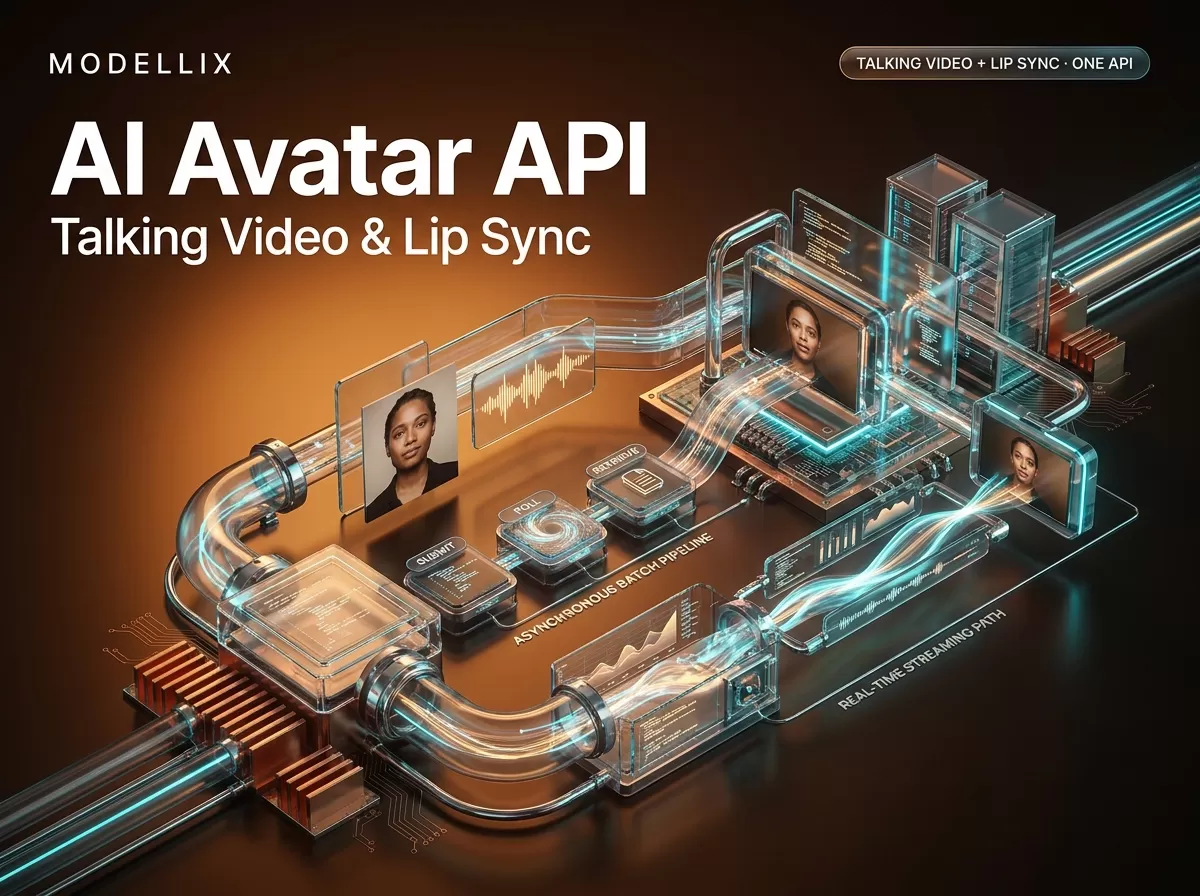
Cover image: illustrative Modellix artwork; it is not a vendor product screenshot or source evidence.