
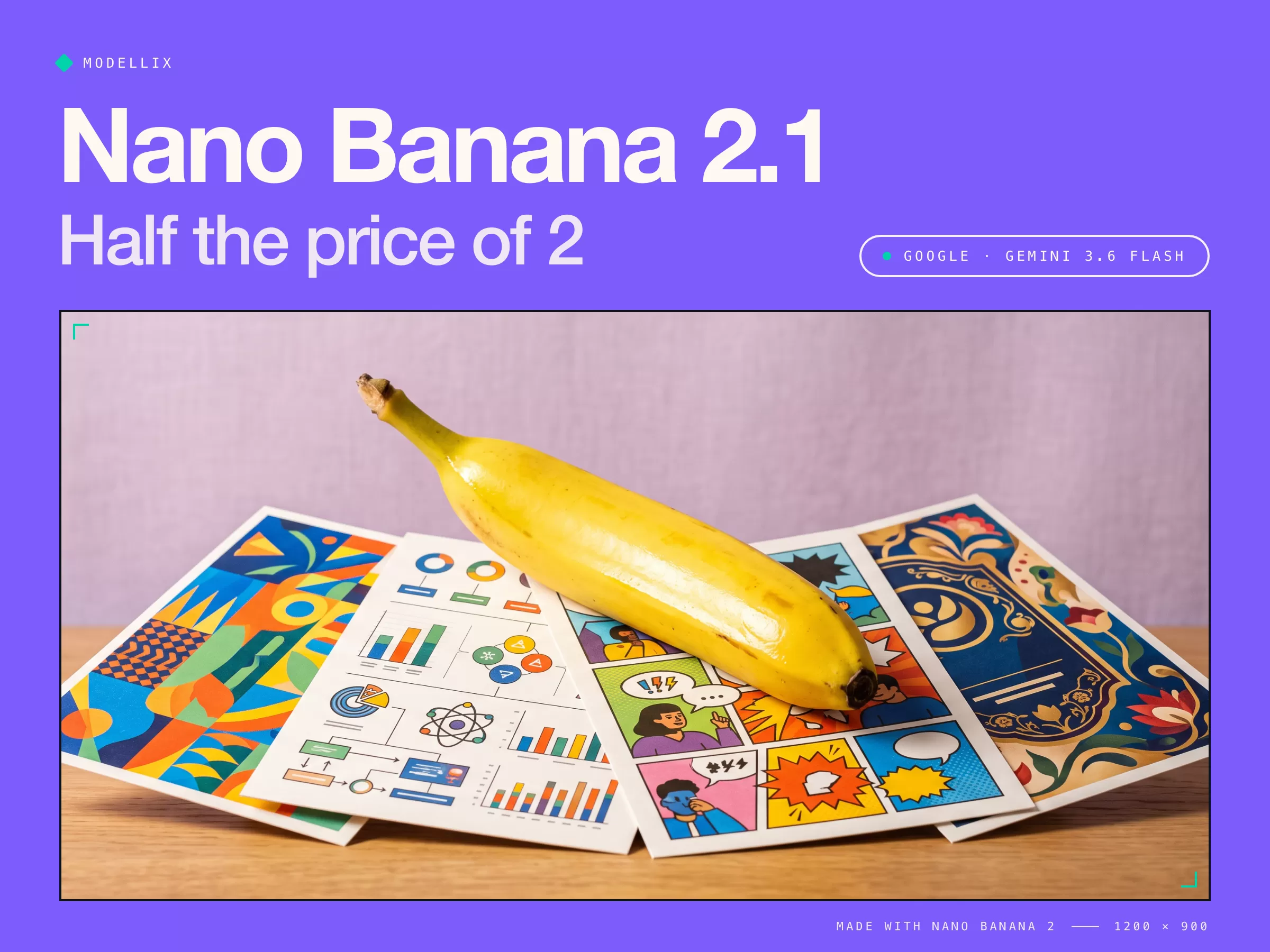
Nano Banana 2.1 is Google's new image generation and editing model, built on Gemini 3.6 Flash. Google released it on October 6, 2026 as gemini-nano-banana-2.1 and marked Nano Banana 2 as deprecated the same day.
The price is the headline: $0.0336 per 1K image, half of Nano Banana 2, and Google's own evals put it ahead of Nano Banana Pro on every row. It is built for infographics, localized posters, and product or character sets that must stay consistent across many images.
Two catches. Input tokens cost three times more than on Nano Banana 2, and the 512px size is gone. Modellix has not added 2.1 yet, so this page also shows what to run today and how to switch in one line when it lands.
Nano Banana 2.1 at a Glance
| Nano Banana 2.1 | |
|---|---|
| Position | Replaces Nano Banana 2 as Google's default Flash image model; sits below Pro in name, above it in Google's evals |
| Released | October 6, 2026 |
| Model ID | gemini-nano-banana-2.1 |
| Based on | Gemini 3.6 Flash |
| Best for | Infographics, in-image text, multi-image edits, consistent characters and products |
| Price per image (Gemini API) | $0.0336 at 1K, $0.0504 at 2K, $0.113 at 4K; Batch API halves each |
| Output sizes | 1K (default), 2K, 4K; no 512px |
| Aspect ratios | Includes 1:4, 4:1, 1:8, and 8:1; tiling artifacts on wide ratios fixed |
| References | Up to 14 images: up to 4 characters and 10 objects |
| Inputs | Text, image, video, PDF |
| Thinking | Minimal, medium (default), or high |
| Per request limits | 131,072 input tokens, 32,768 output tokens |
| On Modellix | Not yet; Nano Banana 2 starts at $0.0405/image |
Specs from Google's Gemini API model page, changelog, and Nano Banana 2.1 model card. The model card lists a 1M token window for the underlying model; the API caps each request at the limits above.
Release Date and Access
Google released Nano Banana 2.1 on October 6, 2026. Its model card lists seven places to use it: the Gemini app, Google AI Studio, the Gemini API, AI Mode in Search, Google Ads, Flow, and Stitch.
In the Gemini app, free users stay on Nano Banana 2. Nano Banana 2.1 needs a Google AI Pro, Plus, or Ultra plan.
The Gemini API changelog marks gemini-3.1-flash-image (Nano Banana 2) as deprecated with no shutdown date announced, and names 2.1 as the replacement. A deprecated model can still get a shutdown date at short notice, so plan the move to 2.1 now instead of waiting for the date.
Nano Banana 2.1 Pricing
| Per image, Gemini API | 1K | 2K | 4K |
|---|---|---|---|
| Nano Banana 2.1 | $0.0336 | $0.0504 | $0.113 |
| Nano Banana 2.1, Batch API | $0.0168 | $0.0252 | $0.0567 |
| Nano Banana 2 | $0.067 | $0.101 | $0.151 |
| Nano Banana 2 Lite | $0.0336 | Not offered | Not offered |
| Nano Banana Pro | $0.134 | $0.134 | $0.24 |
At 1K, Nano Banana 2.1 now costs the same per image as Nano Banana 2 Lite, the budget model. Lite still wins on token prices: $0.25 per 1M input and $1.50 per 1M thinking output.
What 1,000 Images Cost
| 1,000 images | 1K | 2K | 4K |
|---|---|---|---|
| Nano Banana 2.1 | $33.60 | $50.40 | $113 |
| Nano Banana 2.1, Batch API | $16.80 | $25.20 | $56.70 |
| Nano Banana 2 | $67 | $101 | $151 |
| Nano Banana Pro | $134 | $134 | $240 |
Our calculations from Google's list prices. A 10,000-image catalog refresh at 2K drops from $1,010 on Nano Banana 2 to $504 on 2.1, or $252 through the Batch API.
The Costs the Per-Image Price Leaves Out
The per-image price covers the image output tokens only. Your prompt and reference images bill as input at $1.50 per 1M tokens, and thinking bills as text output at $7.50 per 1M. Every 1,000 thinking tokens adds $0.0075 to an image, about 22% of the 1K price (our calculation).
Google's own numbers show when thinking pays for itself: infographic factuality drops from 0.521 to 0.328 with thinking off. Set thinking to minimal for bulk thumbnails and keep it on for infographics. Even with thinking off, 2.1 still beats Nano Banana 2 on every row below.
Nano Banana 2.1 vs Nano Banana 2 and Pro: Benchmarks
Google's model card scores 2.1 against both models it replaces. Here is what changed, how the scores line up, and whether Pro still earns its price.
What Changed from Nano Banana 2
| Nano Banana 2 | Nano Banana 2.1 | |
|---|---|---|
| 1K image | $0.067 | $0.0336 2x cheaper |
| 2K image | $0.101 | $0.0504 2x cheaper |
| 4K image | $0.151 | $0.113 |
| 512px image | $0.045 | Not offered |
| Input tokens, per 1M | $0.50 | $1.50 |
| Text and thinking output, per 1M | $3.00 | $7.50 |
| Infographic factuality (Google eval) | 0.179 | 0.521 2.9x |
| Multi-character consistency (Elo) | 978 | 1106 |
| Wide and panoramic ratios | Tiling artifacts at 2K and 4K | Fixed |
The biggest change is factual accuracy in infographics: Google's autorater scores 2.1 nearly three times higher. That matters for anything with numbers, labels, or diagrams in the image.
Two things got more expensive. Input costs 3x more per token, which adds up on edit jobs that send many reference images. Thinking output costs 2.5x more, and thinking is on by default. Prices from the Gemini API pricing page, standard tier.
Benchmark Scores
| Benchmark | What it measures | 2.1, thinking | 2.1, no thinking | Nano Banana 2 | Nano Banana Pro |
|---|---|---|---|---|---|
| Overall preference | Text-to-image quality, human side-by-side (Elo) | 1050 ± 14 | 1015 ± 13 | 990 ± 7 | 935 ± 8 |
| Infographic design | Layout and visual design of infographics (Elo) | 1048 ± 17 | 1001 ± 17 | 961 ± 12 | 912 ± 12 |
| Infographic factuality | Facts in infographics, autorater score | 0.521 2.9x | 0.328 | 0.179 | 0.265 |
| General editing | Instruction-based edits (Elo) | 1026 ± 12 | 980 ± 15 | 938 ± 11 | 939 ± 10 |
| Single-character consistency | Same person across edits (Elo) | 1028 ± 14 | 1021 ± 14 | 981 ± 10 | 991 ± 9 |
| Multi-character consistency | Several people kept consistent (Elo) | 1106 ± 14 | 1068 ± 14 | 978 ± 10 | 1011 ± 10 |
| Mask and ink editing | Edits guided by a mask or doodle (Elo) | 1049 ± 15 | 1042 ± 16 | 965 ± 12 | 927 ± 12 |
| Product consistency | Same product across scenes (Elo) | 1024 ± 18 | 981 ± 18 | 955 ± 22 | 965 ± 14 |
| Stylization | Restyling an image (Elo) | 1062 ± 20 | 1036 ± 17 | 991 ± 12 | 990 ± 12 |
| Multi-reference editing | Combining several reference images (Elo) | 1066 ± 22 | 1041 ± 20 | 988 ± 13 | 989 ± 12 |
Scores from Google DeepMind's Nano Banana 2.1 model card. Nano Banana 2 was scored with thinking on.
Two caveats. Elo scores come from Google's own human raters and only compare models inside this table; they say nothing about GPT Image or Seedream. And the gaps are often small: on product consistency, 2.1 without thinking sits within the margin of error of Pro.
Is Nano Banana Pro Still Worth 4x?
| Nano Banana 2.1 | Nano Banana Pro | |
|---|---|---|
| 1K image | $0.0336 | $0.134 (4x) |
| 4K image | $0.113 | $0.24 (2.1x) |
| Google's evals | Ahead on all 10 rows | Behind on all 10 rows |
| 512px drafts | No | No |
| Track record | Days | Months of production use |
On Google's numbers, Pro is now the pricier and lower-scoring choice for new work. The one reason to stay is a tuned pipeline: prompts, seeds, and review steps built around Pro's look.
Decision rule: start new projects on 2.1; move existing Pro traffic only after your own prompts pass on 2.1. For older Pro and Nano Banana comparisons, see Nano Banana vs Nano Banana 2 vs Pro and the Nano Banana Pro pricing breakdown.
Nano Banana 2.1 vs GPT Image 2.5 vs Seedream 5.0
Google's model card does not score GPT Image or Seedream, so prices and the test below are the fair comparison.
| Per image | 1K | 2K | Notes |
|---|---|---|---|
| Nano Banana 2.1 (Gemini API) | $0.0336 | $0.0504 | Thinking on by default; 14 references |
| GPT Image 2.5 Sunburst, high (Modellix) | $0.0474 | $0.0963 | Medium quality: $0.0124 / $0.0241; transparent backgrounds |
| Seedream 5.0 Pro (Modellix) | $0.081 flat | $0.081 flat | One price per image |
At 2K, 2.1 costs about half of GPT Image 2.5 on high quality. GPT Image 2.5 on medium is cheaper still, which suits drafts. For the older generations, see our GPT Image 2 API guide and Seedream API guide.
What We Saw in a Small Test
Since 2.1 is not on Modellix yet, we tested the bar it has to clear. We sent one infographic prompt, with exact captions, to Nano Banana 2, Nano Banana Pro, and GPT Image 2.5 Sunburst through the Modellix unified API for image, video, and LLM models.
Prompt used for all three models
A clean, modern 16:9 infographic titled "How Espresso Is Made" on a warm cream background. Five numbered steps from left to right, each with a flat illustrated icon and a short caption: 1 "Grind 18 g of beans", 2 "Tamp evenly", 3 "Brew at 93°C", 4 "Extract for 25 to 30 seconds", 5 "Serve 36 g of espresso". Thin arrows connect the steps. Brown and orange palette, crisp sans-serif typography, generous spacing. No other text.
2K16:9GPT Image quality: high
Nano Banana 2: every caption right, step numbers printed twice

Nano Banana Pro: added accurate details, left the bottom third empty

GPT Image 2.5 Sunburst: the cleanest layout, the slowest return

Run the same prompt yourself
Open a model page, paste the prompt above, and compare your image with these three.
Try Nano Banana 2 Try Nano Banana Pro Explore AI image models →
| Nano Banana 2 | Nano Banana Pro | GPT Image 2.5 Sunburst | |
|---|---|---|---|
| Output at "2K" | 2752 x 1536 | 2752 x 1536 | 2048 x 1152 |
| Gateway processing time | 14.2 s | 27.8 s | 65.6 s |
| Billed on Modellix | $0.0909 | $0.1206 | $0.0963 |
| Title and 5 captions spelled right | 6 of 6 | 6 of 6 | 6 of 6 |
| Layout | Step numbers repeated above and below each icon | Added a 93°C thermometer, timer, and 36 g scale; empty lower third | Balanced, no extra text |
All three spelled every word correctly, so short labels are no longer the hard part. The differences were layout and judgment, which is exactly where Google says 2.1 improved most: infographic design and factuality.
This is one prompt and one run per model, not a benchmark. When Modellix adds Nano Banana 2.1, we will run the same prompt on it and add the result here.
What Can You Build with Nano Banana 2.1
Google's model card points at four kinds of product, each tied to a row it improved most.
- Localized infographics and posters. Diagrams, menus, and explainers with correct labels in several languages. Factuality is the biggest jump over Nano Banana 2.
- Product catalogs. One product shot across dozens of scenes, with up to 10 objects held consistent from your references.
- Comics and storyboards. Up to 4 recurring characters across panels; multi-character consistency gained 128 Elo over Nano Banana 2.
- Retouching with masks and doodles. Mark an area, describe the change, keep the rest untouched.
When Nano Banana 2.1 Is Probably the Wrong Choice
- Small text or long paragraphs. Google's model card says small text is often blurry at 1K. Render at 2K or 4K, or set the copy in your layout tool.
- 512px drafts or transparent backgrounds. 2.1 starts at 1K and has no transparent output. GPT Image 2.5 supports transparent backgrounds.
- A tuned Pro pipeline that already passes review. Rerun your own prompts before switching.
Nano Banana 2.1 API: What to Use Now and How to Switch
Modellix has not added Nano Banana 2.1 yet. Here is what to run today, how to test it in 30 seconds, and how to make the move to 2.1 a one-line change.
What to Use Before Nano Banana 2.1 Lands on Modellix
| If you need... | Use now on Modellix | Why | From (per image) |
|---|---|---|---|
| Fast text-to-image, 512px to 4K | Nano Banana 2 | Same API shape 2.1 will use; 14 aspect ratios | $0.0405 |
| Edits with up to 14 references | Nano Banana 2 Edit | Images or a video as input | $0.0405 |
| The highest-fidelity Nano Banana today | Nano Banana Pro | Same price at 1K and 2K | $0.1206 |
| High-volume 1K drafts | Nano Banana 2 Lite | Lowest Nano Banana price | $0.0306 |
| Clean layouts or transparent assets | GPT Image 2.5 Sunburst | Low to xhigh quality, up to 4K | $0.0053 |
"From" is the lowest price each model page lists. Every Nano Banana route on Modellix lists about 10% below Google's per-image price. If 2.1 follows the same pattern, a 1K image would land near $0.030 (our estimate).
How to Test Nano Banana in 30 Seconds
Setup takes about 30 seconds: sign in with email, Google, or GitHub, add credit, and open a model page. You pay per image, with no subscription. A 2K Nano Banana 2 image came back in 14 seconds in our test.
Create your Modellix account →
Method 1: Playground
No code. Open the Nano Banana 2 model page, paste a prompt, pick the aspect ratio and size, and review the image in your browser.

Method 2: API, Through Your Coding Agent
Paste this into Claude Code, Codex, or Cursor. One sentence and one API key are all your agent needs: change the model name and docs link, and the same prompt batch-generates assets with any model on Modellix.
My Modellix API key is mdlx-••••••••••••••••••••••••. Read https://docs.modellix.ai/get-started/index.md and https://docs.modellix.ai/google/nano-banana-2.md, then use Nano Banana 2 to generate one 2K 16:9 image for each prompt in prompts.txt. Poll each task until it finishes and save the PNG files to ./images.
Swap the masked key for your own from the Modellix console. Treat it like a password and share it only with agents you trust. The raw request format is in the next section and the API guide.
Method 3: Skill
Install the Modellix skill once. After that, your agent finds the right model and request fields by itself.
npx skills add https://github.com/Modellix/modellix-plugin --skill modellix
Use the Modellix skill to generate a 2K 16:9 Nano Banana 2 infographic titled "How Espresso Is Made" with five numbered steps, then download it to ./images.
Setup for each agent host is in the Skill guide.
Method 4: CLI
For scripts and scheduled jobs. One command submits the task, waits, and prints the result URL.
npm install --global modellix-cli
export MODELLIX_API_KEY="your_api_key"

modellix-cli model run --model-slug google/nano-banana-2 \
  --body '{"prompt":"A clean 16:9 infographic titled How Espresso Is Made","aspectRatio":"16:9","imageSize":"2K"}' \
  --wait --timeout 5m --quiet
For batches, put one request per line in a JSONL file and run modellix-cli model batch. See the CLI guide.
How to Get Your Pipeline Ready for Nano Banana 2.1
Nano Banana on Modellix is an async task: submit, poll, then download before the result URL expires. Result URLs expire seven days after the task completes. Three habits make the 2.1 switch a one-line change:
- Keep the model path in config. Moving from
google/nano-banana-2to the 2.1 route should not touch your code. - Stop relying on 512px. 2.1 starts at 1K, so make 1K your draft size now.
- Budget for input and thinking. Count reference images per job, and decide which jobs need thinking before 2.1 bills it.
curl -X POST "https://api.modellix.ai/api/v1/google/nano-banana-2" \
  -H "Authorization: Bearer $MODELLIX_API_KEY" \
  -H "Content-Type: application/json" \
  -d '{
    "prompt": "A clean, modern 16:9 infographic titled \"How Espresso Is Made\" with five numbered steps",
    "aspectRatio": "16:9",
    "imageSize": "2K"
  }'

curl "https://api.modellix.ai/api/v1/tasks/<task_id>" \
  -H "Authorization: Bearer $MODELLIX_API_KEY"
Get a key from the Modellix console. The Nano Banana 2 docs list every field.
One API Key for Every Image Model
Image teams rarely stay on one model. A catalog pipeline might use Nano Banana for product scenes, GPT Image 2.5 for transparent assets, and Seedream for stylized art, each with its own account, key, and request format.
However, on Modellix one key reaches Nano Banana 2, Pro, Lite, and their Edit routes, plus GPT Image 2.5, Seedream, and the video models, all through the same submit-and-poll workflow. When Nano Banana 2.1 lands, moving to it is a change to the model path, not a new integration.
The same images also cost less than Google's list price:
| 10,000 images at 2K | Google list price | Modellix | Saved |
|---|---|---|---|
| Nano Banana 2 | $1,010 | $909 | $101 |
| Nano Banana Pro | $1,340 | $1,206 | $134 |
Our calculations from Google's pricing page and the Modellix model pages.
Try Nano Banana 2
Create a Modellix key, run your own prompts on Nano Banana 2 and Pro today, and switch to Nano Banana 2.1 when it lands.
Get API KeyFrequently Asked Questions About Nano Banana 2.1
Is Nano Banana 2.1 free?
Not in the Gemini app: free users get Nano Banana 2, and 2.1 needs a Google AI Pro, Plus, or Ultra plan. In the Gemini API it is pay per image, from $0.0336 at 1K.
Is Nano Banana 2.1 better than Nano Banana Pro?
On Google's own model card, yes: 2.1 scores higher on all ten evals and costs a quarter of Pro at 1K. Test your own prompts before moving a production Pro pipeline.
Is Nano Banana 2 shutting down?
Google deprecated Nano Banana 2 on October 6, 2026 and has not announced a shutdown date. Google lists Nano Banana 2.1 as the replacement.
Does Nano Banana 2.1 support 4K?
Yes. It outputs 1K, 2K, and 4K, with 1K as the default. The 512px size from Nano Banana 2 is not available.
Related articles
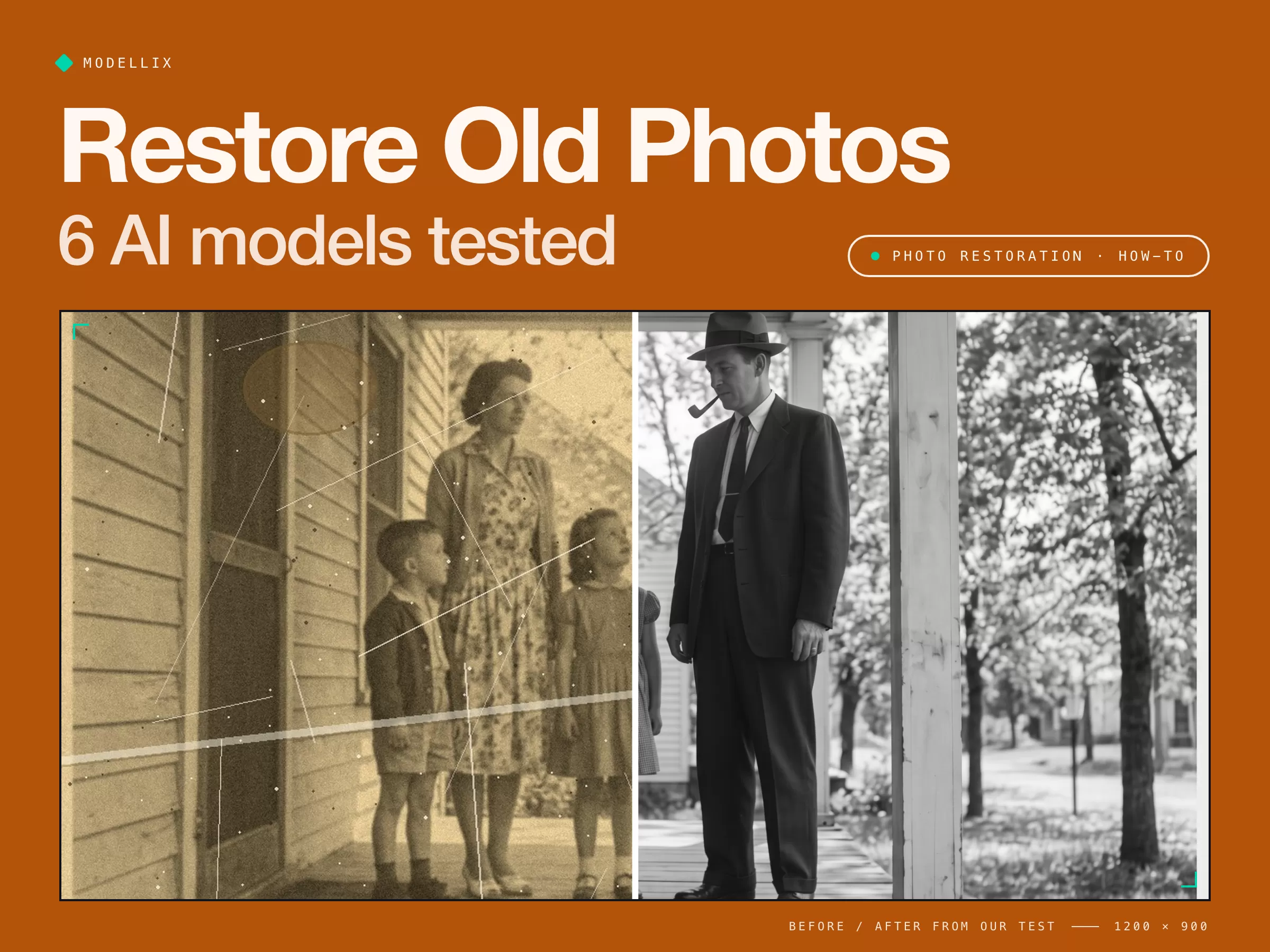
How to Restore Old Photos with AI [Tested on 6 Models]
Restore old photos step by step: scan, repair, check faces, colorize. We damaged a photo on purpose and tested 6 AI models to see which keep faces real.
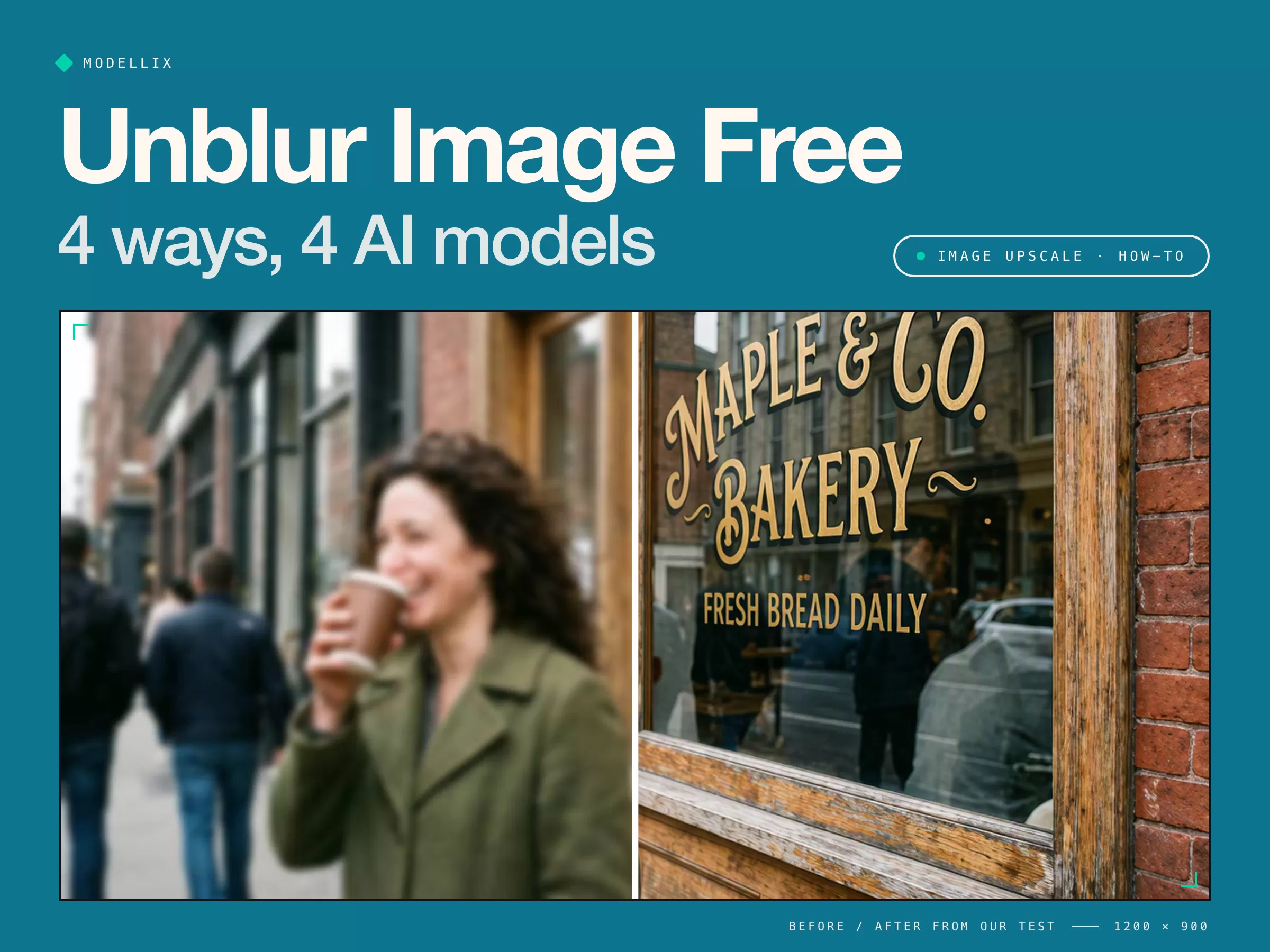
Unblur Image Free [Tested]: 4 Ways and 4 AI Models
Unblur an image for free on your phone, online, or with AI. We blurred a photo and tested 4 AI models: all fixed the sign, not all kept the face.

Seedream 5.0 API: Integration Guide, Pricing & Code
Seedream 5.0 API guide, September 2026: official BytePlus pricing from $0.035 per image, Lite and Pro model IDs, the endpoint, working code, and route fit.
Nano Banana 2 API Key: Integration Guide, Pricing & Code
Where to get a Nano Banana 2 API key: Google AI Studio or Modellix. Step-by-step setup, the auth headers that differ, dated per-image pricing, and working code.