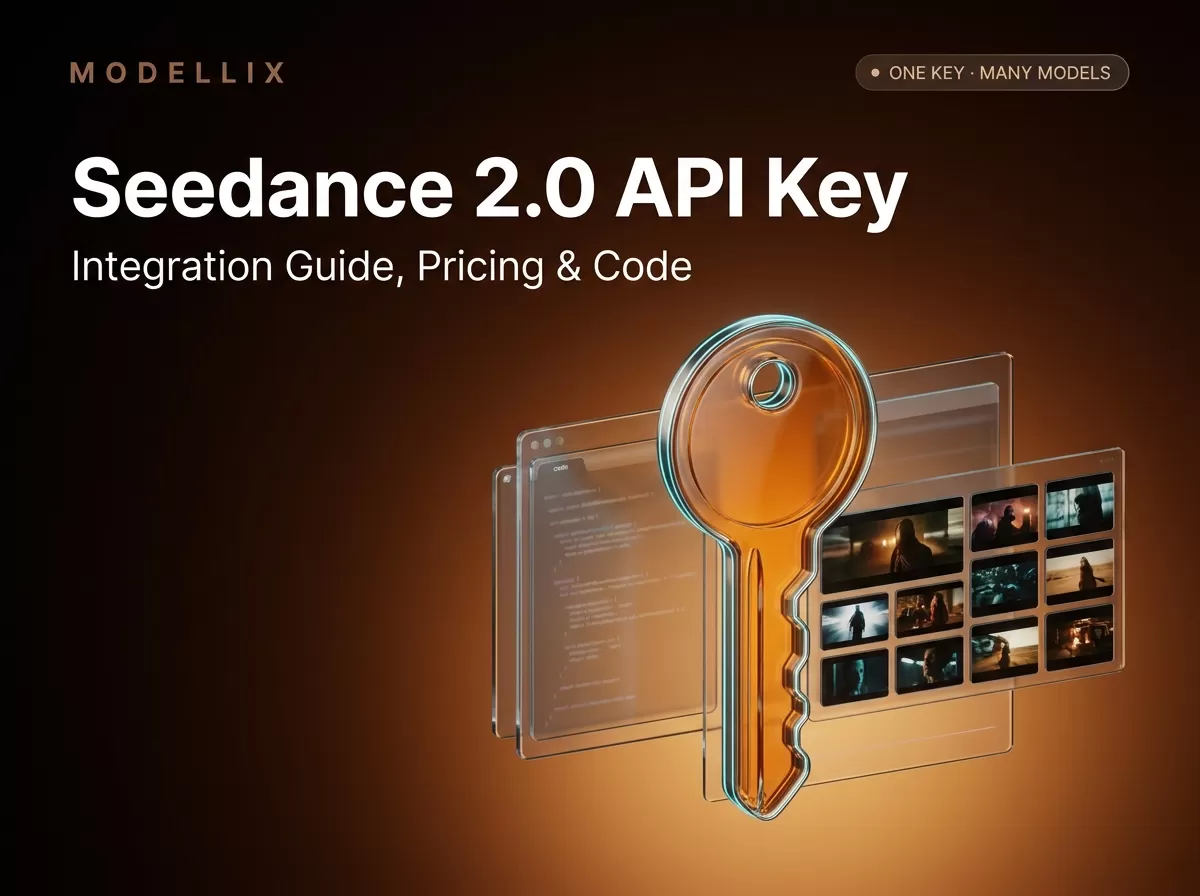
A Seedance 2.0 API key is the credential that unlocks ByteDance’s video generation models over HTTP — and it is not one uniform thing. The official BytePlus route gates the key behind an activation step (funded balance above USD 30 or a purchased resource pack), while aggregator APIs like Modellix issue a key that works the moment you create it, with no activation. Which door you pick determines your endpoint, your billing unit, and most of the error codes you will see.
This guide covers the whole lifecycle of a Seedance 2.0 API key: what it actually is, where to get one (all three routes), step-by-step key creation, a working first call in Python and curl, the pricing that applies to a key as of August 23, 2026, and the security and troubleshooting practices that keep that key from becoming next month’s leaked-credential postmortem. Modellix is an aggregator and has a commercial interest in the aggregator route looking good; the requirements and prices below were pulled from first-party pages today so you can verify every claim.
What a Seedance 2.0 API key is (and what it is not)
A Seedance 2.0 API key is an authentication token that identifies your account to a video-generation endpoint. You send it as a Bearer token in the Authorization header (some platforms use a custom header such as X-API-Key), and the API charges whatever you generate to that key’s account. That is the whole contract — it is not a subscription, not a seat license, and not access to the Dreamina consumer app, which is a separate ByteDance product with its own login.
Two properties of the key matter more than any other:
- The key is not the model access. On the official platform, creating a key succeeds even before you can call anything — the models themselves sit behind an activation step. This is the single most common reason a fresh BytePlus key returns errors.
- Keys are not interchangeable. A BytePlus key only authenticates on
ark.ap-southeast.bytepluses.com. A Volcengine key only works on the domestic China endpoints. An aggregator key only works on that aggregator’s API. The “seedance 2.0 api key” you see referenced in a GitHub wrapper repo is almost always a key from the wrapper’s own provider, not a ByteDance-issued key.
The practical consequence: before you create anything, decide which door you are entering through. The next section maps the doors.
Where to get a Seedance 2.0 API key: three doors
ByteDance serves Seedance 2.0 through two official clouds, and a third route resells the same models through aggregator APIs. Each issues a key with different rules:
| Door | Activation before first call | Where the key comes from | Billing unit | Key scope |
|---|---|---|---|---|
| BytePlus ModelArk (international) | Balance > USD 30, or AI Savings Plan ≥ USD 30 tier, or Seedance resource pack; then activate models | Console API key page | Per token (estimated from resolution × duration) | ByteDance models on BytePlus only |
| Volcengine Ark (mainland China) | Balance ≥ 200 CNY or resource pack; then enable models | Console API key management | Per token | ByteDance models on Volcengine only |
| Aggregator API (e.g. Modellix) | None — key works immediately | Provider console after signup | Per second of generated video | Many providers behind one key |
The official reference states the BytePlus activation requirement plainly: you must have an account balance greater than USD 30, or a dedicated AI Savings Plan at the USD 30 tier or above, or a purchased Seedance resource pack with available quota, before the models can be enabled (Create a video generation task — BytePlus ModelArk API reference, accessed August 23, 2026). The Volcengine tutorial applies the same structure domestically, requiring at least 200 CNY or a resource pack (Doubao Seedance 2.0 series tutorial), with the activation, usage, and cancellation rules spelling out the details.
Aggregators exist precisely because of that gate: they pre-license the models, so their key works the instant you create it. If you want the full comparison of what “access” means on each route — including the community-reported verification friction on the official path — our Seedance 2.0 API access guide covers it in depth; this article stays focused on the key itself.

Figure: the three doors to a Seedance 2.0 API key — official cloud, domestic cloud, and a unified aggregator key — each with its own activation rules and endpoint.
Route 1: get a key on BytePlus ModelArk, step by step
BytePlus ModelArk is the official international door, operated out of the ap-southeast-1 region and usable without a China-region account. The steps:
- Create a BytePlus account and fund the balance above USD 30, or purchase a Seedance resource pack. Without one of the two, the activation step refuses.
- Generate a long-term API key on the API key management page. The official API reference notes this is the only authentication method supported.
- Activate the Seedance 2.0 models in the console’s model management. This is the step the marketing pages skip — activation and key creation are separate actions.
- Read the model ID from the console after activation. ByteDance rotates version-suffixed IDs (e.g.
dreamina-seedance-2-0-260128), so never hard-code one; read it from configuration.
The base URL for all calls is https://ark.ap-southeast.bytepluses.com/api/v3, and video generation is an asynchronous task — submit, then poll. The official API tutorial is the canonical walkthrough for the request shape.
The domestic Volcengine route mirrors this structure with a mainland-China account: balance ≥ 200 CNY or resource pack, key from the console, explicit model enablement, and domestic endpoints. Choose it only if your infrastructure or compliance requirements sit inside mainland China.
Route 2: get a working key from an aggregator
Aggregator platforms license Seedance 2.0 from ByteDance and resell access behind their own REST endpoints. The trade-off is the mirror image of the official route: zero activation friction and per-second billing through a middle layer, at the cost of no direct vendor relationship. A Seedance 2.0 API key from an aggregator works the moment you create it — no balance top-up, no model activation, no resource pack.
The full setup on Modellix is three actions: sign up, create a key in the console at modellix.ai/console/api-key, and call the model. The request uses the same async submit–poll lifecycle as the official API, flattened into one endpoint per model. It carries the 2.0 series as T2V, I2V, and V2V routes plus Fast and Mini tiers behind the same key, and the Seedance model family hub lists the current set — including the newer Seedance 2.5, for which the same console issues a key. If your project needs several video models rather than just Seedance, our guide to running multiple AI video models behind one API key explains the workflow trade-off that motivates the setup.
Make your first call with the key
Both routes use the same shape: submit a generation task, receive a task ID, poll until the status is terminal, then download the video URL before it expires. Below is the aggregator variant with a Modellix key — the shortest path from key to first output.
1 | import os |
1 | # 1. Submit the task — same endpoint and payload as the Python example |
The official route is the same idea over the BytePlus API: POST https://ark.ap-southeast.bytepluses.com/api/v3/contents/generations/tasks with the Bearer header and the activated model ID, then GET .../tasks/{id} until succeeded or failed. Treat the Python and curl snippets as starting skeletons — verify response field names against the current docs for the model ID you actually use. The 2.0 series’ omni-reference mode goes beyond plain text: it accepts multimodal reference input — up to 9 reference images, up to 3 reference videos (2–15s each), and up to 3 reference audio clips — so a generation can be anchored to existing material; the snippets above pass text only. For the complete request parameters, model IDs, and the omni-reference input contract, see our Seedance 2.0 API guide.
Seedance 2.0 API Reference
See the full request and response schema for Seedance 2.0 video generation tasks.
View DocsWhat a Seedance 2.0 API key costs (August 2026 snapshot)
Video APIs bill by the second of generated output (aggregators) or per token (official platform), so the practical cost of a job is rate × duration at the resolution you request. The Modellix per-second ranges below were read from the live model pages on August 23, 2026:
| Route | Per-second price (2026-08-23) |
|---|---|
| seedance-2.0-t2v | $0.0805–$0.8970/sec |
| seedance-2.0-i2v | $0.0805–$0.8970/sec |
| seedance-2.0-v2v | $0.1978–$2.1459/sec |
| seedance-2.0-fast-t2v | $0.0690–$0.1380/sec |
| seedance-2.0-mini-t2v | $0.0460–$0.0920/sec |
The official side is running a limited-time promotion on the 2.0 series through September 7, 2026 (14:00 UTC+8): Seedance 2.0 mini at 40% of list price and Seedance 2.0 fast at 75%, for both 480p and 720p output — for 720p, the BytePlus API reference quotes approximately USD 0.03/second for mini and USD 0.09/second for fast. On the official platform, the base Seedance 2.0 model supports up to 4K output (10-bit H.265), while fast and mini cap at 720p.
Two honest notes before you compare numbers. First, the columns are different contracts: official billing is per token with a promo window that expires September 7, 2026, and aggregator billing is per second with no activation — a “cheapest Seedance 2.0 API key” verdict depends on tier, resolution, duration, billing contract, and promo timing. Second, this snapshot is dated: rates change, and the current per-call price for every model is published on the live pricing pages. That framing is not a claim that Modellix is the cheapest door — during the official promo, the 720p fast tier undercuts aggregator rates, and the right choice depends on your volume and whether you want a direct vendor relationship.
Start Generating with Seedance
Log in to create a Seedance 2.0 API key and run 210+ image and video models on one account.
LoginKey security: treat it like a password
A leaked API key is a billed-by-someone-else credential. The good news: every mistake below is cheap to avoid, and none of the ranking pages for this query covers them.
- Keep the key in an environment variable, never in source code. The snippets in this article read from
os.environfor exactly this reason. A key pasted into a repo — including the “seedance 2.0 api key github” wrapper repos that show you where to paste it — is discoverable by anyone who can read the repo, and by scanners that crawl GitHub continuously. - Never commit
.envfiles. Add them to.gitignorebefore the first commit, not after the first incident. - Rotate on a schedule and on suspicion. Both BytePlus and aggregator consoles let you revoke and re-issue keys. If a key was ever committed, pasted into a chat, or shipped in a client bundle, rotate it immediately.
- Scope keys per environment if the provider allows it. Separate production and staging keys make cost attribution and revocation cleaner.
- Monitor usage per key. Per-second billing means a compromised key burns money until you notice; a quick daily check of per-task cost logs catches it early.

Figure: the key lifecycle — store in an environment variable, use in requests, rotate on schedule, and monitor spend per key.
Key troubleshooting: the errors you will actually hit
Most failed first calls are not model errors — they are key errors. The ones to know before you hit them:
| Error | What it means | Fix |
|---|---|---|
| 401 Unauthorized / invalid_api_key | Wrong, expired, or cross-provider key | Re-check the key against the exact console that issued it; BytePlus, Volcengine, and aggregator keys are not interchangeable |
| 403 / model not activated | The classic Seedance 2.0 trap: account and key exist, but the model was never activated | Complete the activation step (balance/resource-pack requirement) before calling |
| 429 Too Many Requests | Rate limit on the key or account tier | Back off and retry with exponential backoff; check the tier’s RPM limit |
| Insufficient balance | Per-token billing drew the account down | Top up; a funded balance above the activation threshold is not a budget for unlimited generation |
| Region mismatch | Console region and endpoint region disagree (ap-southeast-1 vs domestic CN) | Use the endpoint that matches the account that issued the key |
| Model ID not found | ByteDance rotated a version-suffixed ID | Read the current ID from configuration; never hard-code it |
Key hygiene is the cheapest insurance: keep keys in environment variables, scope them per environment, and rotate on any suspicion. The official ByteDance Seedance page is the canonical source for current model capabilities, and the API documentation is the reference for the aggregator route.
Frequently Asked Questions
How do I get a Seedance 2.0 API key?
Three routes: BytePlus ModelArk (international) with a balance above USD 30 or a resource pack plus model activation; Volcengine Ark (mainland China) with at least 200 CNY or a resource pack; or an aggregator API, which issues a key immediately with no activation. Full steps for all three are above.
Is there a free Seedance 2.0 API key?
There is no free tier on the official route — the activation gate itself requires a funded balance or a paid resource pack. Some aggregators offer free trial credit for new accounts; check the specific provider’s current terms, and note that per-second rates are the billing unit either way.
Is there a Seedance 2.0 API key generator?
No. Keys are issued only from a provider console (BytePlus API keys page, Volcengine console, or an aggregator dashboard). Any “generator” tool is either a wrapper around an account you still have to create, or a credential-harvesting scam — the real key is always created by you, in a console you logged into.
Why does my Seedance 2.0 API key return 403?
Almost always because the model is not activated. On the official route, activation requires the balance/resource-pack condition and a separate console step; until that completes, a valid key still cannot call the model. The fix is the activation step, not a new key.
Can I use one Seedance 2.0 API key for other models?
Only within the scope of the issuing platform. A BytePlus key covers ByteDance models on BytePlus; an aggregator key covers every model that aggregator carries, which is the main reason teams choose the aggregator route.
Which is better for a Seedance 2.0 API key: official or aggregator?
It depends on volume and constraints. At serious ByteDance-only volume, the official per-token economics and direct vendor relationship win; for evaluation, multi-model needs, or speed from signup to first output, the aggregator’s no-activation key is the pragmatic choice. Match the billing contract before comparing any price.
Provider details and pricing reflect public information as of August 2026 and change frequently — the BytePlus promo window closes September 7, 2026, and model IDs rotate. Validate against each provider’s live pages before committing.