What an AI media generation API actually is
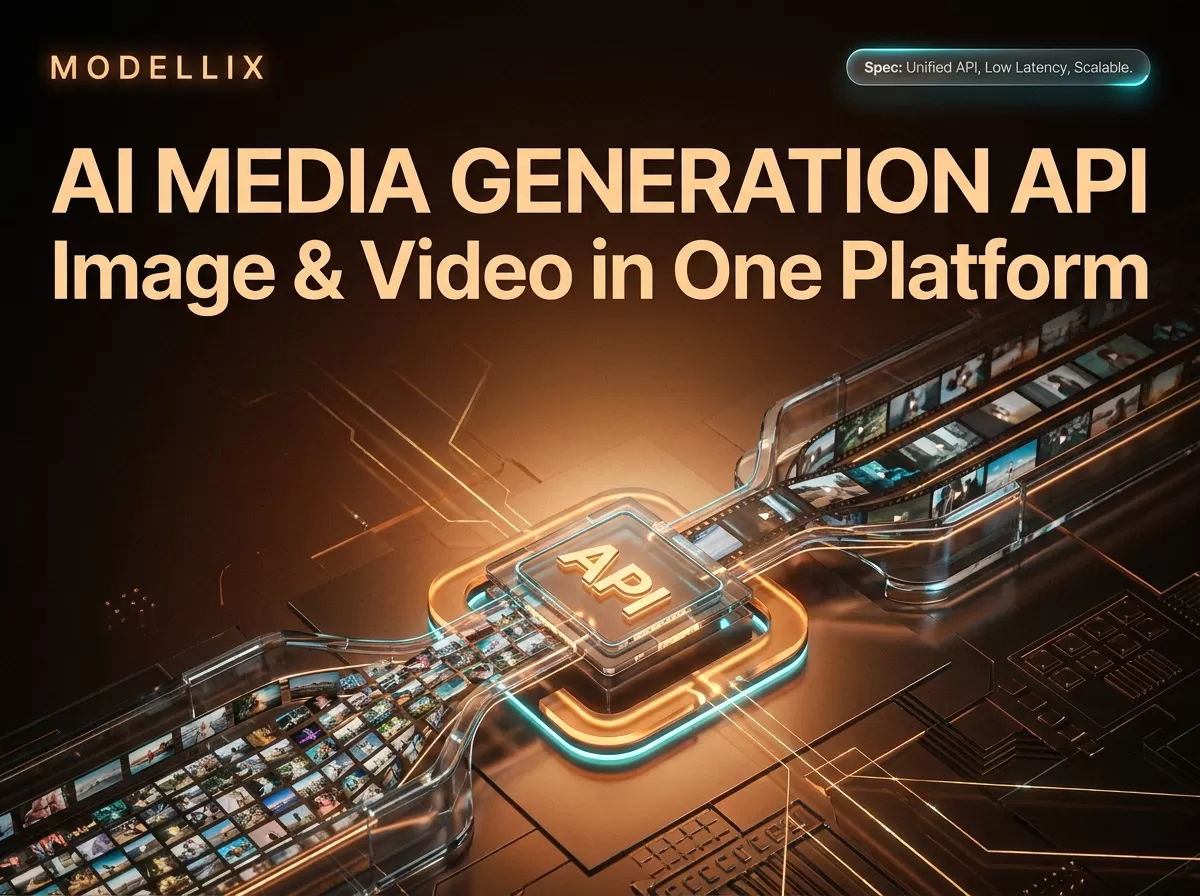
An AI media generation API is a REST interface that turns a text prompt or a reference image into a finished image or video file. You send a request with an API key and a model choice; the service runs a GPU workload and hands back a download URL when the asset is ready. It is the programmatic version of what Midjourney or Runway do in a browser — same models, no human in the loop.
Two boundaries keep that definition useful. First, “media” here means images and video: text-to-image, image-to-image, text-to-video, and image-to-video (the bridge workflow most products end up needing). Audio and 3D sit adjacent — some platforms bundle them, but they are separate buying decisions. Second, a media generation API is not an LLM API. Token-based text APIs return strings; media APIs return files, which is why the whole engineering pattern around them is different: async jobs, file storage, webhooks. The model landscape moves fast enough that our weekly media digest is a better freshness source than this page will ever be.
If your product needs both product images and short videos, the practical question is narrower: can one API surface cover both modalities without forcing you into a second vendor, a second key, and a second billing relationship? OpenAI’s image generation API is a first-party image-only surface; the platforms below solve the combined problem in three different ways.
The three route types behind “image and video API”
“Image and video API” is a search phrase, not a product spec. What you actually find in the market are three route types with different economics:
Single-vendor platform. One company, its own models, one API. fal hosts 1,000+ models on serverless GPUs and is a common home for open image and video architectures; Runware wraps image, video, audio, and 3D behind one endpoint; xAI’s Grok Imagine is an image-and-video API; Leonardo sells a visual-first workflow where you design in a UI and export runnable API code. Strengths: model quality, iteration speed, first-party support. Trade-off: one catalog, and switching model families can mean re-platforming.
Multi-vendor aggregator. One key and one bill across many providers. Modellix exposes 210+ image and video models from twelve model brands — Alibaba, Kling, Google, ByteDance, MiniMax, PixVerse, xAI, and others — behind a single REST API; WaveSpeed and AIMLAPI follow the same shape. Strengths: you can compare models side by side and switch without new integrations, with per-call pricing in one place. Trade-off: no exclusive frontier models, and a small aggregator margin or shared queue behavior.
Programmatic video engine. JSON templates assembled into finished videos at scale. Shotstack and Creatomate target ad, real-estate, and e-commerce teams producing thousands of templated videos. If your “video API” need is really template assembly rather than prompt-to-video generation, this is the category you want — and it is the one most “best media API” articles never mention.
| Route type | What you get | Billing shape | Best for | Watch out |
|---|---|---|---|---|
| Single-vendor platform | One company’s models, one API | Per image / per second / per GPU-second | One strong model family, stable workload | Catalog lock-in |
| Multi-vendor aggregator | Many providers, one key and one bill | Per call, transparent per model | Comparing or switching models | No exclusives, small margin |
| Programmatic video engine | Template-driven video assembly | Per video / per minute | Templated video at scale | Not prompt-to-video |

Route types, not brand names, should drive the shortlist — billing units and switching costs differ more between routes than between two platforms inside the same route.
Five things to check before you pick a media generation API
Most “best API” roundups are marketing exercises. This checklist is what survives contact with a real integration:
- Modality coverage. Does the API serve image and video at the quality you need — including image-to-video, the workflow that trips up image-only platforms? Check the actual model list, not the homepage claim.
- Billing unit and transparency. Per image, per second of video, per GPU-second, or per video? Is a per-call price published before you commit, and does the dashboard log per-request cost? Opaque points systems make forecasting a guessing game.
- Async job model. Media generation takes seconds to minutes. Does the API return a job ID you can poll, or a webhook you can register? What happens on timeout, retry, and duplicate delivery?
- SDK and docs quality. A working Python or TypeScript client, curl examples, and an error-code table with retry guidance decide whether your first integration takes an hour or a week. If you need brand-consistent output, check whether fine-tuning (LoRA-style) is supported at all.
- Rate limits and failure behavior. What are the RPM limits? What does a 429 look like? Is there a queue, and what does a failed job cost? For a media pipeline these are load-bearing details, not fine print.
What an image call and a video call actually cost
Billing units do not compare directly, which is why “which API is cheapest” is unanswerable as asked. Image APIs bill per image; video APIs bill per second, per GPU-second, or per video. The honest comparison is per task, with a model chosen at each end.
Anchors read from the vendors’ own pages on August 13, 2026:
| Route | Anchor | Unit |
|---|---|---|
| xAI Grok Imagine | from $0.02 | per image; video priced per generation |
| fal | pay-per-use | per GPU-second; free tier advertised |
| Modellix floor — MiniMax Image 01 T2I | $0.0040 | per image |
| Modellix floor — Wan 2.2 I2V Flash | $0.0008 | per second of video |
Two caveats keep these numbers honest. The Modellix figures are the cheapest routes on the platform today, not typical ones — flagship models cost anywhere from ~8× (Imagen 4.0 at $0.033 per image) to several hundred× (Veo 3.1 at $0.322–0.483 per second) the floor price. And an aggregator is not automatically cheaper than a direct vendor: fal is frequently the low-cost home for open models, and per-model pricing differs by route. That is why Modellix’s pricing page is a searchable per-model table rather than one headline rate.
A worked example makes the spread concrete: five product images plus one 30-second 1080p clip.
| Task | Floor route | Realistic mid route |
|---|---|---|
| 5 images | 5 × $0.0040 = $0.02 | 5 × $0.033 (Imagen 4.0) = $0.165 |
| 30s video | 30 × $0.0008 = $0.024 | 30 × $0.13 (Veo 3.1 Fast) ≈ $3.90 |
| Total | ≈ $0.04 | ≈ $4.07 |
Model selection, not platform selection, drives most of the cost — and per-second video billing is the line item to model first in your forecast.
The floor route is not the point: quality demands usually push you up the curve, and the same discipline applies whichever route you pick. Our cheapest AI API analysis applies it to a wider field.
How the async pipeline works (with code)
Every serious media generation API follows the same pattern: initiate a job, poll or listen for completion, fetch the asset.
- POST the prompt (and optional reference image) to a model endpoint → get a
task_id. - Poll the task status, or register a webhook to be notified.
- Fetch the finished file from the returned CDN URL.

The job-id → poll/webhook → CDN flow appears in every serious media API; only the endpoint names differ.
A minimal Python example against Modellix’s documented API shape: POST /api/v1/<provider>/<model>/async returns a task_id, fetched via GET /api/v1/tasks/{task_id} with a Bearer API key.
1 | import requests, time |
For production, skip the polling loop: send the X-Webhook-URL header and let the service push the result. This is where orchestration layers earn their keep — Trigger.dev’s media generation guide shows retries, human-approval gates, and batch coordination for exactly this pipeline. Working Python and JS examples are also what most people hunt for under “ai media generation api github”, so treat the snippet above as a starting point, not the finished integration.
Free tiers and testing paths
“Can I get an AI API for free?” is one of the most common follow-ups on this keyword, so here is the honest map as of August 2026:
- fal advertises a free tier on its pricing page for getting started with pay-per-use billing.
- xAI (Grok Imagine) publishes no free tier on its API page — assume paid, verify in the console.
- Modellix does not publish a free tier on its pricing page or docs as of this writing — the docs advertise a 10% discount on your first top-up instead; check your console at signup for any trial credit. At the floor prices above, every $10 of credit covers roughly 2,500 images or about three and a half hours of video — enough to validate an integration before paying.
- OpenAI image APIs are pay-as-you-go, with no free tier for the API itself.
The testing path that actually works: build against the free or trial tier of one aggregator and one single-vendor platform, run your real prompts, and log per-call cost on both. Thirty minutes of that beats a week of reading comparisons. If you want a concrete starting point, create a Modellix account and run the five checks above against real prompts — if the console shows a signup credit, use it; otherwise the docs currently advertise a 10% discount on your first top-up. Starting from zero, our Nano Banana API key guide shows the full get-a-key → first-image loop on one concrete model.
When one platform is enough — and when it isn’t
A single-vendor platform is enough when you have found one model family you trust, your workload is stable, and you value first-party support. Most teams building on Kling or Veo start here, and it is a defensible place to stay.
The aggregator route earns its keep in two situations: when your product needs several models (a cheap image tier, a cinematic video tier, an image-to-video tier) and you do not want three integrations and three invoices; and when you want to re-evaluate model choice monthly without re-platforming. The price of that flexibility is being one layer removed from the model vendor.
Disclosure, because it is required: Modellix is an aggregator, and this article is written by its team. We have a commercial interest in you choosing this route, which is why the framework comes first — our Modellix vs fal comparison applies the same route logic to a specific pair, including the places where fal is the better answer. Decide with the checklist, then test on free credits, then commit.
FAQ
Is there an API for AI image generation?
Yes. OpenAI exposes GPT Image through its API, xAI and Leonardo offer image APIs, and aggregators expose dozens of image models behind one key. It is the most crowded part of this category.
How do I generate AI media?
Send a prompt to a media generation endpoint, receive a job ID, poll or register a webhook, and download the finished file from the returned URL. The Python walkthrough above shows the full pattern.
Can I get an AI API for free?
fal advertises a free tier on its pricing page. Modellix’s docs advertise a 10% discount on your first top-up rather than a published free tier — check your console at signup for any trial credit. OpenAI’s image APIs and xAI’s Imagine API are paid and pay-as-you-go.
Can I use the Grok API for free?
As of August 2026, xAI’s public API pages do not advertise a free tier. Sign up, check your console for any signup credit, and assume usage-based pricing.
Do I need a separate API key for each model?
Not on an aggregator: one Modellix API key authenticates every model in the catalog, so the same Authorization: Bearer <key> header works for image calls, video calls, and every provider behind the single endpoint. Separate keys only appear when you integrate several single-vendor platforms directly.
What is the difference between an image API and a video API?
Billing unit (per image vs per second), job duration (seconds vs minutes), and the async pattern — video generations outlive typical HTTP timeouts, so video APIs lean harder on webhooks. An image and video API combines both surfaces under one key and one rate model, which is the setup this guide is about.