How Overseas AI Short Drama Crossed the Industrialization Line
For about two years, “Chinese AI short drama going overseas” read as a curiosity: cheap vertical clips, dubbing experiments, viral outliers. That framing is now wrong. In the first week of September 2026, three near-simultaneous moves — a government-backed overseas service network, an industry estimate that AI-driven drama and anime now anchor the export market, and the airdrop of a fully AI-generated serial onto a broadcast prime-time slot — signal that AI short drama has stopped being a content experiment and become a structured, policy-supported export sector.
This piece reads those signals as an operator would. The task here was to separate what is actually verifiable from what is industry shorthand, so each claim below is marked accordingly. That distinction matters more than the headlines, because the decisions production teams need to make — where to localize, what compliance to carry, whether the unit economics are real — depend on knowing which numbers are audited and which are marketing arithmetic.
Start with the market size — and the verifiable core
The cleanest set of verified numbers comes from DataEye, the industry data firm whose H1 2026 read on overseas short-drama apps is widely cited by 36Kr’s English coverage. DataEye estimated that overseas short-drama apps pulled in about US$1.27 billion in combined iOS/Android in-app purchase revenue in the first half of 2026, up roughly 13% year on year. Chinese-origin apps accounted for about US$1.18 billion of that — roughly 93% of the global category, down only slightly from 95% in 2025. That same body of reporting pegs the full-year overseas micro-short-drama market at over US$6 billion in 2026.
The AI piece of that is where the growth concentrates. In DataEye’s city-level analysis of AI drama and anime, the firm estimates the overseas AI-drama-and-anime market will exceed US$4 billion in 2026, or nearly 70% of the total overseas micro-short-drama figure. The numbers deserve one caveat, because the same research house has also framed “AI drama and anime” as a roughly US$650 million sub-segment for 2026 depending on scope — so treat the US$4 billion as an umbrella read tied to content that is AI generated or AI-authored throughout the export funnel, not a single reconciled line item. What is uncontested across every frame is the direction: AI-led output is the growth engine of the export market, and Chinese operators dominate it.

The state is now building the export channel
Two things had to change before AI short drama could scale overseas at this pace: the compliance burden had to be navigable, and localization had to stop being a per-title handcrafted project. On September 4, 2026, China’s Lingang New Area addressed both with a concrete institutional move.
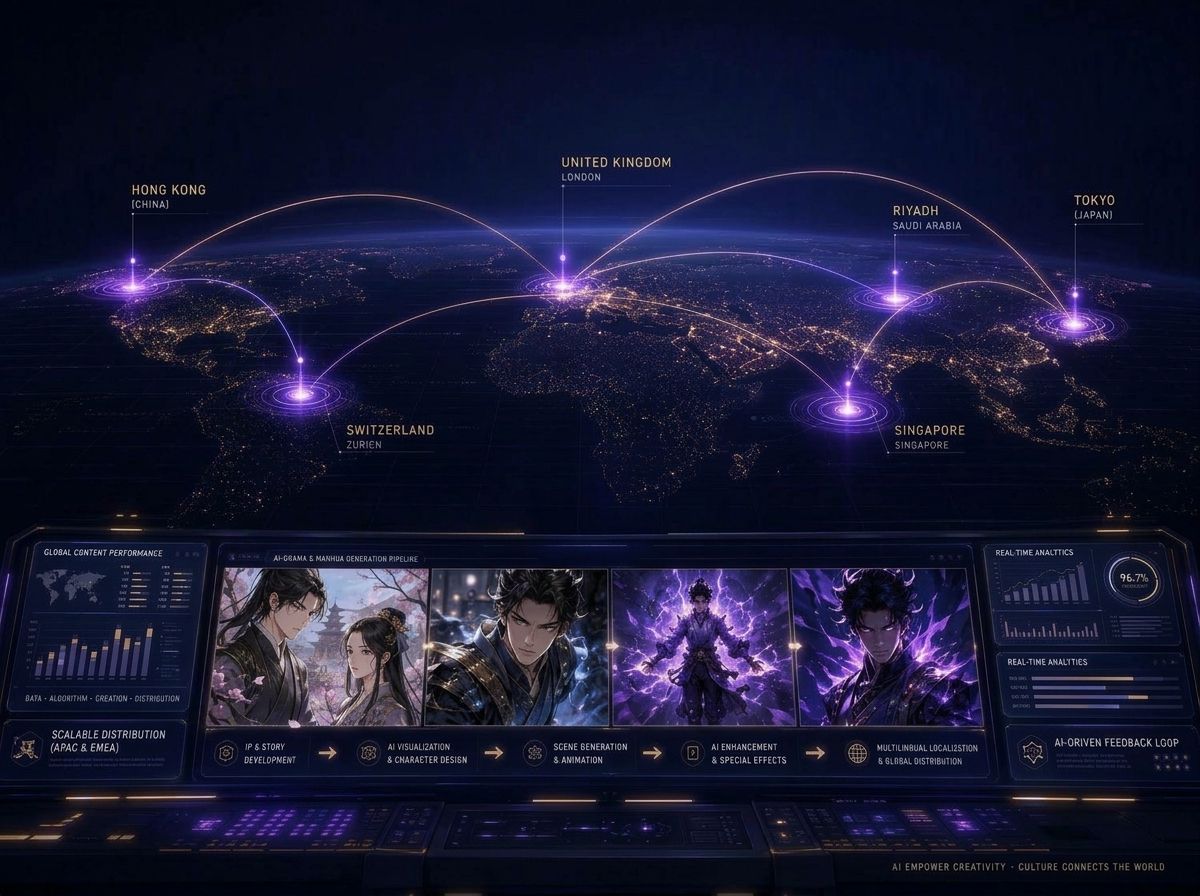
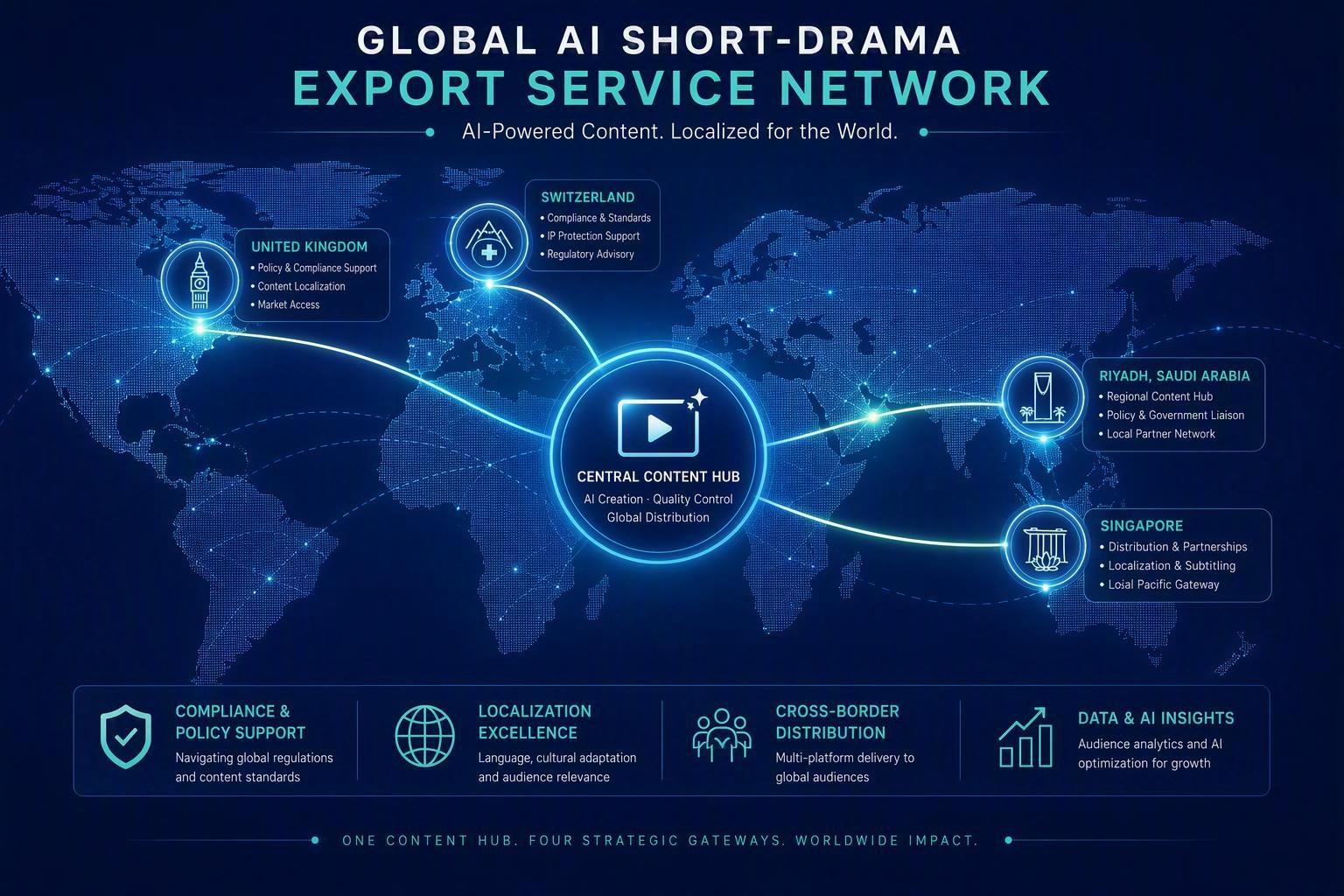
At the 2026 AI+ micro-short-drama going-global industry promotion conference, Lingang formally unveiled its AI+ micro-short-drama overseas service station, per coverage of the event. The first wave of four overseas outposts was switched on in Saudi Arabia’s Riyadh, Singapore, the UK, and Switzerland. Those four points are not chosen at random: Singapore anchors the SEA distribution corridor and a major free-trade hub, the UK and Switzerland sit inside more stringent European data and content regimes, and Riyadh is where Gulf-funded media expansion is concentrating. The station’s stated job is two-sided — compliance and policy navigation on the one hand, and localization and content co-creation on the other — essentially an institutional answer to the two reasons most Chinese AI-drama exporters stall before they launch.
Three digital-culture companies signed into the new area at the same event. The one most relevant to AI-media readers is Shanghai Xintiance Digital Technology, whose leadership said at the conference it will double down on overseas expansion of its DeepDrama AI-video platform and on AIGC interactive film-game and AI film-TV formats. DeepDrama is described in its own launch coverage as a one-stop AI video platform — script, character, storyboard, dynamic footage, voice and score — aimed at continuous-narrative production, with Russian, English and Spanish versions and a “multilingual inference” architecture built for cross-border crews. Framing it as “three companies signed with an AI platform among them” understates what is happening: an AI whole-pipeline tool is being pulled into a state-subsidized export lane.
The policy firepower behind the lane is real. In the same week, the president of Shanghai’s online audio-visual association cited the US$1.27 billion H1 overseas IAP figure as the context for why this matters. And Lingang’s digital-culture export package offers up to RMB10 million in support for qualifying overseas-facing projects — a signal to studios that the cost of going global is now partly a state-funded line item, not fully on their books.
Short-form broke the cost curve; prime-time validates the format
Underneath the export push sits a content breakthrough that no longer belongs to mobile rails. On August 31, 2026, Beyond Wukong — China’s first fully AIGC long-form drama — aired in the evening prime-time slot on Hunan Satellite TV and streamed on Mango TV, making it the first AI-generated series to reach a conventional broadcast channel. The run is planned as a 30-episode, roughly 40-minutes-per-episode fantasy serial, and broadcasters committed prime real estate to it — the clearest institutional signal yet that AIGC can hold long-form continuity at a professional standard.
Why this belongs in an “overseas going-global” story: every export hit eventually needs to prove it can be more than a mobile micro-drama, because mid- and high-tier markets monetize long-form and licensed IP differently. Its creators reported production times and costs a fraction of comparable live action — figures that, like the economic shorthand below, are best read as directional rather than audited. The strategic point for decision-makers is the same one that lifted the earlier deep read on this milestone: a fully synthetic drama has crossed into mainstream broadcast, which resets what “China IP for export” can be priced as.

Separating real model capability from investment shorthand
The most commonly repeated line in this trend — “three people, seven days, ten languages,” built on a claim that a roughly RMB3,000 core can transfer-render a 50-episode serial at an ROI of about 1.2–1.3 with a 60-day payback — is best treated as industry shorthand, not an audited standard. No single authoritative, methodology-transparent source sits behind that exact bundle. What the underlying stream of conference and media reporting does support is more modest and more useful: AI micro-drama per-minute costs have collapsed, and a small experienced crew can now turn around a full multi-lingual series in one to two weeks at a fraction of live-action budgets. The specific ROI and payback numbers, however, depend entirely on distribution, acquisition cost, paywall conversion, and language-market mix — none of which a rendering cost alone can guarantee.
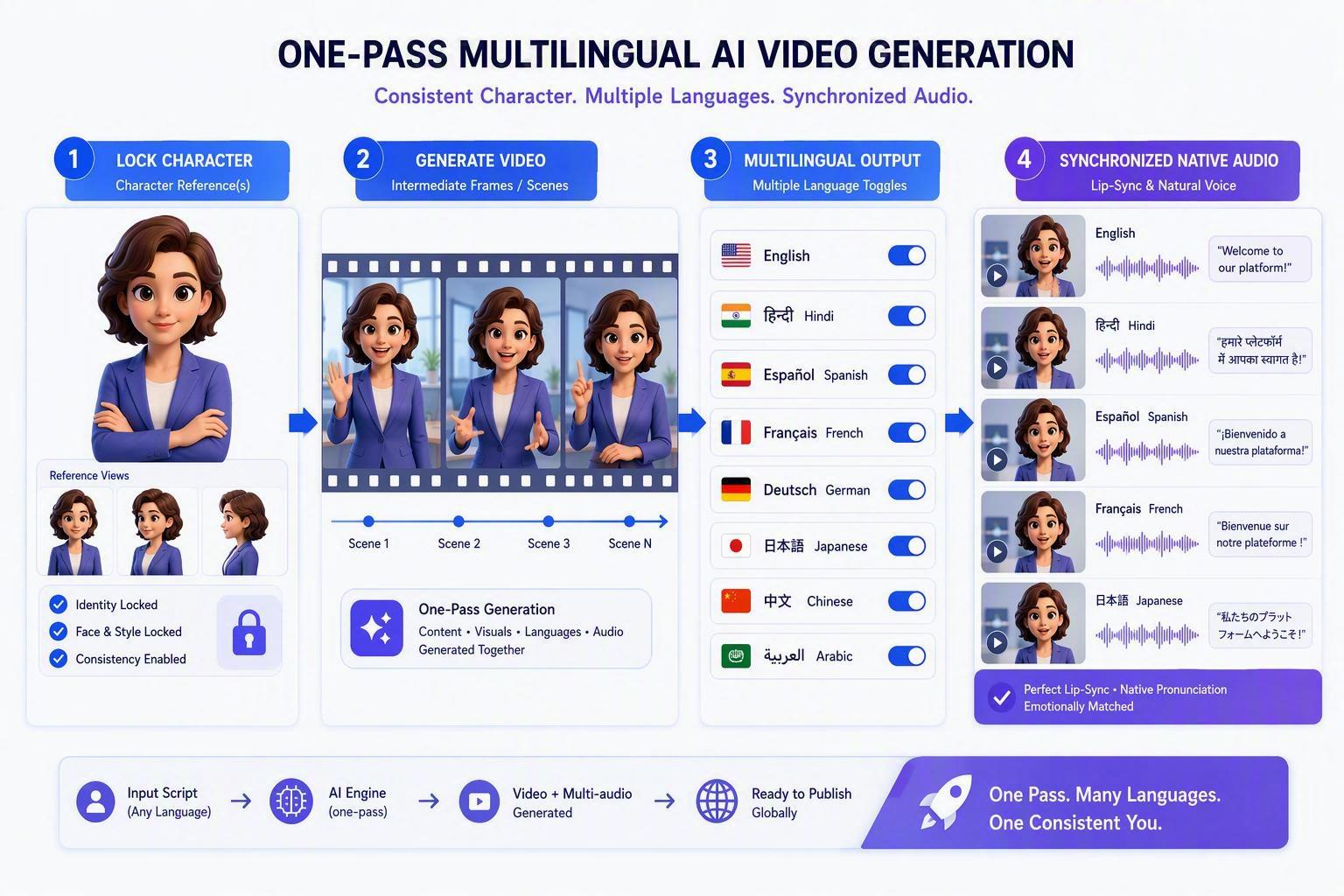
What is genuine product capability here is the underlying Seedance 2.5 model family, now argued repeatedly as the workhorse of this pipeline. Seedance 2.5 natively generates single-pass shots up to 30 seconds, ingests up to 50 multimodal references (images, video, audio) to keep characters and sets consistent, and — the part that makes “ten languages” credible at the render stage — produces synchronized native audio with lip-sync and supports 10+ languages in a single generation flow. That last capability is exactly why multilingual export no longer requires a dubbing studio per market. The multibillion-dollar market estimate sits on top of real, checkable tooling improvements, not vapor.
Differentiation beyond volume: premium, IP, and interactive
Volume alone is no longer a moat. Once a three-person crew can render a series in days, the market floods with undifferentiated content, and the value migrates to distribution, IP, and formats that can’t be cloned with one prompt. September’s operators illustrate the three escape routes.
FizzDragon, the Singapore-based AIGC studio platform, is pushing interactive film-games and interactive drama — a format where the viewer’s choices shape the narrative and monetization doesn’t depend solely on per-episode unlocks. Its product positioning points at interactive, first-person, personalized story experiences delivered globally rather than a simple vertical-drama feed.
Loomi Entertainment Group is pursuing the lower-tech but higher-margin playbook of deep overseas market operation — building the distribution, payment, and repeat-audience infrastructure in specific regions rather than shipping one-off titles.
Yuguangchen has staked out the least obvious position: an AI-talent incubation and industry-academia-research model, turning commercial production experience into curricula and agent tooling, and aiming to export that training system. In a market where talent availability, not model access, is becoming the binding constraint, the talent-enablement play is a defensible bet.
Three different strategies, one shared diagnosis: the moat has moved from “who can generate content cheaply” to “who can own the format, the region, or the talent that the cheap content runs on.” That is the premium-ization and IP-ization the industry keeps citing, and it is now visible in actual company roadmaps.
What production teams should actually do now
If you run a studio, an ad agency scaling content, or a vertical-drama platform thinking about overseas, the practical reading of September 2026 comes down to four moves.
- Treat compliance and localization as product features, not afterthoughts. The rise of dedicated export stations exists precisely because cross-border data rules, AI-content labeling, and portrait/likeness rights now gate a launch. Whatever the regional target, budget governance and local-context work as early as script stage.
- Model your economics on verified capability, not the “seven-day, ten-language” slogan. Real edge lives in the pipeline discipline of character/set consistency and multi-language native audio — capabilities you can benchmark directly against the current model generation — not in a return figure someone else quoted at a summit.
- Pick a moat: format, region, or talent. The space is wide open across interactive film-games, deep regional operation, and talent/education enablement. Volume production without one of these will face brutal margin compression as the render supply curve flattens.
- Watch broadcast-adjacent IP economics. AIGC’s arrival in prime-time resets how Chinese mythology and folklore IP can be priced and licensed for overseas — a lever that mid-tier markets are not yet fully pricing in.
The gap between what is verifiable and what is being marketed in this trend is large, and it is the most honest lens through which to plan. The market size, the institutional export channel, the tooling capability, and the broadcast validation are all real and checkable. The headline ROI math is not yet. Teams that build on the first four — and treat the fifth as a model to validate with their own distribution and conversion data — are the ones positioned to ride the globalization of AI short drama without being burned by its hype.
Market and policy figures in this digest were cross-checked against DataEye reporting via 36Kr, Lingang conference coverage, and vendor announcements as of September 5, 2026. Market-size estimates vary by scope and methodology, and the RMB3,000 / ROI figures remain unaudited industry shorthand — verify current numbers against the linked primary sources before committing a slate or a budget.