
AI Media Pulse: It’s Not One Chatbot Anymore — September 5, 2026
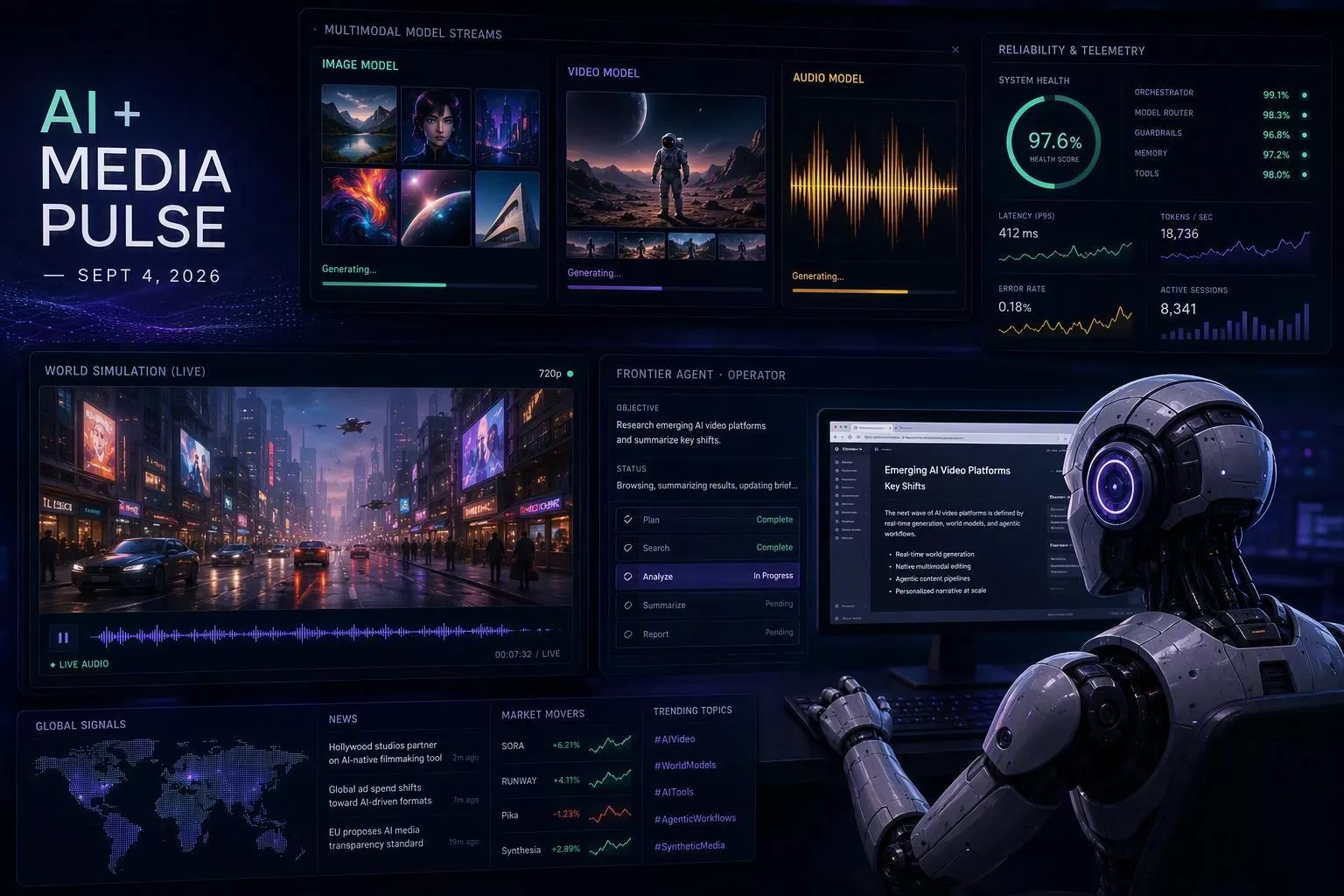
The thing about this week’s AI media conversation is that it isn’t about a new hashtag going viral. There is no single flashy model stealing the feed. Instead, the people actually building with this stuff are circling a set of maturing operational questions: which tool does the job, what do you lose by betting on one vendor, how long a story can one generation hold, and what an image is actually worth. Read through the noise and a through-line appears: the prize has moved off the single magic model and onto the stack — the right model for each step, routed together.
Below is an operator’s digest of the week’s more useful threads. Each theme follows the same shape: what happened, why it matters, and what to watch. Confirmed releases and benchmarks are kept separate from quality-and-taste opinions, because that line matters when you’re wiring any of this into a delivery pipeline.
A sourcing note before you read on: this is written from the viewpoint of the people who build media pipelines for a living, and each claim links to a primary or reputable source where one exists. Where a number is a benchmark score, a third-party estimate, or a vendor’s own spec rather than a verified release, it is flagged in the line — treat those figures as directional, not gospel. Model availability, pricing, and capability shift weekly in this market, so confirm the current state with the vendor before you commit a pipeline to it.
Assemble a stack, not a single chatbot
What happened
The mainstream push has shifted from “which chatbot is best” to “pick the right tool per job.” The clearest current reference point is OpenAI’s GPT-6 Astra, released September 3 and pitched less as a chat model than as a computer-use and agentic-work flagship — able to operate software the way a person does across browsers, spreadsheets and terminals. Independent write-ups note its 1.05M-token context, OSWorld 2.0 score around 72.6%, and a higher price tier ($10/$50 per million input/output tokens), with OpenAI gating the most capable cyber abilities behind a stricter “Critical” access threshold.
Alongside that, the recurring guidance across 2026 model guides is that no single model wins everything. A common split: Claude-family models for deep coding and long agentic runs, OpenAI’s agent stack for orchestration and computer use, Gemini for long-context research, and Perplexity for source-grounded search and synthesis.
Why it matters
For a media team, the parallel is uncomfortable but unavoidable: you probably shouldn’t be running all of your image, video, and audio work through one model, either. The teams that ship reliably in 2026 are the ones that treat model choice like a routing decision — which generator holds a character’s face, which holds a product’s physics, which wins on cost per second, which renders text cleanly. That is exactly the same discipline as “don’t use one chatbot for every coding job,” just extended to the media stack.
What to watch
- Whether the Astra price-to-capability ratio holds on real volume, not benchmark demos.
- Whether “router-first” thinking crosses from developer tools into media pipelines.
- Which creators standardize a repeatable multi-model path rather than a single tool.
Reliability, and the single-vendor lock-in lesson
What happened
On September 3, several of the biggest names went dark in the same window — ChatGPT and Codex, Claude, and Grok, with Gemini seeing elevated user reports. Coverage from 9to5Google and others tracked a morning that mostly cleared by early afternoon. The notable detail for anyone building pipelines: no single shared root cause was confirmed. OpenAI attributed ChatGPT/Codex to a routing error of roughly 34 minutes; Anthropic said a Claude infrastructure issue resolved after a little over three hours; and SpaceXAI blamed its Memphis compute center for the Grok outage. Speculation about a common cloud or DNS trigger stayed exactly that — unconfirmed.
Why it matters
Whether or not one root cause existed, the operational lesson is the same: if your render pipeline, A/B test, or delivery deadline sits behind a single inference vendor, you now have a documented day you don’t want to repeat. The cost isn’t just the chat outage, it’s the batch job that stalls and the API contract that goes silent mid-task.
What to watch
- Whether providers get more transparent about root causes — asymmetry in disclosure is itself a signal.
- How quickly “multi-provider resilience” joins quality and price as a procurement criterion.
- Whether shared compute relationships between labs concentrate or spread single points of failure.
The 30-second unit gets a native build
What happened
The story-length ceiling for a single generation keeps rising. ByteDance’s Seedance 2.5 (generally available since late July) generates native 30-second clips in a single pass — no stitching short shots together — with synchronized audio, multi-shot narrative coherence, and support for text-to-video, image-to-video, and video-to-video workflows across up to roughly 50 multimodal references. Several hosts (fal, Replicate, and others) list it as a live 30-second, T2V/I2V/V2V model.
Why it matters
Thirty seconds is a meaningful production threshold. It’s long enough for one complete narrative arc — setup, pressure, a turn, a cliffhanger at around the 24–30 second mark — which is squarely where micro-drama, product moments, and social storytelling live. When a model can hold one coherent 30-second unit natively, the content-building block changes: teams can plan around a full beat-packed shot instead of stitching and re-stitching five-second fragments and hoping the character doesn’t drift.
What to watch
- Whether character and scene consistency holds across the full 30 seconds at volume, not just on demos.
- How multi-round extension turns a single 30-second unit into longer sequences without losing identity.
- Whether “one coherent take” becomes a category you can standardize into reusable templates.
Image generation gets a cost conversation
What happened
The economics of still-image generation are maturing into per-unit numbers teams can actually budget around. Third-party comparisons, such as fal’s GPT Image 2 vs Nano Banana 2 breakdown, lay out the split: GPT Image 2 is token-billed and can reach roughly $0.21 for a high-quality 1024px image, while Nano Banana 2’s pricing is a flatter per-resolution model — around $0.045–$0.067 for common sizes and up to roughly $0.15 at 4K. Nano Banana Pro sits in between at around $0.039 (1K) to $0.24 (4K).
Why it matters
Image cost used to be negligible enough to ignore. As teams route thousands of frames through pipelines, the delta between a $0.05 image and a $0.21 image becomes a line item — and it shifts which model you reach for based on the job. For keyframes, moodboards, and bulk thumbnail work, cost per image and speed dominate; for hero shots where text has to render cleanly, higher per-image spend can still be the right call. The useful discipline is picking by unit economics, not by which model had the nicer demo.
What to watch
- Whether the per-image price tiers hold once traffic lands on the APIs at real volume.
- Whether “text-in-image fidelity” stays the premium that justifies the more expensive tier.
- How transparent per-image pricing becomes a default when you compare across providers.
Quality and originality get gatekept
What happened
The most opinionated thread this week isn’t really about output — it’s about reception. In 2026, assessments of AI motion and video keep reaching the same honest conclusion: short clips look strong, but coherence and control degrade past a threshold, and the industry increasingly treats AI models as “shot generators” rather than complete story makers until a human pass fixes timing, physics and narrative. Alongside that sits a loud originality backlash. Reporting on AI “slop” and on player/creator reactions to AI-looking in-game and cover art shows audiences docking points for visuals that read as generic, derivative, or AI-flavored.
The other pole is worth naming: X’s Grok Imagine Odyssey contest put $175,000 — $100k / $50k / $25k — behind asking creators to build a scene from Homer’s The Odyssey entirely with one tool’s video, image, and voice capabilities (other tools restricted to editing, music and sound). That’s a single-suite bet, at the opposite end of the spectrum from “choose the best model per job.”
Why it matters
Here’s the tension operators have to hold: model capability is racing ahead, but the gatekeeping — from platform policy, from audiences, from the “AI slop” reflex — hasn’t moved at the same speed. A technically impressive 30-second clip can still get docked for looking like everyone else’s. And as the broader discussion around AI thumbnails and original artwork shows, originality and craft are becoming a quality metric all their own, separate from resolution or prompt-following.
What to watch
- Where the line sits between “AI-assisted craft” and “reads as AI slop” for your specific channel and audience.
- Whether platform monetization rules keep tightening against mass, low-effort AI output.
- Whether “motion-design-grade control” becomes the differentiator that separates premium AI content from the generic feed.
The synthesis: steer many models, don’t bet on one
Across all of this week’s threads, no single winner emerges — and that’s the point. One vendor’s compute can wobble, one image model wins on cost while another wins on fidelity, one video model holds narrative while another is faster. The teams that trend reliably are the ones building a stack that can swap the best model per job without rebuilding the pipeline around it. That’s also the quieter trend behind the movement from one-chatbot thinking to stack thinking in media: value has moved to the routing layer that keeps the strongest model per use case reachable, observable, and exchangeable.
If you’re planning that kind of multimodal pipeline, the practical first step is unglamorous: get the per-step costs and capability ceilings onto one page so the routing questions above become answerable. A catalog that lists models and unit pricing side by side — such as the one Modellix maintains across image, video, and audio — is a decent shortcut for exactly that comparison if you’re weighing options anyway.
This digest reflects releases, outages, and pricing as reported on September 5, 2026. Benchmark scores, per-image prices, and contest terms shift frequently — re-check the linked primary sources before locking a pipeline or a budget to any figure here.