AI short drama goes global: India & Indonesia are setting the new pace
For most of 2025 and early 2026, the conversation about AI-generated drama centered on China — near-total AI adoption in its short-drama sector and industry-first long-form shows on national TV. A flood of news on and around September 4, 2026 signals that the next chapter is being written elsewhere. In the span of a single week, India’s biggest audio-platform parent relaunched its short-drama product as an AI-animated play, a consultancy published a serious forecast for the country’s micro-drama ad market, and Flipkart shipped a micro-drama tab inside its shopping app. In Indonesia, a studio premiered what it bills as the country’s first fully AI-produced epic, spanning 57 episodes.
Read together, these moves are less about any single launch and more about a structural shift: AI drama is moving from experimentation into industrialized, market-sized production in fast-growing emerging markets. For teams producing multimedia content at scale, the pattern to watch is not just the volume — it is the economics and the toolchain decisions underneath.
A telling pivot: Pocket FM drops Pocket TV, relaunches as animated Pocket Saga
The sharpest optics come from India’s audio-series leader. Two months after it shuttered its microdrama app Pocket TV, parent Pocket Entertainment is back in the format with a new platform called Pocket Saga.
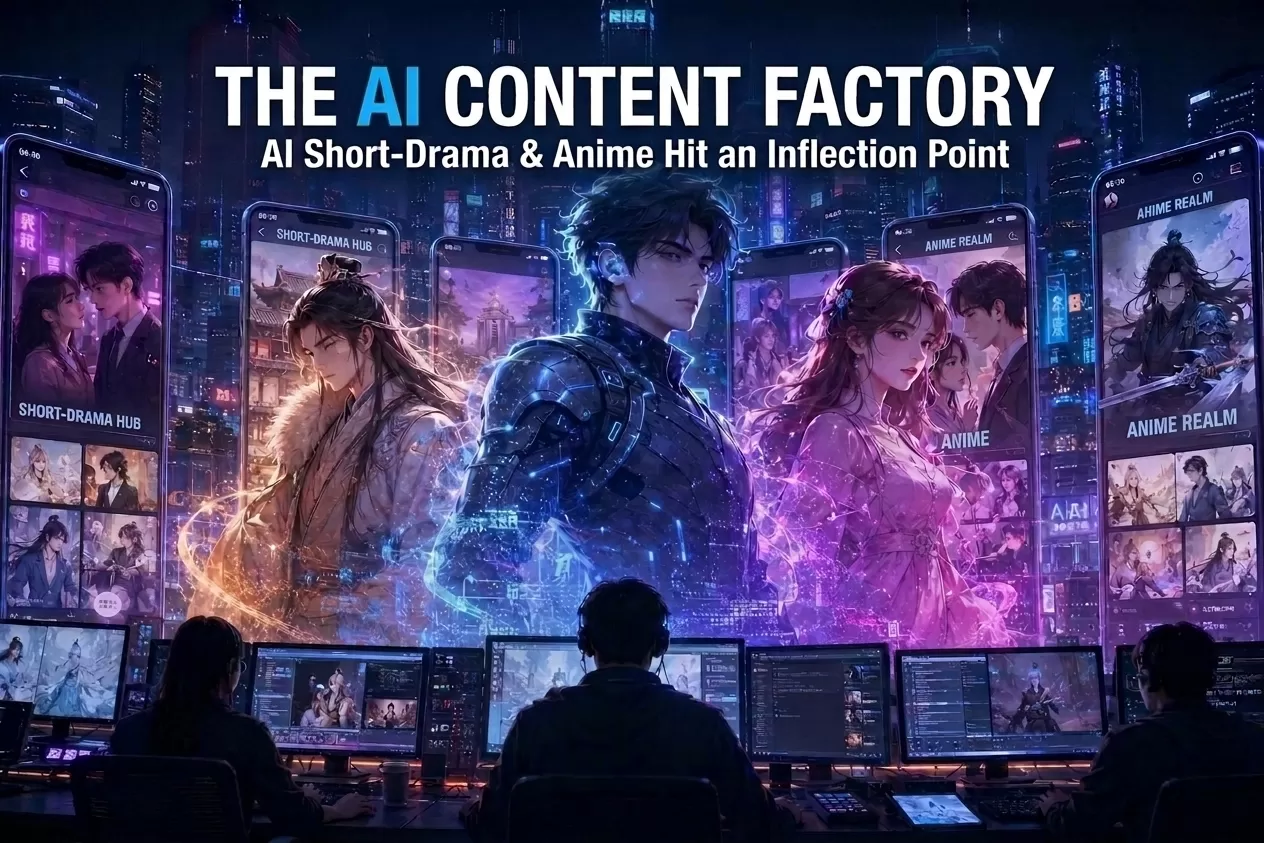
When it closed Pocket TV, CEO Rohan Nayak reportedly framed the app as a “product experiment” whose economics “were not quite what they are made out to be.” Pocket Saga reads as the course-corrected answer. Rather than license live-action microdramas, it is a revamped version of Pocket Toons — the company’s AI-first comics app, launched alongside its “Blaze” AI studio in February 2025 — re-positioned as a short-series platform offering animated shorts, including anime and AI-generated video adaptations of the company’s existing audio stories. Genres span fantasy, romance, action, mystery, and thriller, monetized through the familiar micropayment model of coin-gated episode unlocks.
The strategic signal here is direct: a large audio-content owner is choosing to retell its massive library as AI-generated video rather than produce live action. That is a repeatable, cost-optimizing move for any studio sitting on a deep catalog. It is also worth noting that Pocket Entertainment has not publicly confirmed which generation stack powers the platform — a reminder that, more and more, the model vendor is treated as a competitive secret.
The market math behind the rush: Redseer’s FY32 India forecast
A day after the Pocket Saga reports, consultancy Redseer published a monetization report on India’s micro-drama market that helps explain why platforms are willing to iterate. Two numbers matter most.
First, the market is still early but enormous in reach: Redseer pegs the addressable paid base at roughly 250–280 million users, against only about 15–17 million who currently pay monthly. Second, it forecasts a dramatic monetization flip — advertising (AVOD) revenue climbing from around ₹24 crore in FY26 toward ₹5,000–5,500 crore by FY32, with AVOD daily active users expanding roughly 8× to 140–150 million. The Economic Times’ coverage of the same data frames a total micro-drama market heading toward ₹23,500–25,500 crore by FY32.
The takeaway for production teams is straightforward: the near-term monetization engine in India will not be subscriptions alone. It will be ad-supported viewing at very large scale — a model that rewards volume, consistency, and low marginal cost per episode. Those are precisely the conditions under which AI production becomes economically decisive.
Commerce meets entertainment: Flipkart’s Play-tab micro-dramas
The most unusual entrant is not a streaming company at all. Flipkart launched a micro-drama section inside its core shopping app, adding a “Play” tab with Explore and Drama feeds. Partners include Terribly Tiny Tales, Pratilipi, and content from Pinkvilla, the entertainment outlet Flipkart took a majority stake in during September 2025. Industry coverage frames the play as an engagement and commerce move — layering product placement and brand integration inside storylines to turn short-form drama into a soft advertising channel on top of an existing high-traffic app.
It is not a coincidence that this commerce-native bet sits alongside an earlier AI-visual acquisition. Flipkart announced a majority stake in Minivet AI in December 2025, an AI startup focused on automated, low-cost product-video generation for e-commerce (its foundational models were never disclosed). Slotted together, the signals form a coherent hypothesis: an e-commerce giant wants cheap, generated visual content — both product creative and drama — feeding a large, engaged app audience. For agencies and studios, this is a preview of content-to-commerce convergence in a market where retail reach and entertainment are colliding.
Indonesia’s Jaka Tingkir Saga: from AI animation to a 57-episode AI epic
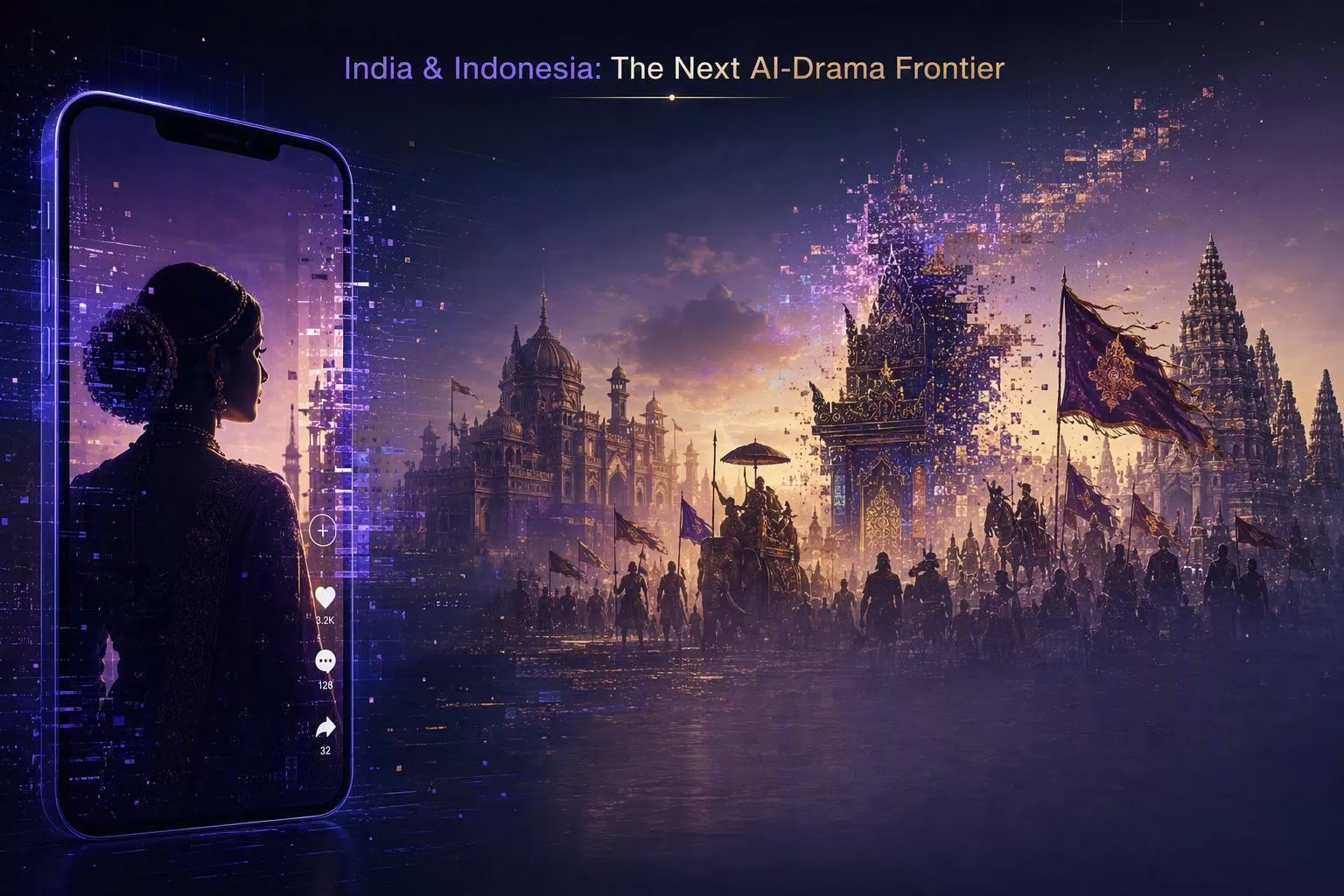
South of India, Indonesian studio Kampanye AI premiered Jaka Tingkir Saga: Bengawan Sore on September 3, 2026 — billing it as the country’s first 100% AI-produced epic, a 57-episode retelling of the Jaka Tingkir legend and the Pajang–Jipang conflict. Production reports emphasize that there was no physical filming: no sets, no locations, no hired extras. The visuals were generated from scripts, director direction, and thousands of carefully engineered prompts; established actors such as Dian Sidik and Adelia Rasya are “re-created/presented” through the AI pipeline. Distribution runs through the vertical-drama platform Dynasty Shorts, where lead figures overlap: Choky Andriano is CEO of Kampanye AI, and Andi Sultan leads both the studio and Dynasty Shorts.
Indonesia is not new to AI dramatization — broadcaster TRANS7 aired the country’s first fully AI-animated series, Legenda Bertuah, in January 2026. What is different about Jaka Tingkir Saga is scope and format: a 57-episode historical epic is a much heavier continuity and consistency challenge than a short animated slot. That a small studio publicly commits to that scale speaks to how far character and scene consistency have come in consumer-grade generation — and also to how visible the “first AI epic” marketing halo can be.
One detail is worth flagging for anyone evaluating production options: like its Indian counterparts, the studio has not disclosed which base video models it used. Reports say only that output was prompt-driven at scale.

The quiet model war under all of it
Across these launches, one question keeps surfacing: which model stack actually makes 57-episode AI epics and AI-animated short drama possible? The market’s loudest answer so far has been multi-model.
Consider VerSe Innovation’s SparkStation, the content-operating-system play from the parent of Dailyhunt and Josh. SparkStation markets itself as explicitly model-agnostic: an orchestration layer that routes discrete tasks — creating a face, camera movement, a voice, costume continuity — to whichever model suits each job, and reports cost drops like producing a 60-second brand film for a small fraction of its traditional price. Coverage of its launch at Film Expo 2026 (via IndianTelevision) frames it as a single pipeline covering ideation through script, storyboard, casting, music, dialogue, editing, rendering, ad formats, and distribution in 60-plus languages.
The reason this approach keeps recurring is practical. No single video model is best at every step: realism, motion control, dialogue and lip-sync, character consistency, and per-minute cost each favor different models in current benchmarks (Veo, Kling, Seedance, Wan, and others are the names that cycle through these comparisons, though SparkStation’s own integration list is not publicly enumerated). A production house betting its entire catalog on one vendor inherits that vendor’s ceiling and its pricing volatility. Hence the two strategies visible in the market: model-agnostic orchestration (VerSe), and keeping the toolchain proprietary (Pocket, Kampanye AI). Both treat model choice as strategic leverage, not a default.

What this means for production teams
Strip the novelty away and these September developments share a through-line: AI drama in India and Indonesia is being built for scale, ads, and commerce — not for viral one-offs. The practical implications for studios and agencies are concrete.
- Design for ad-supported, high-volume economics. Redseer’s AVOD forecast and Flipkart’s content-to-commerce model both reward cheap, consistent, high-volume output. Optimize pipelines for predictable per-episode cost, not just aesthetic ceiling.
- Resist single-vendor lock-in. Pocket, Kampanye, and Flipkart/Minivet all keep their stacks close. Whether you buy into one model or orchestrate several, budget for switching and for the day a vendor changes pricing or behavior.
- Turn existing catalogs into new formats. Pocket Saga’s core bet is adapting an owned audio library into AI video. The lowest-risk AI production move is often one you already own the rights to.
- Expect the “AI look” bar to keep rising. An epic that solves character and set consistency across 57 episodes, plus continuity tooling like SparkStation’s, is rapidly eroding the old excuses about AI output quality. Treat consistency engineering as a first-class capability, not a nice-to-have.
The AI-drama story has clearly left China’s borders. Between India’s market-scale economics and Indonesia’s ambition to own the “first 100% AI epic” moment, the region is now where the production strategies that most teams will copy over the coming year are being shaped. If you are evaluating how to route these workloads without betting your whole pipeline on a single generation vendor, a unified gateway that lets you call and compare multiple leading models through one interface — such as Modellix models — is a reasonable place to start your own tests.
Data in this digest was compiled on September 4, 2026 from publicly available sources including Moneycontrol, Redseer, Economic Times, Entrackr, IndianTelevision, Suara, and industry reports. All figures are subject to revision as full-year data becomes available.