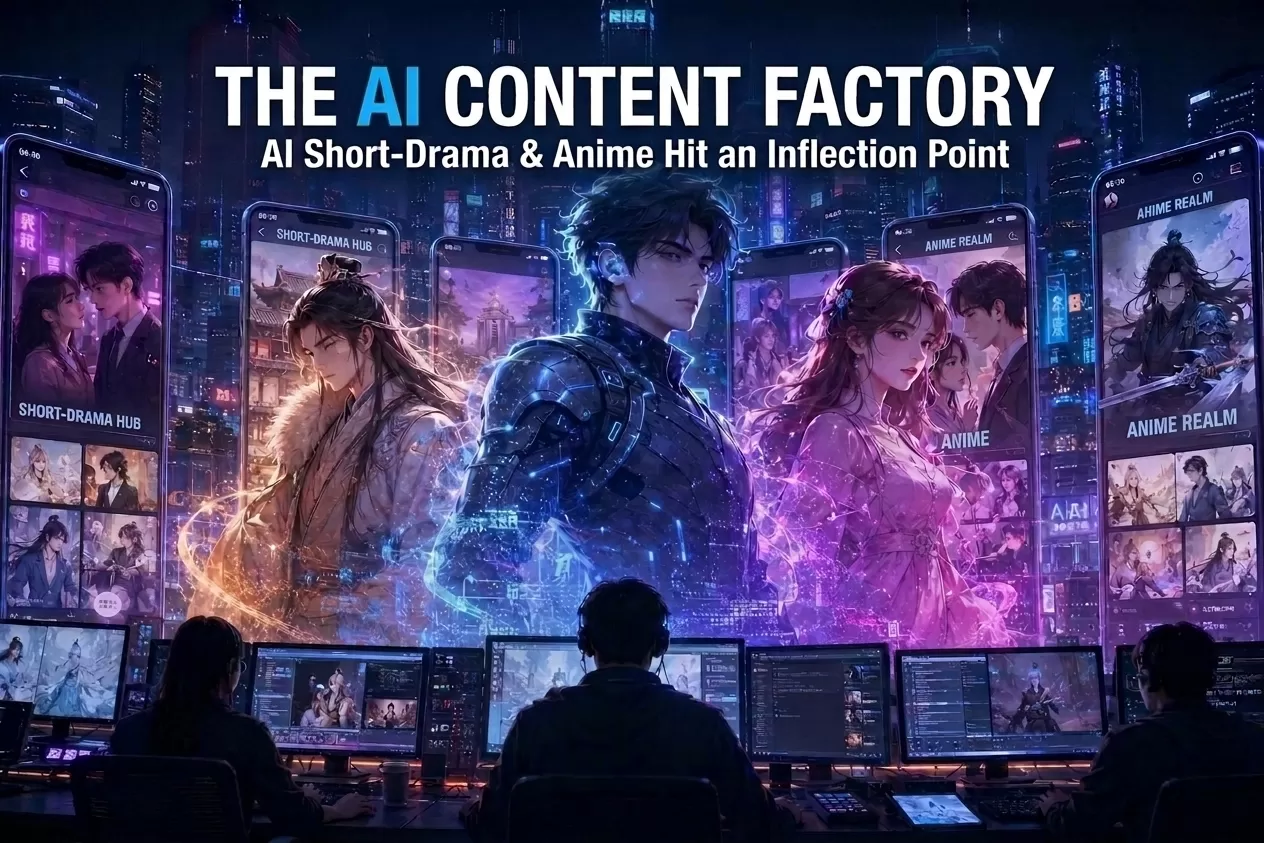
The AI short-drama & AI anime industry just crossed an inflection point
Two years ago, “AI-generated short drama” was a novelty experiment. By the first half of 2026, it became the default production method of an entire industry. The shift is not one market’s story anymore — it is a global one, moving through China, Korea, India, and Southeast Asia at the same time, and it is changing who can produce video, at what cost, and at what risk.
This is a digest of the signals that landed on September 1, 2026, and what they mean for the studios, platforms, and creative teams now operating in this market.

The 95% AI threshold: production costs just collapsed
The single most important number is the one that caught global attention this week. According to estimates published by the China Netcasting Services Association (2026), roughly 128,000 micro-dramas were released in China in the first quarter of 2026, with more than 95% AI-generated — about 122,000 titles, against almost zero a year earlier, as CNBC’s August report summarized.
Industrial scale followed almost immediately. By January 2026, Chinese platforms were launching around 470 AI short-drama titles per day; by March, roughly 50,000 AI-native episodes hit Douyin in a single month, according to industry data platform DataEye. The top of the charts confirm the shift: in May 2026, 89 of the top 100 anime and drama titles on Douyin were AI-generated human-like dramas, per DataEye’s May ranking.
AI anime — animated comic-drama shot and rendered entirely by generative models — is now a mainstream category of its own. DataEye’s data shows AI-simulated live-action anime climbing from 7% to 38% of the top-100 anime titles between January 2025 and January 2026, in a market the official Xinhua news agency sized at roughly 16.8 billion yuan (about $2.4 billion) in 2025.
The cost math is the real story. Advanced models cut production time for a short drama to under five days at roughly 10% of traditional cost, per Caixin’s reporting. When a pilot episode that once cost tens of thousands of dollars drops by an order of magnitude, the economics of the whole format change overnight.
That is exactly what the global media scrutiny picked up on. A Financial Times feature on Chinese actors being written out of dramas by AI doubles was followed by coverage in Korea’s Chosun Ilbo, the Philippine Star, Japan’s Gigazine, and Korea’s WowTV — aggregation of which appears in Gigazine’s English summary. The trigger for the coverage is not just the volume — it is the actor unemployment inflection. Live-action crews and actors, who rode the short-drama boom, are now finding work scarce as studios default to AI production.
Key Takeaway: The industry did not adopt AI as an assistive tool; it replaced live-action as the default method. Anyone building a 2027 pipeline is planning against AI-first production economics, not traditional ones.
The oversupply problem: volume alone no longer wins
What the 95% figure hides is that most of those titles don’t succeed. The economics of AI production created a flood, and the flood raised the bar for breaking out. Industry estimates cited by The Paper suggest roughly one in every 77 new AI short dramas breaks even, and only about 0.48% of new AI titles in H1 2026 exceeded 100 million views, as covered by Our China Story.
The strategic implication cuts against the instinct to “produce more, cheaper.” When everyone can produce cheaply, cost stops being a moat. What still separates winners:
- Differentiation in story and craft, not just volume
- Consistent character and world continuity across many episodes (the weakest point of early AI output)
- Targeted distribution and monetization rather than spray-and-pray release
In an oversupplied market, the defensible edge shifts from “we can make more” to “we can make it well, consistently, and get it in front of the right audience.”
Korea enters the fray: Showbox launches Showbite
The first-mover advantage in AI short drama belonged to China, but the incumbents elsewhere are moving. Korea’s Showbox — the studio behind box-office hits like The King’s Warden — launched a dedicated microdrama label, Showbite, rolling out original short-form content from September 2026 across romance, comedy, revenge, action-thriller, period drama, fantasy, mystery, and horror (Variety, September 1).
Showbite explicitly targets international audiences, and it is no longer a side experiment. It follows Showbox’s earlier co-production deal with ReelShort (announced in June), and the label is expected to surface at the Asian Contents & Film Market during the Busan International Film Festival. The message is unmistakable: a traditional film heavyweight treating vertical drama — and AI-driven economics — as a serious, global category.
For regional players, it signals that the barrier to entering short drama is no longer access to live-action production; it is access to an efficient, scalable pipeline and the taste to run it.

India builds its own pipeline: the Dwarka Project
Diffusion is happening fastest in markets building sovereign AI production capacity rather than importing it. India’s BULLET Microdrama, backed by ZEE Entertainment, unveiled the trailer for The Dwarka Project at Anime India on August 31 — described as India’s first AI-led anime feature, a 100-minute sci-fi film set in 2166, created entirely on Trinetra AI, BULLET’s in-house Indian filmmaking platform.
The significance is not the movie itself. It is that an emerging market with a huge, price-sensitive audience built an end-to-end AI anime pipeline locally, rather than renting one. China proved the model; India is proving it can be localized and owned, which has direct implications for cost, cultural fit, and content compliance in markets with their own regulatory and linguistic constraints.

Production goes industrial: Qwen-Creative’s Agent Teams
The most telling product-level signal this week came from Alibaba’s Qwen-Creative, which launched Agent Teams on August 31 — a multi-agent production workflow where specialized agents (screenwriter, director, artist, storyboard, cinematography, editor) collaborate from script to final cut, powered by the Wan 3.0 video model family.
The shift in framing matters more than the specific tool. Earlier AI video tools asked creators to write a single prompt and hope for a shot. Agent Teams treats production as a studio-like pipeline with repeatable roles — the same way teams have industrialized other media. It standardizes the chain from idea to scored, edited, delivered episode, which is precisely what makes mass production of a serialized drama or anime practical.
This is the direction the entire category is heading: from “generate a clip” to “operate a content factory.” Teams that want to stay competitive will increasingly be judged on how they orchestrate multiple models and agents into a repeatable pipeline, not on which single model they prompt.
Profitability arrives: ReelShort enters Indonesia and turns a profit
The commercial validation landed from ReelShort, the microdrama platform owned by Crazy Maple Studio (COL Group). On September 1 it entered Indonesia for the first time via a partnership with Vidio, bringing more than 200 titles with Indonesian dubbing through a dedicated short-drama tab, alongside local co-production and a skills exchange for Indonesian creative talent. It follows ReelShort’s earlier Southeast Asian pushes in Thailand and the Philippines.
On the financial side, Media Partners Asia projects ReelShort will reach about $1.05 billion in 2026 revenue, a 34% increase from 2025 (~$785 million), post its first meaningful net profit (~$40 million, after a ~$12 million loss in 2025), and hold roughly 29% of global short-drama revenue — ahead of DramaBox, DramaWave, NetShort, and GoodShort.
This is the point where a format stops looking like a hype cycle and starts looking like a mature business. When the category leader reaches billion-dollar scale and turns its first profit while expanding into a new geography, the economics stop being theoretical. Distribution is globalizing, and localization — dubbing, co-production, cultural fit — is becoming the competitive edge in new markets.
What this means for production teams
Taken together, the September 1 signals describe three simultaneous thresholds:
- A production-cost inflection — AI is now the default method of the world’s largest short-drama market.
- Industrialization and globalization — incumbents (Korea), sovereign pipelines (India), and global distribution (ReelShort in Indonesia) are all entering, which raises the stakes for quality and localization.
- A profitability maturation — the category leader is scaling and turning a profit, confirming the business model.
For studios and creative teams, four priorities follow:
- Differentiate on quality above volume. In a market where ~1 in 77 titles breaks even, consistency and craft beat output count.
- Treat production as a pipeline, not a single prompt. Multi-agent orchestration and multi-model routing are becoming table stakes.
- Factor in localization and compliance early. Korean, Indian, and Southeast Asian expansion reward teams that localize language, culture, and legal/portrait rights from the start.
- Watch the labor and regulation signal. Actor displacement in China is a leading indicator; expect scrutiny on AI-content labeling, copyright, and talent rights to tighten — build auditable, policy-compliant pipelines now.
The window where “AI short drama” was a curiosity has closed. What follows is an industrialized, globalized, and increasingly profitable — but crowded — market. The teams that treat it as a discipline, not a shortcut, are the ones that will still be standing when the next inflection arrives.
Data in this digest was compiled on September 1, 2026 from publicly available sources including CNBC, Financial Times, Variety, DataEye, Xinhua, Caixin, Deadline, and industry association reports. All figures are subject to revision as full-year data becomes available.