

Breakthroughs in Video Generation & Multi-Reference Consistency
Mainting visual and character consistency across multi-shot sequences has historically been the primary bottleneck in commercial AI video production. Recent updates focus squarely on multi-reference conditioning, first/last frame control, and consumer-grade rendering speed.

Multi-reference conditioning and face-locking controls are replacing pure prompt-to-video generators in commercial agency pipelines.
Open-Source Video Models & Local Hardware Execution
The release of Wan2GP (and the broader Wan AI ecosystem) highlights the growing viability of running AI video generation locally on modest hardware setups. By supporting first-frame and last-frame conditioning, Wan2GP enables creators to specify exact starting and ending visual anchors for short clips—such as tracking a moving vehicle through neon-lit streets—ensuring motion trajectories remain fluid without visual drift.
Character-Locking & Multi-Reference Conditioning
Multimodal updates from upcoming engines like SpaceXAI Imagine Omni address consistency head-on by integrating simultaneous facial, clothing, and audio conditioning. Creators can lock specific facial features (@face) alongside outfit references and voice inputs, allowing the same digital persona to move seamlessly across distinct background environments within a single workflow pass.
In parallel, commercial studios are pairing image engines with specialized video motion models:
- Seedance 2.0 and the upcoming Runway Seedance 2.5: By chaining GPT Image 2 or Midjourney reference frames into video diffusion pipelines, creators are producing contemporary dance and short film sequences with precise character persistence.
- Decart Lucy 2.5: Offers real-time video editing, scene reframing, and visual effects (VFX) replacement tailored for production environments.
- Vidu S1: Developed by a Tsinghua University research team, Vidu S1 delivers real-time interactive video generation driven by voice commands, achieving 540p resolution at 42 FPS on standard consumer GPUs.
- Google Vids & OpenAI Sora: Google Vids integrates Gemini-powered AI avatars to generate personalized presentation videos from a single selfie and audio file, while Sora and Kling Video continue to expand end-to-end cinematic text-to-video capabilities.
- TapNow Creative OS & Kreado AI: Streamline the end-to-end film pipeline from initial reference image ingestion to multi-avatar, multilingual final export.
Industry Observation: The core battleground in AI video has officially moved from raw frame fidelity to multi-point reference control. Tools that allow explicit first/last frame pinning and facial locking are rapidly replacing pure prompt-to-video generators in commercial agency pipelines.
Voice Cloning & Audio Economics: The Open-Source Shift
While video generation dominates visual headlines, voice synthesis and audio pipelines are experiencing an economic transformation driven by open-source releases and cost competition.
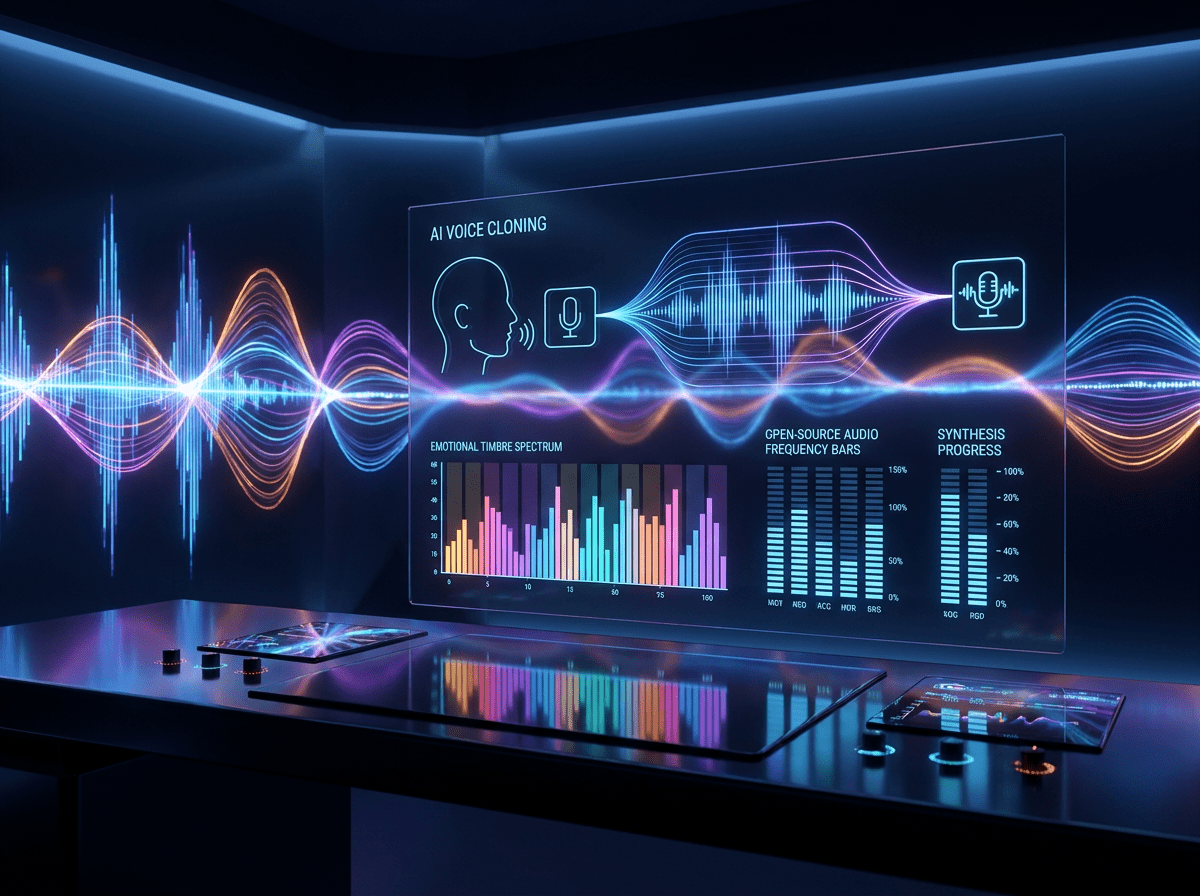
Open-source voice cloning engines are achieving parity in emotional nuance, driving production studios to re-evaluate proprietary API budgets.
High-Fidelity Voice Cloning at Scale
Fish Audio S2.1 Pro launched as an open-source voice cloning model requiring only five seconds of reference audio to replicate timbre and pitch. The engine introduces granular emotional control and cross-lingual translation—demonstrating smooth timbre retention when switching from Mandarin voice inputs to emotive English narration. Crucially, developers deploying Fish Audio report operational costs estimated at roughly one-sixth the cost of proprietary cloud APIs like ElevenLabs. This price differential is driving engineering teams to re-evaluate cloud audio API budgets and adopt self-hosted or open-source voice infrastructure.
Music & Sound FX Synthesis
The broader audio generation ecosystem continues to diversify:
- ACE-Step 1.5: Offers a free, open-source local UI for generating extended vocal and instrumental tracks, establishing a self-hosted alternative to proprietary music services.
- Suno & Udio: High-fidelity text-to-song platforms like Suno and Udio are expanding genre controls and vocal engine realism for rapid audio prototyping.
- WaveForge: Converts AI-generated audio tracks into cinematic music video concepts, bridging the gap between sound design and visual editing.
Industry Observation: Proprietary voice APIs are facing severe pricing pressure. As open-source voice cloning engines achieve parity in emotional nuance and zero-shot voice cloning, production studios are shifting high-volume localization work to open-source models to avoid API usage caps and scaling bottlenecks.
Photorealism, Voxel 3D & Privacy-First Local Inference
Underpinning both video and audio pipelines are steady advances in base image generation, 3D asset creation, and offline hardware execution.

The market bifurcates between photorealistic image generators for marketing assets and structured 3D procedural generators for virtual worlds.
Photorealism & Hand Precision
Community implementations of Midjourney v8.1 / v8.2 demonstrate noticeable gains in hyper-realistic lighting, skin textures, and hand anatomy. By resolving long-standing issues with finger counts and joint flex, Midjourney outputs are increasingly serving as pristine anchor frames for video motion pipelines.
Procedural 3D & Voxel Worlds
In 3D asset generation, Sakana AI in collaboration with NYU introduced Dream-Cubed, a generative model focused on Minecraft-style voxel structures. The engine proceduralizes 3D block generation from a single voxel into sprawling, interconnected cities, opening new avenues for rapid game design and virtual set creation.
Offline & Enterprise Privacy
Privacy concerns surrounding cloud-based data ingestion have fueled interest in offline AI solutions:
- ODS Local AI: Provides zero-cloud-dependency inference for image generation, text analysis, and voice processing, keeping intellectual property strictly within local hardware boundaries.
- Maginary.ai, Adobe Firefly & Stability AI: Continue pushing visual storytelling capabilities, offering prompt-driven multi-model generation with commercial safety frameworks.
Industry Observation: The coexistence of hyper-realistic image models (like Midjourney) and structured 3D procedural generators (like Dream-Cubed) reflects a bifurcated market: studios need photorealism for marketing assets, but require structured 3D geometry for virtual worlds and interactive media.
Scaling Multimodal Pipelines: The Infrastructure Solution
As media production teams combine disparate tools—using Midjourney for character design, Wan2GP or Runway for video motion, Fish Audio for narration, and Suno for background music—they encounter a formidable operational challenge: API fragmentation. Managing multiple vendor contracts, conflicting parameter formats, unaggregated call logs, and unpredictable usage costs quickly degrades engineering efficiency.
This is where unified API infrastructure becomes essential.
Modellix solves this fragmentation by offering a single, unified API gateway that connects developers and content studios directly to leading multimodal AI models across image, video, and audio generation. With transparent unit-cost pricing, real-time API call logging, and enterprise-grade cloud stability, Modellix enables teams to scale automated media pipelines without the overhead of managing individual model integrations.
One disclosure before we close: we run Modellix. We have a commercial interest in the unified API space. Every tool and model mentioned above was selected for editorial relevance, not commercial partnership. Data on model capabilities comes from each vendor’s public documentation and announcements as of July 30, 2026.
Model capabilities, pricing, and availability verified against each vendor’s official documentation and public announcements as of July 30, 2026. The AI video and media generation landscape evolves rapidly — verify against the linked pages for the latest details. Modellix offers unified API access to multimodal AI models with pay-as-you-go billing; we have a commercial interest in the infrastructure comparison.


