

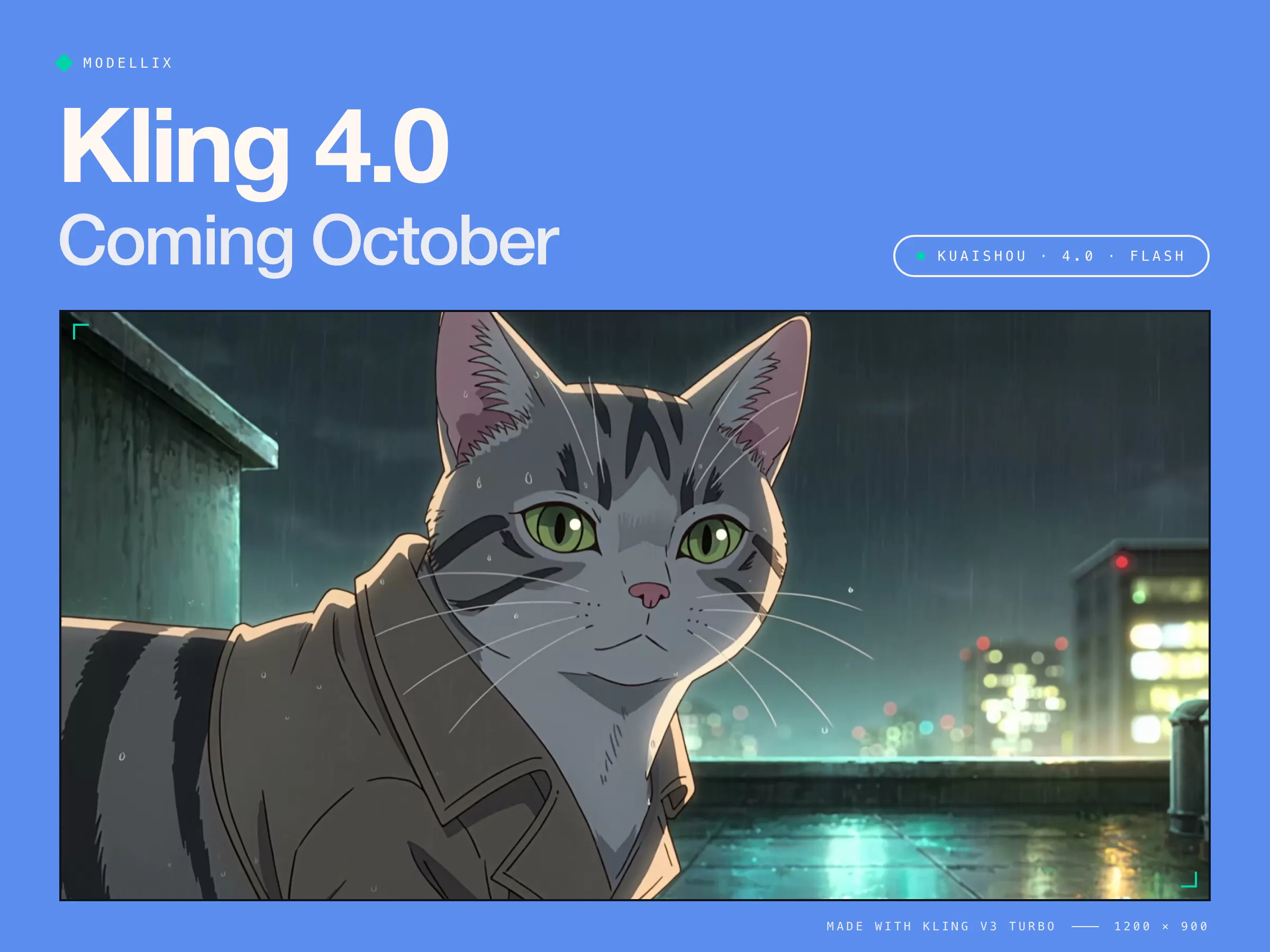
Kling 4.0 is Kuaishou’s next flagship video model. Kling announced it on September 28, 2026: the full model arrives in October, and a lighter Kling 4.0 Flash is already open to Ultra Yearly subscribers in the Kling app.
The headline change is length. Kling 4.0 generates native 30-second clips, twice Kling V3’s 15-second ceiling, with 4K HDR output, stereo audio, and up to 15 multimodal references.
There is no public API or per-second price yet. Modellix will add Kling 4.0 once its API ships. Until then, the Kling V3 family covers most of the same work, billed per second with no subscription, and this page shows which route to use for what.
Kling 4.0 at a Glance
| Kling 4.0 | |
|---|---|
| Position | Next Kling flagship after Kling V3; Flash is the lighter early-access tier |
| Announced | September 28, 2026 |
| Full release | October 2026 |
| Available now | Kling 4.0 Flash, for Ultra Yearly subscribers in the Kling app |
| Clip length | Native 30-second generation, plus video extension |
| Output | Up to 4K, 10-bit HDR |
| Audio | High-quality stereo, more accurate lip sync |
| References | Up to 15 multimodal references (“Omni Reference”) |
| Shot control | Up to 10 keyframes |
| Languages | Multiple languages, accents, and dialects |
| Price per second | Not published yet; Kling V3 on Modellix starts at $0.0672/s |
| API and model IDs | Not published yet |
Specs from Kling AI’s official announcement on X.
Kling 4.0 vs Kling V3
Kling V3 is the current generation and is already available on Modellix. Here is how the announced 4.0 specs compare.
| Kling V3 (on Modellix now) | Kling 4.0 (announced) | |
|---|---|---|
| Longest single clip | 15 s | 30 s 2x |
| Resolution | Up to 4K | Up to 4K, 10-bit HDR |
| Audio | Native audio, on or off | Stereo audio, more accurate lip sync |
| References | Image and video references on the V3 Omni routes | Up to 15 multimodal references |
| Shot control | Multi-shot prompts, up to 6 shots | Up to 10 keyframes |
| Extending a clip | Separate generations | Built-in video extension |
The two changes that matter most are length and references. A 30-second native shot removes most of the stitching that short-drama and ad teams do today. Fifteen references make it easier to keep one character, product, or set consistent across a series.
The V3 column comes from the Modellix model docs for kling/kling-v3-t2v and the V3 Omni routes. For V3 prices by resolution and duration, see our Kling 3.0 cost breakdown.
Kling 4.0 Release Date and Access
Kling says the full model launches in October 2026. The exact day has not been announced.
Kling 4.0 Flash went live the same day as the announcement, but only for Ultra Yearly subscribers in the Kling app. Kling has not announced API access for Flash.
Three things are still unpublished: API access, per-second pricing, and model IDs. Keep duration, resolution, and audio configurable in your code, so the 4.0 limits can slot in without a rewrite.
How Much Will Kling 4.0 Cost per Second?

Fair question, and the one most builders ask first. Kling has not published a per-second API price for Kling 4.0 or 4.0 Flash yet. For now, Flash is only in the Kling app, on the Ultra Yearly plan.
So here is our best guess. Kling 4.0 adds 4K HDR, stereo audio, and 30-second clips on top of Kling V3, so we expect it to cost at least what V3 does today. Flash is the lighter tier and will probably land closer to V3 Turbo.
| Our estimate, not Kling’s price | 1080p with audio | A 10-second clip |
|---|---|---|
| Kling 4.0 | $0.14 to $0.20/s | $1.40 to $2.00 |
| Kling 4.0 Flash | $0.09 to $0.12/s | $0.90 to $1.20 |
We will swap in Kling’s real numbers the day they are published. Until then, Kling V3 runs on Modellix at these rates, billed per second with no subscription.
| Kling V3 on Modellix | 720p | 1080p | 4K |
|---|---|---|---|
| V3 T2V, audio off | $0.0672/s | $0.0896/s | $0.336/s |
| V3 T2V, native audio | $0.1008/s | $0.1344/s | $0.336/s |
| V3 Turbo T2V | $0.0896/s | $0.112/s | Not offered |
Prices from the Modellix model pages. In our small test below, a 6-second 1080p clip with audio billed $0.81 on V3 and $0.67 on Turbo. A full 15-second V3 clip at 1080p with audio works out to about $2.02 (our calculation).
What to Use Before Kling 4.0 Ships
Each headline 4.0 feature already has a live route you can build on today.
| If you need… | Use now on Modellix | Why | From (per second) |
|---|---|---|---|
| Cinematic text-to-video with sound, up to 4K | Kling V3 T2V | 3 to 15 s, native audio, multi-shot prompts | $0.0672 |
| Fast drafts with audio | Kling V3 Turbo T2V | Audio included, 720p or 1080p | $0.0896 |
| Consistent characters, reference images, or editing existing footage | Kling V3 Omni | Image and video references, video-to-video edits | $0.1008 |
| One continuous 30-second shot | Seedance 2.5 T2V or Wan 3.0 T2V | Both publish a 30-second ceiling today | $0.103 / $0.05 |
| A premium 8-second baseline | Veo 3.1 | 4K at 8 s, native audio | $0.36 |
“From” is the lowest resolution each model page lists; higher resolutions and audio cost more. For a wider comparison of live video routes, see our guide to the best AI video generation APIs.
What Can You Build with Kling
Kling 4.0’s feature list reads like a brief for serialized video. These are the products it will make easier, and the ones you can start on Kling V3 now.
- AI short-drama and anime series. Episodes with a recurring character. V3 handles 15-second scenes today; 4.0 doubles the scene length and adds keyframes for tighter storyboards.
- Product ads from brand assets. Packshots and lifestyle photos as references, turned into short spots. V3 Omni takes references now; 4.0 raises the limit to 15.
- Localized ad variants. One concept voiced in several languages. 4.0 adds accents and dialects to native audio.
- Talking-character clips. Mascots or presenters with lip sync, where V3 Turbo is the fast, cheaper draft route.
Each of those products rests on the same few building blocks: a face that carries emotion, dialogue with sound, believable action, and scale. Here is how Kling V3 handles each one today.
Copy any prompt below and try it yourself in the Kling V3 T2V playground. Generated on Modellix: 5 seconds, 720p.
Cinematic camera & expression shift
“Slow dolly-in on a woman sitting alone at a dim jazz bar counter, warm tungsten light. As a spotlight sweeps across her face, her expression shifts from calm to quiet surprise. Shallow depth of field, 35mm film look.”
Natural dialogue & native audio
“Two friends share noodles at a rainy night street-food stall. The man laughs and says, "You still owe me dinner." Steam rises, neon reflects on the wet pavement, handheld camera, natural ambient sound.”
Fluid action & body physics
“A parkour runner sprints across a sunlit rooftop, vaults a railing and lands in a roll, jacket and dust reacting realistically. Tracking shot at shoulder height.”
Epic scale & camera movement
“Aerial drone shot rising over misty mountain ridges at sunrise, slowly revealing an ancient cliffside temple, golden light breaking through the clouds, sweeping cinematic reveal.”
What we saw in a small test
We sent the same prompt, with the same settings, to Kling V3 T2V and Kling V3 Turbo T2V through the Modellix unified API for image, video, and LLM models.
Prompt used for both models
Premium anime short-drama shot, painterly 2D cel animation with cinematic lighting. A silver tabby cat detective in a small trench coat stands on a rain-soaked neon rooftop at night, slowly turns its head toward the camera as lightning flashes behind it, raindrops sparkle on its whiskers. Slow push-in, shallow depth of field, teal and amber neon rim light, subtle film grain. Sound: steady rain, distant thunder. No text, no subtitles, no logos.
6 seconds1080p16:9
Kling V3 T2V: polished, closer to 3D
Kling V3 Turbo T2V: closer to 2D cel anime
Run the same prompt yourself
Open a Kling V3 model page, paste the prompt above, and compare your clip with these two.
Try Kling V3 T2V Try Kling V3 Turbo Explore AI video models →
| Kling V3 T2V | Kling V3 Turbo T2V | |
|---|---|---|
| Output | 1920 x 1080, 6.04 s, with audio | 1920 x 1080, 6.04 s, with audio |
| Gateway processing time | 102.9 s | 601.6 s |
| Billed | $0.8064 ($0.1344 per second) | $0.672 ($0.112 per second) |
| Style | Polished, closer to 3D rendering | Closer to the 2D cel-anime look we asked for |
| Request fields | Accepts audio: native |
Rejects audio; returned an audio track anyway |
Both models followed the scene: the cat, the trench coat, the rain, and the neon rim light. Turbo matched the anime-drama style better and cost 17% less, but took about ten minutes to return in this run.
This is one prompt and one run per model, not a benchmark. Once Kling 4.0 is available by API, we will test it against Seedance 2.5 on the shots readers ask about most, real-human fight and action scenes, and report the cost per second of each.
How to Test Kling V3 in 30 Seconds
Setup takes about 30 seconds: sign in with email, Google, or GitHub, add credit, and open a model page. You pay only for the seconds of video you generate, with no subscription. The clip itself takes a minute or more to render.
Create your Modellix account →
Method 1: Playground
No code. Open the Kling V3 T2V model page, paste a prompt, and review the clip in your browser.

Method 2: API, Through Your Coding Agent
Paste this into Claude Code, Codex, or Cursor. One sentence and one API key are all your agent needs: change the model name and docs link, and the same prompt batch-generates assets with any model on Modellix.
My Modellix API key is mdlx-••••••••••••••••••••••••. Read https://docs.modellix.ai/get-started/index.md and https://docs.modellix.ai/kling/kling-v3-t2v.md, then use Kling V3 T2V to generate one 6-second 1080p 16:9 clip for each scene in scenes.txt. Poll each task until it finishes and save the MP4 files to ./clips.
Swap the masked key for your own from the Modellix console. Treat it like a password and share it only with agents you trust. The raw request format is in the next section and the API guide.
Method 3: Skill
Install the Modellix skill once. After that, your agent finds the right model and request fields by itself.
1 | npx skills add https://github.com/Modellix/modellix-plugin --skill modellix |
Use the Modellix skill to generate a 6-second 1080p Kling V3 T2V clip of a silver tabby cat detective on a rain-soaked neon rooftop, then download it to ./clips.
Setup for each agent host is in the Skill guide.
Method 4: CLI
For scripts and scheduled jobs. One command submits the task, waits, and prints the result URL.
1 | npm install --global modellix-cli |
For batches, put one request per line in a JSONL file and run modellix-cli model batch. See the CLI guide.
How to Get Your Pipeline Ready for Kling 4.0
Kling video on Modellix is an async task: submit, poll, then download before the result URL expires. In our runs, result URLs expired seven days after the task completed. Three habits make the 4.0 switch painless:
- Read field support per route. Kling V3 accepts
audio; V3 Turbo rejects it. Expect 4.0 to add new fields rather than reuse every V3 one. - Treat duration as a setting, not a constant. V3 stops at 15 seconds; 4.0 goes to 30.
- Save outputs on completion. Store the MP4 before the result URL expires.
1 | curl -X POST "https://api.modellix.ai/api/v1/kling/kling-v3-t2v" \ |
Get a key from the Modellix console. The Kling V3 T2V docs list every field.
Try Kling V3 Now with One API Key for Every Model
Video teams rarely stay on one model. A short-drama pipeline might use Kling for character scenes, Seedance for long takes, and Veo for a premium hero shot, each with its own account and request format.
However, on Modellix one key reaches Kling V3, V3 Turbo, and V3 Omni, plus Seedance, Veo, Wan, and Hailuo, all through the same submit-and-poll workflow. When Kling 4.0’s API ships and Modellix adds it, moving from V3 to 4.0 is a change to the model path, not a new integration.
Try Kling V3
Create a Modellix key, run your own brief on Kling V3 and V3 Turbo today, and switch to Kling 4.0 when it arrives.
Get API Key![AI Anime Video Generator [Full Guide]: Free vs Paid vs API](https://img.modellix.ai/en/article/cover-ai-anime-video-generator.webp)
![AI Animation Generator [No Code]: 4 Ways, Free to 4K](https://img.modellix.ai/en/article/cover-ai-animation-generator.webp)
![AI Movie Maker [No Code]: Make a 30s Trailer for Under $10](https://img.modellix.ai/en/article/cover-ai-movie-maker.webp)