Grok Aurora vs Grok Imagine are not competing models. Aurora is xAI’s image-generation engine, released in December 2024 as a code-named model inside Grok. Grok Imagine is the image-and-video API product xAI has built around that engine since 2025. If you search for a head-to-head, you are really looking for a naming guide — and, if you are building something, a route decision: consumer subscription, xAI’s direct API, or an aggregator API. There is no grok-aurora endpoint in the xAI API; the models you can actually call are grok-imagine-image* for images and grok-imagine-video* for video.
This is from Modellix, an API aggregator that resells Grok Imagine routes, so we have a commercial interest in the aggregator channel of this comparison. The goal is to sort out the naming confusion with first-party data, not to crown a winner — and where we are the more expensive route, we say so. All prices below were pulled from xAI’s official pages and Modellix’s model pages on August 26, 2026.
What Aurora and Grok Imagine actually are
Aurora started as xAI’s image model. The official announcement from December 2024 describes it as an autoregressive mixture-of-experts network trained on interleaved text and image data, notable for photorealistic rendering, precise text rendering, and native image editing — it replaced the Flux-based generation that shipped with earlier Grok versions. At that stage it produced static pictures only.
Grok Imagine is the product that grew out of that engine. It launched publicly in August 2025 as xAI’s image-and-video suite: the video pipeline first generates a high-resolution keyframe with an Aurora-derived image model, then animates it into clips of up to 15 seconds. By February 2026 xAI had shipped Grok Imagine 1.0, and xAI’s own product page now describes the Imagine API as “state-of-the-art video generation, video editing, and image creation, all in one API,” citing a top ranking in the Artificial Analysis text-to-video leaderboard. xAI’s Imagine API page currently lists image output up to 2K, up to 10 images per request, video up to 15 seconds, and pricing from $0.02 per image.
The short version: Aurora is the engine. Grok Imagine is the product name for the API and the consumer suite. If you have seen both names in the same week, that is because xAI’s own 2024 announcement used “code-named Aurora,” and the community kept the name alive for the image model while the product moved on. For the API-side details — endpoints, model IDs, request shapes — we keep a separate Grok Imagine API model guide, but the naming table below is all you need to decode what people mean.

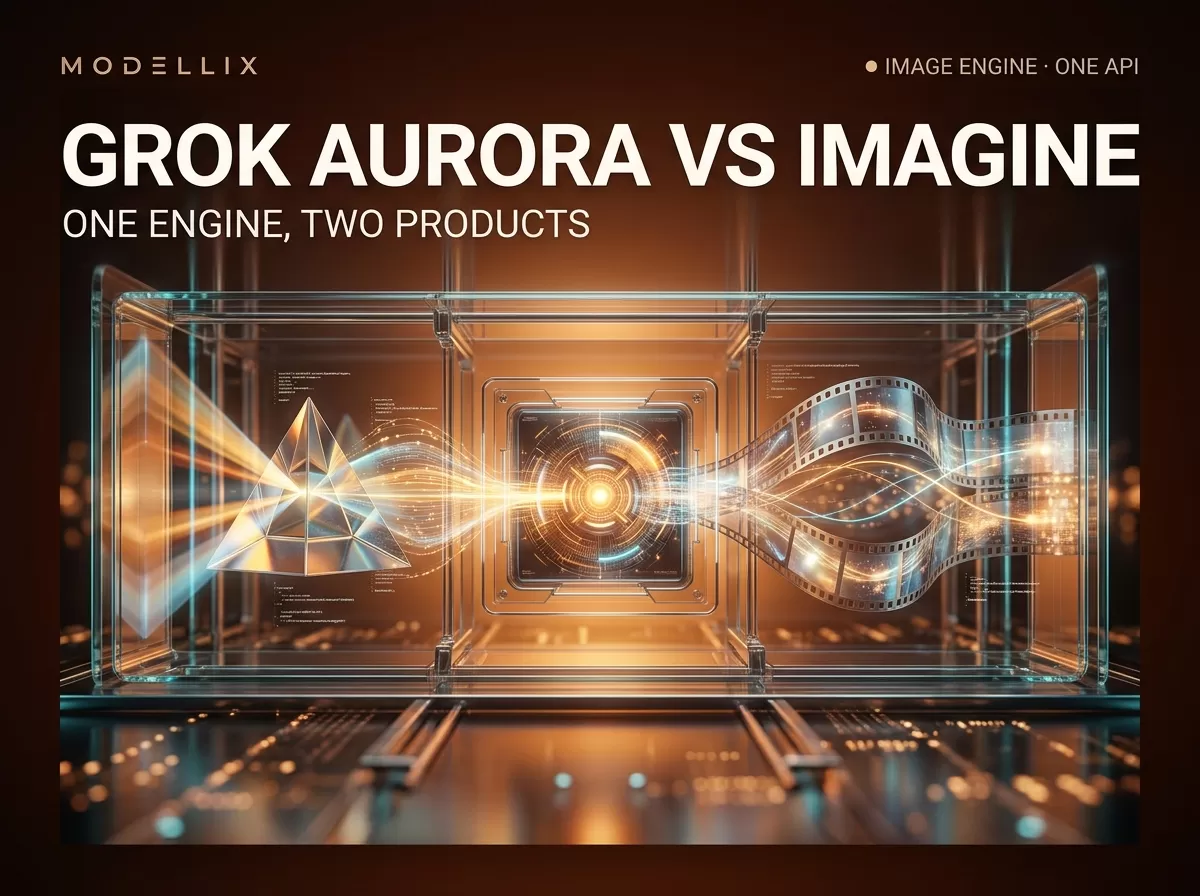
The same engine, two product surfaces: Aurora generates still images, and the Imagine suite builds video and editing on top of that keyframe pipeline — rendered concept, not an official xAI diagram.
Grok Aurora vs Grok Imagine: what the names actually mean
| Name | What it is | Where you meet it | Can you call it directly? |
|---|---|---|---|
| Aurora | The image-generation engine (autoregressive MoE, Dec 2024) | News posts, Reddit threads, Grok chat | No API model ID uses this name |
| Grok Imagine | The image + video product (consumer suite and API) | grok.com, X, the Imagine API | The product name; the API uses model IDs below |
| grok-imagine-image | API model: standard image generation | docs.x.ai, aggregator catalogs | Yes — $0.022/image total |
| grok-imagine-image-quality | API model: higher-quality images | docs.x.ai, aggregator catalogs | Yes — $0.06–$0.08/image |
| grok-imagine-image-2.0 | API model: current-generation image model | docs.x.ai | Yes — $0.05–$0.09/image by tier |
| grok-imagine-video / -1.5 | API models: text/image-to-video | docs.x.ai, aggregator catalogs | Yes — per-second pricing |
| SuperGrok | Consumer subscription (images + video inside Grok) | x.ai/pricing | Not an API |
The confusion is real and mostly harmless: someone saying “Grok Aurora” is usually talking about the image model; someone saying “Grok Imagine” is usually talking about the product or API. The frequently asked Reddit question “is A or B, Aurora or Imagine” turns out to be two variants of the same Imagine model family with different internal encoders — not two competing products. If you are comparing prices or building an integration, ignore the community names and work from model IDs. We published the Grok Imagine pricing breakdown if you want the full consumer-versus-API math in one place.
Image generation: the Aurora engine, priced per image
On the API, the Aurora engine is exposed as three image models. xAI lists input and output costs separately, so the table below sums them into a single per-image total, which is the number that matters for a budget.
| API model | Input | Output | Total per image |
|---|---|---|---|
| grok-imagine-image (1K or 2K) | $0.002/img | $0.02/img | $0.022 |
| grok-imagine-image-quality (1K) | $0.01/img | $0.05/img | $0.06 |
| grok-imagine-image-quality (2K) | $0.01/img | $0.07/img | $0.08 |
| grok-imagine-image-2.0 (1K Low) | $0.01/img | $0.04/img | $0.05 |
| grok-imagine-image-2.0 (2K Medium) | $0.01/img | $0.08/img | $0.09 |
Source: xAI API pricing, accessed August 26, 2026. Input costs per image, output costs per image at the listed resolution tier.
The standard model charges the same $0.02 output whether you ask for 1K or 2K, which makes it the default for volume work. The quality model is roughly three times the standard model per image. The current-generation grok-imagine-image-2.0 adds a quality knob (Low / Medium) on top of resolution, landing between $0.05 and $0.09 — that is the model to test first if you care about output quality rather than cost.
For comparison, here is what the same models cost through Modellix’s xAI provider page, scraped the same day:
| Model | xAI direct (total) | Modellix (listed) | Direction |
|---|---|---|---|
| grok-imagine-image | $0.022/img | $0.0230/img | direct cheaper by ~4.5% |
| grok-imagine-image-quality | $0.06–$0.08/img | $0.0805/img | direct cheaper at 1K; ~parity at 2K |
Modellix displays a single per-image price per model rather than resolution tiers, which simplifies forecasting but blurs the resolution difference. On the standard row the direct API is currently the cheaper option — that is not a claim that we are the low-cost route anywhere, and you should re-check both pages before committing budget, because these numbers drift. grok-imagine-image-2.0 is listed in our catalog too, but its price is not exposed in the same scrapeable field, so check the live model page rather than trusting a number we could not verify.
Video: where Imagine leaves the still-image name behind
Video is where “Aurora” stops being useful terminology. Aurora produces static images; everything that moves is Grok Imagine. Two video models matter on the API:
| API model | Input | Output | What you get |
|---|---|---|---|
| grok-imagine-video | $0.01/sec + $0.002/img | 480p $0.05/sec · 720p $0.07/sec | Text- or image-to-video, up to 15s |
| grok-imagine-video-1.5 | $0.01/img | 480p $0.08 · 720p $0.14 · 1080p $0.25 per sec | Image-to-video, up to 15s, 1080p |
Source: xAI API pricing (docs.x.ai/developers/pricing), accessed August 26, 2026.
A worked example makes the unit costs concrete. A 5-second 720p clip on grok-imagine-video costs $0.05 of input time plus $0.35 of output time — $0.40 total through the direct API. The same clip through Modellix’s listed grok-imagine-video route (a single $0.0805/sec price) costs $0.4025 — effectively identical on this row. A 5-second 1080p clip on grok-imagine-video-1.5 costs $0.01 plus $1.25 — $1.26 direct — versus $1.5525 on our listed grok-imagine-video-1.5-i2v route, where the direct API is about 23% cheaper. The honest pattern: on single-model, single-resolution comparisons, the direct API is usually at or below what we charge; the aggregator’s value lives in the catalog, not in beating xAI on price for one model.
On the consumer side, xAI’s pricing page currently lists Free at $0, SuperGrok at $30/month, and SuperGrok Plus at $100/month with 1080p video. Third-party trackers report that broad free image generation was removed around March 2026, which matches the API-first direction of the product — if you need predictable programmatic costs, the API is the only route with published unit prices. If you are not sure Grok is the right model family for your workload at all, our Grok Imagine alternatives post covers the rest of the field — Google Veo and OpenAI Sora on the video side, the Flux family on the image side.
Direct xAI API or an aggregator — what actually changes
Once the naming is settled, the real decision is the access route. Three routes exist, and they answer different questions:
| Route | Billing | Best if… | Watch out for |
|---|---|---|---|
| SuperGrok (consumer) | $30/mo flat | You generate inside Grok chat for yourself | No deterministic quota; not a programmatic API |
| xAI API (direct) | Per image / per second | You build with xAI models and want official billing | One more vendor account, per-model pricing to track |
| Aggregator API (e.g. Modellix) | Per image / per second | You need Grok plus other model families behind one key | Extra hop; single-list prices that can sit above direct |

Three access routes to the same models: consumer subscription, direct API, and an aggregator hub — rendered concept showing the routing difference, not an official diagram.
When to pick the direct xAI API
Being honest about the trade-off: if your product only needs xAI models, the direct API is frequently the cheaper row, and it gets new models the day xAI ships them. grok-imagine-image-2.0 is documented on the xAI side with full tier pricing, while our catalog lists it without the same scrapeable price — that kind of lag is exactly when direct wins. You also get xAI’s own status page, first-party support, and no intermediary to debug. If one vendor is your whole world, go direct and skip the aggregator conversation entirely.
Where Modellix falls short
We are newer than the direct route in every sense that matters for this decision: the platform has been live since April 2026, our catalog depth is still growing, and on several single-model rows — including the quality image model — our listed price is currently higher than the direct API. We do not offer a free tier with a documented allowance (our docs describe a 10% first-top-up discount instead of a free quota). And an aggregator adds a hop: one more abstraction between your code and the model vendor, which matters if you need to trace a generation issue to xAI’s infrastructure. None of this is an argument that an aggregator is the low-cost route; it is an argument that the aggregator’s job is coverage — one key, one bill, and per-task cost logs across many model families, including Chinese models that are awkward to reach directly from Western accounts.
For the current state of our catalog and pricing, the Modellix pricing table and full model catalog are the right pages to check, and the Modellix vs fal comparison shows how we position against a competing aggregator — including where we lose.
Compare Grok Image and Video Routes
Log in to check live Grok Imagine pricing and test the same prompt across xAI and other model families on one Modellix key.
LoginHow to choose
| If your main reason is… | Start with |
|---|---|
| Clearing up the naming question | This article’s table — you are done after H2 2 |
| Cheap, predictable per-image cost | xAI direct, grok-imagine-image at $0.022/image |
| Highest image quality from the Aurora lineage | Test grok-imagine-image-2.0 tiers on the xAI console |
| Video with native audio, up to 15s | grok-imagine-video (720p) or grok-imagine-video-1.5 (1080p) |
| One API key across Grok and other model families | An aggregator — but compare the specific rows you need |
| Just using it inside a chat app | SuperGrok at $30/mo, with no quota guarantees |
One practical habit beats every comparison table: run the same prompt through the xAI console and through the aggregator route you are considering for a week, and log cost per usable output. Model quality is prompt-dependent, prices drift, and new tiers land monthly — a dated comparison is exactly what this category is full of.
FAQ
Is Grok Aurora the same as Grok Imagine?
Aurora is the image-generation engine xAI released in December 2024; Grok Imagine is the image-and-video product and API built on that engine since 2025. They are the same lineage, not competitors — Aurora is the engine, Imagine is the product.
Is there a “grok-aurora” model in the xAI API?
No. The xAI API exposes grok-imagine-image, grok-imagine-image-quality, and grok-imagine-image-2.0 for images, plus grok-imagine-video and grok-imagine-video-1.5 for video. “Aurora” persists as the community name for the image model, not as an endpoint.
Which is better for images, Aurora or Grok Imagine?
They are the same engine under different names. The actual choice is between API model tiers: grok-imagine-image at $0.022/image, grok-imagine-image-quality at $0.06–$0.08, or the current-generation grok-imagine-image-2.0 at $0.05–$0.09 depending on resolution and quality settings.
Is Grok Imagine free?
xAI’s pricing page lists a Free tier at $0, but third-party trackers report that broad free image generation was removed around March 2026. For programmatic use, the API starts at $0.022 per standard image or $0.05–$0.07 per video second (480p–720p) plus input components — check the live pages before budgeting.
What does Grok Imagine video cost per second?
On the direct API, grok-imagine-video output is $0.05/sec at 480p and $0.07/sec at 720p, plus $0.01/sec of input time; grok-imagine-video-1.5 output is $0.08/$0.14/$0.25 per second at 480p/720p/1080p plus a $0.01 input image. Aggregator routes list a single blended per-second price — on our grok-imagine-video route that is currently $0.0805/sec.
Can I access Grok image generation through an aggregator?
Yes. Modellix lists the Grok Imagine image and video models under its xAI provider, with pay-as-you-go billing and per-task cost logs. We have a commercial interest in that route, so compare the specific model rows against the direct API before choosing — on several rows the direct API is currently cheaper.
Provider details and pricing reflect public information as of August 26, 2026, and change frequently. Validate against each provider’s live pricing before committing. Access image and video models, including the leading Chinese models, through a single API key at modellix.ai.