The short answer: Alibaba API pricing is three billing paths, not one price list
“Alibaba API pricing” is not a single price card. On the AI side it means Alibaba Cloud Model Studio, and you pay for its models through one of three routes: pay-as-you-go unit prices per model (the default), a fixed monthly AI Coding Plan, or—if you route through an aggregator—whatever that aggregator charges per call. On top of that, unit prices change by model family (Qwen text, Qwen image, Wan video), by tier, and by region. Comparing any two numbers without fixing all three of those variables produces a meaningless answer.
For a developer starting today, the current official pay-as-you-go page (accessed August 16, 2026) lists the Qwen text family from $0.05 per 1M input tokens (qwen-flash, first tier) to $2.50 in / $7.50 out per 1M tokens (qwen3.7-max, list price), images from $0.03 per generated image (qwen-image-plus), and video from $0.02/second (wan2.2-t2v-plus, 480P). Model Studio also grants a free quota in the Singapore region only — valid 90 days after activation per the pricing page’s per-model notes (the free-quota policy page states the window as 30–90 days, with uniform 90 days for users who first activate from September 8, 2026) — which is how most new accounts start at zero cost.
Modellix is an aggregator and has a commercial interest in this comparison. We offer a catalog of Alibaba image and video models behind one API key, but we do not offer Qwen text/LLM models—those are direct-only or via an LLM-focused provider. The numbers below do not support a blanket “aggregator is cheaper” claim; model, resolution, region, billing path, and access route all have to match before a price comparison means anything.
Which “Alibaba API” are you pricing?
The search result page for “Alibaba API” mixes two unrelated products, and the pricing is not interchangeable:
- Alibaba Cloud Model Studio — the AI model platform (Qwen LLMs, Qwen Image, Wan/Wanx video). This is what this guide covers, and what the official Model Studio pricing page describes.
- Alibaba.com open API — the e-commerce marketplace’s seller/transaction APIs (product listing, order data). That has its own API reference (openapi.alibaba.com) and its own commercial terms, entirely unrelated to AI model pricing.
There is also a third, smaller source of confusion: other Alibaba Cloud services (object storage, ECS, CDN) bill per their own price books. If the page you are reading quotes per-million-token or per-second prices, you are on the Model Studio track; if it quotes per-request marketplace data fees, you are not.
How Alibaba Cloud Model Studio bills you
The official pricing page states that model API calls are billed on a pay-as-you-go basis by default. Three billing rules matter before you read any table:
- Tiered pricing for text. For some models, the unit price depends on the total input tokens in a single request, and all tokens in that request are billed at the tier’s unit price. Example: qwen3.6-flash costs $0.25/1M input for requests up to 256K tokens, but $1.00/1M for 256K–1M requests—the entire request jumps to the higher tier.
- Discounts that don’t stack. Batch inference discounts both input and output by 50%; context caching discounts input only. The official page says these two discounts cannot apply simultaneously.
- Region columns everywhere. Every table splits prices by deployment scope (Singapore / China / Hong Kong / Frankfurt / US / Tokyo). The numbers below are the International scope prices, which is what most non-China developers will be billed.
Output is billed only for successfully generated images and videos; failed requests incur no cost and do not consume free quota.
If you see a prepaid “token plan” option in your regional Model Studio console, note that its terms are separate from the pay-as-you-go unit prices documented on the international pricing page. The tables in this guide follow the documented pay-as-you-go default.

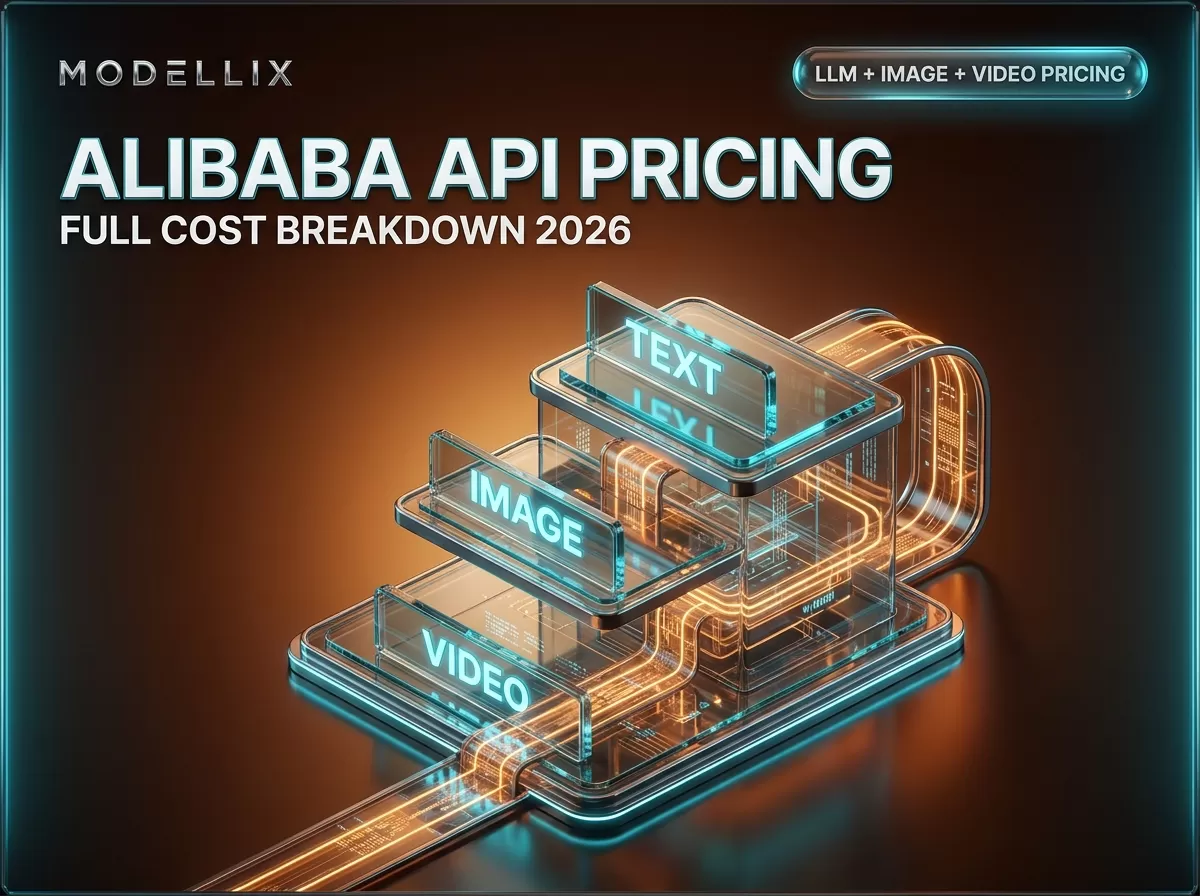
Alibaba API pricing is organized by modality—text, image, and video each have their own billing unit. Illustrative Modellix artwork, not an official Alibaba Cloud graphic.
Qwen text model API pricing: current per-1M-token rates
The text family is where Model Studio’s price ladder is easiest to see. All prices below are International scope, per 1 million tokens, read from the official pricing page on August 16, 2026:
| Model | Input tokens per request | Input price | Output price |
|---|---|---|---|
| qwen3.7-max (list; 50% off) | 0–1M | $2.50 | $7.50 |
| qwen3.6-max-preview | 0–128K | $1.30 | $7.80 |
| qwen3.6-max-preview | 128K–256K | $2.00 | $12.00 |
| qwen-max | No tiered pricing | $1.60 | $6.40 |
| qwen3.7-plus (list; 20% off) | 0–256K | $0.40 | $1.60 |
| qwen3.7-plus (list; 20% off) | 256K–1M | $1.20 | $4.80 |
| qwen3.6-flash | 0–256K | $0.25 | $1.50 |
| qwen3.6-flash | 256K–1M | $1.00 | $4.00 |
| qwen3.5-flash | 0–1M | $0.10 | $0.40 |
| qwen-flash | 0–256K | $0.05 | $0.40 |
| qwen-flash | 256K–1M | $0.25 | $2.00 |
Source: Alibaba Cloud Model Studio pricing, accessed August 16, 2026. Prices above are the official list prices; the official page currently applies limited-time discounts — 50% off qwen3.7-max, 20% off qwen3.7-plus — and lists the discounted amounts alongside the list prices. Check the live page for the current promotion status.
A few notes that change how you read this table:
- Output costs dominate. Across the family, output is 3–6× the input price. A chat-heavy workload is much more expensive per token than a retrieval-heavy one.
- Tiered pricing is per request, not cumulative. A 500K-token request to qwen3.6-flash is billed entirely at the 256K–1M tier rate, not a blend.
- Qwen-Turbo is deprecated but still billed. The official page notes “Qwen-Turbo will no longer be updated. We recommend switching to Qwen-Flash,” and still lists International prices of $0.05/1M input, $0.2/1M non-thinking output, $0.5/1M thinking output (with a 1M-token free quota). If you’re still calling qwen-turbo, plan the migration to Qwen-Flash.
Qwen image API pricing: per-image rates
Image generation is billed per successfully generated image — the official page states plainly: “You are not charged for input” and “Cost does not depend on image resolution or aspect ratio.” There is no input-image fee and no 1K/2K price ladder; each model has one flat International-scope rate. International-scope rates from the official page (August 16, 2026):
| Model | Output price |
|---|---|
| qwen-image-2.0-pro | $0.075/image |
| qwen-image-max | $0.075/image |
| qwen-image-2.0 | $0.035/image |
| qwen-image | $0.035/image |
| qwen-image-plus | $0.030/image |
Source: Alibaba Cloud Model Studio pricing, accessed August 16, 2026. Official page notes: image generation bills output only, and the unit price is independent of resolution and aspect ratio.
Two practical consequences: resolution does not change the bill (a 2K generation costs the same per image as a 1K one), and failed generations are free—which matters for batch pipelines where you retry on quality gates.
For comparison, Modellix’s Alibaba provider page currently lists live route prices for the models above (live check, August 16, 2026): alibaba/qwen-image-plus at $0.0172/image (official $0.03), alibaba/qwen-image-2.0-pro at $0.0465/image (official $0.075), and alibaba/qwen-image at $0.0207/image (official $0.035). On every image route currently listed, the aggregator price is below the official International list price. Note that Modellix also carries alibaba/qwen-image-3.0 ($0.0020/image) and alibaba/qwen-image-3.0-pro ($0.0460/image) — new-generation routes the official pricing page had not listed as of August 16, 2026, so there is no official price to compare them against yet. That is the shape of a real comparison—one model at a time, not a brand-level verdict.
Wan video API pricing: per-second rates by resolution
Video is billed per second of successfully generated output — the official page states: “Video generation You are not charged for input.” This is the table developers ask for most and the one aggregator comparison pages rarely provide. International-scope rates, official page, August 16, 2026:
| Model | 480P | 720P | 1080P |
|---|---|---|---|
| wan2.7-t2v | — | $0.10/s | $0.15/s |
| wan2.6-t2v | — | $0.10/s | $0.15/s |
| wan2.5-t2v-preview | $0.05/s | $0.10/s | $0.15/s |
| wan2.2-t2v-plus | $0.02/s | — | $0.10/s |
| wan2.1-t2v-turbo | $0.036/s | $0.036/s | — |
| happyhorse-1.1-t2v (list; 40% off) | — | $0.14/s | $0.18/s |
| happyhorse-1.0-t2v (list; 20% off) | — | $0.14/s | $0.24/s |
Source: Alibaba Cloud Model Studio pricing, accessed August 16, 2026. wan2.6-t2v is priced identically to wan2.7-t2v on the official page. HappyHorse prices shown are list prices with limited-time 40% (1.1) / 20% (1.0) discounts applied on the official page; check the live page for current promotion status.

Wan video pricing rises with resolution and model generation—each tier is a different per-second rate. Illustrative Modellix artwork, not an official Alibaba Cloud graphic.
What this means for a real workload: a 5-second 1080P clip on wan2.7-t2v is $0.75 of output (5 × $0.15). The same clip at 720P is $0.50, and at 480P on wan2.5-t2v-preview it is $0.25—the cheapest per-second tier currently listed in the official t2v family.
Modellix’s live route prices for the same family (August 16, 2026): alibaba/wan2.7-t2v at $0.0621–$0.0920/second, alibaba/happyhorse-1.1-t2v at $0.1242–$0.1597/second, and alibaba/wan2.2-i2v-flash as low as $0.0008–$0.0216/second. The ranges reflect resolution and duration-dependent pricing on Modellix’s side; they are displayed route ranges, not a conversion of Alibaba’s per-second list prices.
The free quota: what “free” actually means (and how to start)
Model Studio’s free quota policy is the most under-reported part of Alibaba API pricing, and it answers the PAA question “how to get Alibaba API”:
- Granted automatically when you first activate Model Studio in the Singapore region.
- Per-model, typically 1,000,000 tokens for text models (100 images for image models, 10–50 seconds of video for video models), and independent per model—quota cannot be merged or transferred.
- Valid 90 days after you activate, per the per-model notes on the pricing page. The free-quota policy page states the window as 30–90 days, with uniform 90 days for users who first activate Model Studio from September 8, 2026. The countdown is not paused by inactivity, and unused quota is voided at expiry—no reissue, no extension.
- International scope only. Models deployed in other regions or with other service scopes are not eligible.
So the realistic zero-cost start is: activate in Singapore, test every model you care about within the quota window (90 days per the pricing page’s per-model notes; 30–90 days per the policy page), and treat the quota as an evaluation budget, not a production allowance. The official models page lists which models and regions carry free quota.
The Alibaba AI Coding Plan: a fixed-fee path
Separate from pay-as-you-go, Alibaba sells an AI Coding Plan at a fixed monthly fee for use inside coding tools: $50/month (Pro), with request quotas up to 6,000 per 5 hours and 90,000 per month, covering exact-version models including qwen3.7-plus, qwen3.6-plus, kimi-k2.5, glm-5, and MiniMax-M2.5. The Lite plan is no longer available for new subscriptions as of March 20, 2026.
This is a different purchase decision from API billing: it’s a per-seat fixed cost for AI-assisted development, not a metered unit price, and the model list is an exact-string allowlist (version mismatches are not supported). If your use case is coding-assistant traffic, compare $50/month against your metered Qwen bill; if your use case is programmatic generation into your own product, the API price tables above are the relevant numbers.
Direct Alibaba Cloud vs an aggregator: compare routes, not brand names
Choosing between Alibaba Cloud direct and an aggregator like Modellix is a route decision, and the honest answer is “it depends on what you’re calling.” Start with the at-a-glance difference:
| Question | Direct Alibaba Cloud | Aggregator (e.g., Modellix) |
|---|---|---|
| Qwen text/LLM models | ✅ Full catalog, official pricing | ❌ Not offered (Modellix has no LLM routes) |
| Qwen image models | ✅ Official per-image rates | ✅ Live route prices (qwen-image-plus $0.0172/image; qwen-image-3.0 $0.0020/image) |
| Wan video models | ✅ Official per-second rates | ✅ Live route prices (wan2.7-t2v $0.0621–$0.0920/s) |
| Signup friction | Alibaba Cloud account + Singapore region for free quota | One API key, no regional activation |
| Billing | Per Alibaba Cloud meter | Single bill across all providers |
| Free quota | 30–90-day Singapore-only per-model quota (90 days per pricing-page notes; uniform 90 days for new activations from Sept 8, 2026) | Provider-dependent; check current onboarding offer |
Sources: Alibaba Cloud Model Studio pricing and Modellix Alibaba provider page, both accessed August 16, 2026.
A few honest boundaries before you pick a side:
- For Qwen text models, this comparison doesn’t apply to Modellix. We don’t serve LLMs; if you need Qwen text, you’re comparing Alibaba direct against an LLM-focused provider, not against us.
- Unit price is only half the story. Direct access means managing an Alibaba Cloud account, region selection, and per-model quota rules. An aggregator trades those for a single key and one bill. That workflow value is real, but it is not a price discount—treat it as a separate axis.
- When to pick direct: you need a specific model version the aggregator doesn’t carry, you want the official free quota, or you’re at a scale where you want Alibaba’s support/SLA directly.
- When an aggregator makes sense: you’re already calling models from multiple providers and want one integration, you need image/video models alongside other vendors, or you want to avoid maintaining a second cloud account.
For the Wan and Qwen-image models we do carry, see our Wan 2.7 API guide and the unified AI API overview for how the aggregation layer changes integration cost.
What a real task actually costs
Unit prices are abstract; here are three representative workloads priced both ways (direct, using the official International rates above; aggregator, using Modellix’s live route prices, all as of August 16, 2026):
- Five-second 1080P Wan video, wan2.7-t2v: direct = 5 × $0.15 = $0.75; Modellix route at the $0.0920/s ceiling = 5 × $0.0920 = $0.46 (at the $0.0621/s floor, $0.31).
- 1M-token Qwen conversation, qwen3.7-plus: 500K input + 100K output = 0.5 × $0.40 + 0.1 × $1.60 = $0.36 direct at list price (with the current 20% off: 0.5 × $0.32 + 0.1 × $1.28 = $0.288; aggregator LLM pricing not applicable—Modellix doesn’t carry text models).
- 1,000-image batch, qwen-image-plus: direct = 1,000 × $0.03 = $30.00; Modellix = 1,000 × $0.0172 = $17.20.
Example 3 shows the largest absolute gap of the three, and it deserves a caveat: route pricing changes and model choice change it. A 1,000-image batch on qwen-image-2.0-pro direct ($0.075/image) versus the Modellix route ($0.0465/image) is $75 vs $46.50 — a smaller percentage gap than on qwen-image-plus, which is exactly why the comparison has to be model-by-model. The point of the exercise is not “aggregators are cheaper”—it’s that the gap is model-specific and must be priced per task. See our cheapest AI API comparison for the cross-vendor view, and always recheck both price pages on the day you commit. If you want to check current per-model rates for Alibaba’s image and video catalog without creating a second cloud account, the Modellix pricing page lists live per-call prices across all providers.
A practical buying checklist
Before you put Alibaba models in a budget:
- Name the model and version. qwen-flash and qwen3.7-max are different price tiers; a date-suffixed snapshot version bills as a separate model.
- Fix the region. International vs China prices differ; free quota exists only in Singapore.
- Pick the billing path. Pay-as-you-go (default), AI Coding Plan ($50/month, coding tools only), or aggregator route—one workload should not mix paths.
- Watch tiered pricing. A request that crosses a token tier re-prices the whole request.
- Read discounts as temporary. Batch (50% off) and context-cache discounts don’t stack; “limited-time” list-price discounts are promotional.
- Price the task, not the unit. Multiply per-second/per-image/per-token rates by your actual workload before comparing anything.
- Recheck before purchase. Alibaba and Modellix both change pricing without notice; this article is a dated snapshot, not a quote.
FAQ
What is the pricing for the Alibaba Cloud AI API?
Alibaba Cloud Model Studio bills pay-as-you-go by default: Qwen text from $0.05/1M input tokens (qwen-flash first tier), Qwen image from $0.03 per generated image (qwen-image-plus), and Wan video from $0.02/second (wan2.2-t2v-plus 480P). Prices are per-model, per-region, and change over time—check the official pricing page on the day you commit.
How much does it cost to use the Qwen API?
A 1M-token conversation on qwen3.7-plus (500K in / 100K out) is about $0.36 direct at list price, or about $0.29 with the current 20% discount. Qwen text models are not available through Modellix; for image models, qwen-image-plus is $0.03/image direct and $0.0172/image on Modellix’s route (August 16, 2026).
How to get Alibaba API?
Create an Alibaba Cloud account, activate Model Studio in the Singapore region, and you receive a per-model free quota (typically 1M tokens for text models) valid 90 days after activation per the pricing page’s per-model notes (the policy page states 30–90 days, with uniform 90 days for new activations from September 8, 2026). The free quota policy explains eligibility and expiry.
Is the Alibaba API free?
There is a free quota, not a free tier: per-model allowances valid 90 days after activation per the pricing page’s per-model notes (the policy page states 30–90 days, uniform 90 days for new activations from September 8, 2026), in the Singapore region only, voided at expiry regardless of use. After that, pay-as-you-go rates apply.
Does Alibaba Cloud have a prepaid token plan?
Some regional Model Studio consoles offer prepaid token-plan options, but the international pricing page documents pay-as-you-go as the default and this guide covers that path. If you buy a regional token plan, treat its balance and expiry terms as separate from the unit prices above.
Is Modellix cheaper than Alibaba Cloud direct?
Only for specific models, and only where both sides list the model. For qwen-image-plus, Modellix’s $0.0172/image is below the official $0.03; for qwen-image-2.0-pro, Modellix’s $0.0465/image is below the official $0.075. On the newest routes (qwen-image-3.0/3.0-pro, wan3.0), only Modellix has published prices so far — the official page had not listed them as of August 16, 2026. Wan video route ranges vary by resolution and duration. Compare model-by-model, never brand-by-brand.
Pricing sources accessed August 16, 2026: Alibaba Cloud Model Studio pricing, Model Studio models, free quota policy, AI Coding Plan, and the Modellix Alibaba provider page. Alibaba Cloud and Modellix can change pricing, availability, and terms without notice. Modellix is an aggregator and has a commercial interest in this comparison.
Cover and body images: illustrative Modellix artwork; they are not Alibaba Cloud product screenshots or source evidence.