Nano Banana vs Nano Banana 2 vs Pro: Which Should You Use?
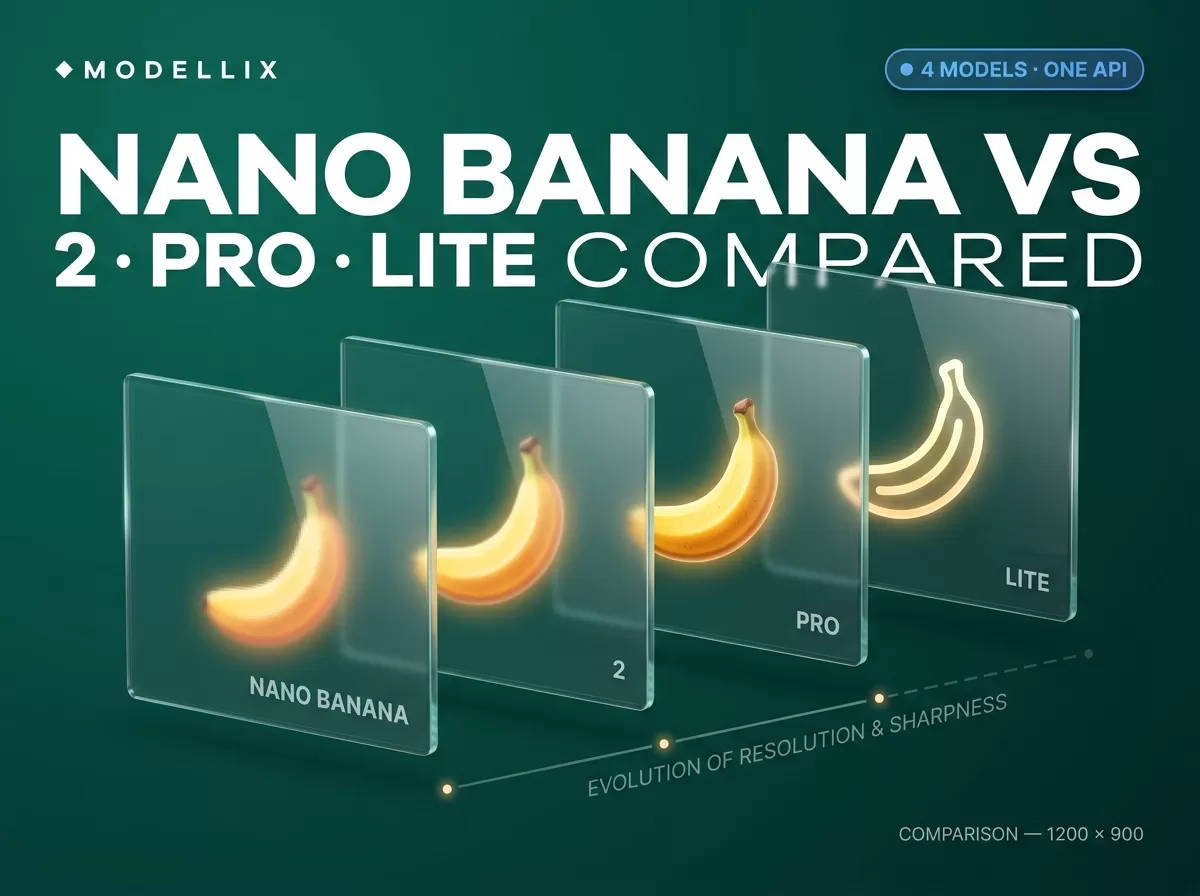
If you searched nano banana vs and got stuck, it’s because the query is missing its second half — and that’s the whole problem. “Nano Banana” isn’t one model. It’s Google’s nickname for a family of Gemini image models, and the comparison that actually matters is usually inside that family: Nano Banana vs Nano Banana 2 vs Nano Banana Pro. This guide sorts the four current versions by the things a builder decides on — price per image, resolution, and speed, all from Google’s own pricing page — then covers the two outside models people genuinely compare against, Seedream and Imagen. No leaderboard, just what each one costs and when to reach for it.
One caveat up front: this is a price, resolution, and speed decision guide built from first-party pricing pages — not a hands-on quality benchmark. Where fidelity is what separates two tiers, we quote the vendor’s own positioning rather than invent test results.
The short answer
Pick by resolution and budget, not by which looks “best” in a cherry-picked demo.
- Nano Banana (
gemini-2.5-flash-image) is the original. It still works, but for general speed tasks Nano Banana 2 is the newer default — Modellix’s model routing even flags the base as superseded — so there’s no reason to start a new build on it. - Nano Banana 2 (
gemini-3.1-flash-image) is the default workhorse: fast, high-throughput, and the only tier below Pro that scales from 512px up to 4K. Choose it for most product and batch work. - Nano Banana 2 Lite (
gemini-3.1-flash-lite-image) is the cheapest in the family and the fastest, but capped at 1K. Choose it for high-volume drafts, thumbnails, and cost-sensitive pipelines. - Nano Banana Pro (
gemini-3-pro-image) is the highest-fidelity tier for complex compositions — and the most expensive, roughly double Nano Banana 2 at the same resolution.
Outside the family, only two models come up often enough to matter: Seedream (ByteDance) and Imagen 4 (Google) — and Google has already flagged Imagen 4 for shutdown, telling developers to migrate to Nano Banana. More on both below.
Nano Banana is a family, not a model
Before comparing anything, get the names straight, because half the confusion around nano banana vs comes from treating one nickname as one product. Google’s Gemini API pricing page lists each tier in the full Nano Banana series with its real model ID and a 🍌 next to it:
| Nickname | Google model ID | Status |
|---|---|---|
| Nano Banana | gemini-2.5-flash-image |
Available (preview); Nano Banana 2 is the newer general-purpose default |
| Nano Banana 2 | gemini-3.1-flash-image |
Current |
| Nano Banana 2 Lite | gemini-3.1-flash-lite-image |
Current |
| Nano Banana Pro | gemini-3-pro-image |
Current |
Two things follow from this. First, Nano Banana is Google’s — every tier is a Gemini image model, not a third party’s invention. Second, when someone says “Nano Banana is better/worse than X,” always ask which tier — a Lite-vs-Pro gap inside the family is larger than most cross-vendor gaps.

Google’s Gemini API pricing page: the Nano Banana family (base, 2, 2 Lite, Pro) each appears with a 🍌 in the page’s own index, with the Nano Banana 2 tier’s per-image prices ($0.045–$0.151) in the main table — proof the family is first-party Google. Captured July 25, 2026.
Nano Banana vs Nano Banana 2 vs Pro: the full comparison
Here is the whole family side by side, with Google’s official per-image price and, for readers who route through an aggregation layer, one provider’s carry price for the same models. Prices pulled 2026-07-25 — image pricing on this page drifts, so re-check before you budget.
| Nano Banana | Nano Banana 2 Lite | Nano Banana 2 | Nano Banana Pro | |
|---|---|---|---|---|
| Model ID | gemini-2.5-flash-image |
gemini-3.1-flash-lite-image |
gemini-3.1-flash-image |
gemini-3-pro-image |
| Google price / image | $0.039 (≤1024px) | $0.0336 (1K) | $0.045 / $0.067 / $0.101 / $0.151 (512 / 1K / 2K / 4K) | $0.134 (1K–2K) / $0.24 (4K) |
| Modellix carry price / image | $0.0336 (≤1K) | $0.0274 (1K) | $0.0403 / $0.0575 / $0.0851 / $0.1248 | $0.1265 (1K–2K) / $0.2093 (4K) |
| Max resolution | 1K | 1K | 4K | 4K |
| Positioning | Original; NB2 is the newer default | Cheapest, ultra-low latency | Fast, high-volume default | Highest fidelity, complex compositions |
| Best for | Legacy pipelines only | Drafts, thumbnails, batch | Most product / pipeline work | Detailed art, hard compositions |
Google prices are from the Gemini API pricing page; Modellix carry prices from its Nano Banana 2 and Nano Banana Pro model pages, all 2026-07-25. Each cross-tier price comparison in the prose below stays on one platform at a time — Google official against Google official, or Modellix carry against Modellix carry — so a platform’s markup never masquerades as a model’s price gap. Reading the rows:
- Nano Banana (base): the original fast model. Google keeps it live and lists it at its normal per-image price with no deprecation flag; it’s Modellix’s model routing that marks it superseded by Nano Banana 2 for general speed tasks. Either way, treat it as legacy — no reason to start here in 2026.
- Nano Banana 2 Lite: the efficiency specialist — fastest and cheapest, but 1K only and not for maximum detail. This is your high-volume, cost-first tier.
- Nano Banana 2: the sweet spot. Same speed story, but it scales 512px → 4K and supports 14 aspect ratios, so it covers everything from tiny iterations to 4K finals. For most builders, this is the answer to “which Nano Banana?”
- Nano Banana Pro: the quality tier — Google describes it as its higher-fidelity image model for complex creative compositions, priced like a step up (its text I/O is billed the same as Gemini 3.1 Pro). You pay roughly 2× Nano Banana 2 at 1K for it.
Nano Banana 2 vs Pro: the decision most people are actually making
Search volume makes it clear the real question hiding behind nano banana vs is Nano Banana 2 vs Pro. Here’s the honest fork.
At 1K, Google charges $0.067 per image for Nano Banana 2 and $0.134 for Nano Banana Pro — both from Google’s own pricing page, so Pro is about twice the price on the same platform. At 4K the gap is $0.151 vs $0.24. So the question is never “is Pro better” (it is, at the top end); it’s “is it worth 2× for your use case.” For a fuller per-tier breakdown, see the Nano Banana Pro pricing breakdown and the Nano Banana 2 pricing pages.
- Choose Nano Banana 2 when you generate at volume, iterate fast, or produce social/marketing/UI assets where “fast and good enough at 4K” wins. This is the default for pipelines and products.
- Choose Nano Banana Pro when a single image carries weight — complex multi-element compositions, detailed stylized art, hero visuals — and the 2× cost is negligible against the value of that one output.
A useful rule: if you’re generating thousands of images, the price gap compounds and Nano Banana 2 (or Lite) usually wins; if you’re generating dozens of high-stakes images, Pro’s fidelity is cheap. And if you only need 1K drafts, Nano Banana 2 Lite undercuts both.
Nano Banana vs Seedream
Outside the family, the most-searched rival is ByteDance’s Seedream. It’s a legitimate comparison, not a Google model — so this is a genuine cross-vendor choice.
Seedream’s current flagship, Seedream 5.0 Pro, is a professional-grade text-to-image model built for top-tier fidelity with precise control over the position of elements, strong prompt adherence, and bilingual (Chinese/English) prompts up to 10,000 characters. Its trade-offs: it caps at 2K (no 4K), and it generates exactly one image per request — no batch or streaming. On Modellix it carries at $0.1035 per image. (ByteDance’s own list price isn’t published in a form we could verify first-hand, so we compare same-platform carry prices here rather than quote an unverified vendor figure.)
How to choose:
- Nano Banana Pro if you need 4K, tight integration with Google’s Gemini stack, or conversational multi-turn editing. On Modellix’s carry pricing it runs $0.1265 per image at 1K–2K versus Seedream’s $0.1035 — same platform, so Seedream is a touch cheaper at the resolutions it supports.
- Seedream 5.0 Pro if you want its precise element-positioning control and are working at or below 2K, especially for bilingual or long, detailed prompts.
Neither is universally “better” — Seedream competes hardest at ≤2K, Nano Banana Pro pulls ahead when you need 4K or the wider Gemini toolchain.
Nano Banana vs Imagen 4
This one has a decisive, first-party answer — and it surprises people, because both models are Google’s. Imagen 4 was Google’s photorealism-and-typography flagship, priced at $0.02 / $0.04 / $0.06 per image for Fast / Standard / Ultra, which is cheaper than Nano Banana at a glance.
But read the warning Google puts directly above those prices: Imagen 4 models are “deprecated and will be shut down on August 17, 2026; migrate to Gemini 2.5 Flash Image to avoid service disruption.” In other words, Google itself is pointing developers away from Imagen 4 and toward Nano Banana.

Google’s own deprecation notice for Imagen 4 — “deprecated and will be shut down on August 17, 2026; migrate to Gemini 2.5 Flash Image” — proof the migration guidance is Google’s, not ours. Captured July 25, 2026.
One thing to untangle, because it looks like a contradiction and isn’t: Google’s Imagen-4 notice names base Nano Banana (Gemini 2.5 Flash Image) as the migration target — that guidance is relative to Imagen, telling Imagen users where to land. Inside the Nano Banana family, Nano Banana 2 is the newer general default over base. Both are true at once: base is Google’s supported successor to Imagen, and Nano Banana 2 is the newer sibling to base. If you’re migrating off Imagen and want the current default, you can go straight to Nano Banana 2.
So the practical verdict:
- For any new build, use Nano Banana — Google is sunsetting the direct Imagen 4 API, and starting there means a forced migration within months.
- If you already depend on Imagen 4’s photorealism or its batch generation (1–4 images per request, person-generation controls) and reach it through an aggregation layer, that access may persist for a while after Google’s direct-API shutdown — some layers still carry it (Modellix lists Imagen 4.0 Standard at $0.0322/image) — but the platform vendor’s own roadmap is the tie-breaker, and it points to Nano Banana.
If your original reason to prefer Imagen was “it’s Google’s photorealism model,” note that Google’s answer to that need is now Nano Banana.
What about Flux, DALL·E, GPT Image, and Qwen?
You’ll see those pairings suggested, but their search demand is a fraction of the ones above, and lumping them in would turn this into a roundup instead of a decision. If you’re comparing Nano Banana against the whole field of image generators, that’s a different job — see our broader Nano Banana alternatives overview. And if the model you’re really weighing is Midjourney, the API-vs-no-API tradeoff there deserves its own treatment: see the Nano Banana vs Midjourney comparison. This page stays on the comparison the query actually implies — inside the Nano Banana family, plus the two rivals (Seedream, Imagen) people genuinely put next to it.
Calling any of these from one API
Whichever way you land, all of these are API models you can call from code. Nano Banana runs through Google’s Gemini API; Seedream and Imagen through their own vendors — or you can reach them through a single aggregation layer instead of wiring up three billing accounts. That’s the role something like Modellix plays: one API key calls image, video, and audio models across a dozen providers, with per-parameter pricing and per-call cost logging so you can see exactly what each generation cost — useful precisely when you’re comparing tiers like Nano Banana 2 vs Pro and watching the per-image math. It’s pay-as-you-go with no monthly fee, and the carry prices in the table above come from there; it is not a claim that any single model is cheapest on it, and the models themselves remain Google’s and ByteDance’s — an aggregator distributes access, it doesn’t build the models.
For the whole family priced in one place, see the full Nano Banana family price breakdown.
FAQ
Which version of Nano Banana is better?
There’s no single winner — the family is tiered. Nano Banana 2 is the best default (fast, 512px–4K). Nano Banana 2 Lite is cheapest but 1K-only. Nano Banana Pro has the highest fidelity for complex images at roughly double the price. The original Nano Banana is legacy. Pick by resolution and budget.
Is Nano Banana 2 or Pro better?
Pro produces higher fidelity on complex compositions, but at 1K it costs $0.134 per image versus $0.067 for Nano Banana 2 — about 2× on Google’s own pricing. Use Nano Banana 2 for volume and general work; step up to Pro when a single image is high-stakes enough to justify the cost.
Is Nano Banana the same as Gemini?
Yes. “Nano Banana” is Google’s nickname for its Gemini image models — Nano Banana is gemini-2.5-flash-image, Nano Banana 2 is gemini-3.1-flash-image, and Nano Banana Pro is gemini-3-pro-image, all listed on Google’s official pricing page.
Is Nano Banana better than Seedream?
It depends on resolution. Nano Banana Pro reaches 4K and integrates with Google’s Gemini editing tools; ByteDance’s Seedream 5.0 Pro caps at 2K but offers precise element-position control and bilingual prompts, and carries slightly cheaper at ≤2K on the same platform. Match to your resolution and prompt needs.
Is Nano Banana better than Imagen 4?
For new projects, yes — not on quality alone, but because Google marks Imagen 4 as deprecated (shutting down August 17, 2026) and explicitly tells developers to migrate to Nano Banana (Gemini 2.5 Flash Image). Starting on Imagen 4 today means a forced migration soon.
How much does Nano Banana cost per image?
On Google’s official pricing (2026-07-25): the base Nano Banana is $0.039, Nano Banana 2 Lite $0.0336 at 1K, Nano Banana 2 ranges $0.045–$0.151 (512px–4K), and Nano Banana Pro is $0.134 up to 2K and $0.24 at 4K. There’s no monthly fee — you pay per image.