The short answer: Nano Banana and Imagen are different Google image families
Nano Banana and Imagen are both Google image-generation models, but they are not the same model — and the names are where most of the confusion starts. Nano Banana is Google’s nickname for its Gemini image model family (four current tiers, from gemini-2.5-flash-image to gemini-3-pro-image), built for fast generation, conversational editing, and legible text. Imagen 4 is Google’s separate, specialized text-to-image family (Fast, Standard, and Ultra tiers), built for high-quality generation from a prompt. Both families are callable through the Gemini API with a single Google key, and both are billed per image — but on different scales. If you searched nano banana vs imagen (or imagen vs nano banana), the practical question is which family fits your workflow: generation-first quality, or editing-first control. This guide compares them on naming, quality, editing, verified pricing, and API access, with every price read from official pages on August 18, 2026. One timing note before the details: Google has deprecated the Imagen models on the Gemini API — its deprecations page (updated August 13, 2026) lists August 17, 2026 as the shutdown date for all three Imagen 4 model IDs, with gemini-3.1-flash-image (Nano Banana 2) as the suggested replacement.
This article is written by Modellix, an AI model API aggregator, and we have a commercial interest in this comparison. We say plainly where each family wins and where we do not, and we are not trying to crown a single winner.
By the Modellix team · Last verified August 18, 2026
At a glance: Nano Banana vs Imagen
| Dimension | Nano Banana (Gemini image family) | Imagen 4 |
|---|---|---|
| What it is | Gemini image model family (nickname “Nano Banana”) | Dedicated text-to-image family |
| Tiers (2026) | Nano Banana 2, Nano Banana 2 Lite, Nano Banana Pro, Nano Banana | Imagen 4 Fast, Standard, Ultra |
| Core strength | Conversational editing, speed, text in images | Generation quality, photorealism, first-pass polish |
| Editing existing images | Yes — multi-turn, reference-based | No — text-to-image only |
| Max resolution | 4K (Pro); up to 4K on Nano Banana 2; 1K on 2.5/Lite | 2K-class output (per Google’s Imagen docs) |
| Billing | Per image, priced by output resolution/tokens | Per image, flat per tier |
| Google official price (Aug 18, 2026) | $0.0336–$0.24 per image by tier and size | $0.02 (Fast) / $0.04 (Standard) / $0.06 (Ultra) |
| API | Gemini API (generativelanguage) | Gemini API (imagen-4.0-generate-001 family) |
| Free tier | Not available on paid models | Not available |
Both families verified live on August 18, 2026. Google changes model names, tiers, and prices frequently — treat this table as a dated snapshot, not a quote.
Are Nano Banana and Imagen the same model? No — here is the family tree
This is the first question the search engines get, and most comparison articles answer it wrong. Google’s own docs draw the line clearly: Nano Banana is the nickname for the Gemini image generation models — Google’s image generation documentation opens with “Nano Banana image generation” as the name of the Gemini capability, and the pricing page labels each tier with the 🍌 moniker. The current family:
| Model ID | Marketing name | Google’s own positioning (docs, Aug 2026) |
|---|---|---|
gemini-2.5-flash-image |
Nano Banana (deprecated — sunset Oct 2, 2026) | Speed and efficiency; 1024px output |
gemini-3.1-flash-image |
Nano Banana 2 | “Your go-to image generation model” — best balance of quality, cost, latency |
gemini-3.1-flash-lite-image |
Nano Banana 2 Lite | Most efficient; ultra-low latency |
gemini-3-pro-image |
Nano Banana Pro | Professional assets; Google Search grounding, “Thinking” process, up to 4K |
Imagen is a separate family. Google’s Imagen API docs describe it as the dedicated text-to-image model line, accessed through the Gemini API as imagen-4.0-generate-001 (Standard), imagen-4.0-fast-generate-001 (Fast), and imagen-4.0-ultra-generate-001 (Ultra) — all deprecated GA models (released June 24, 2025; shutdown August 17, 2026, per Google’s deprecations page). Google’s own model-selection guidance is blunt: “Although Nano Banana image generation models are recommended for most use cases, you can also explore dedicated image generation models: Imagen.” So the honest framing is: Nano Banana is the general-purpose Gemini image family, Imagen is Google’s specialized generation-first line. Both families’ docs also note that all generated images include a SynthID watermark. One claim you will see repeated on comparison sites — that “Nano Banana 2 is a variant of Imagen 3” — is wrong: Nano Banana models are Gemini models, and Imagen 3 is an earlier entry in the Imagen line (DeepMind’s Imagen page keeps the family history). If you are comparing against older content, also note the direction of the migration: Google is consolidating Imagen users onto Nano Banana — the Imagen models on the Gemini API are deprecated (sunset August 17, 2026), and Google’s own Imagen docs recommend migrating to Nano Banana for image generation. Check Google’s current docs before wiring anything up.
The practical consequence: you rarely have to choose “Nano Banana vs Imagen” as an either/or — both families are one API key away on Google’s side. The real choice is which family to route which workload to.
Output quality: generation-first vs edit-first
On pure prompt-to-image quality, the honest verdict is the one the SERP keeps circling: Imagen 4 is the stronger first-pass generator, and Nano Banana is the stronger editor. The two families optimize for different definitions of “better,” and pretending otherwise is how comparison articles go wrong.
Imagen 4’s edge is generation polish. It is Google’s “specialized” text-to-image line, and its tiers map to effort: Fast for quick outputs, Standard for the default quality, Ultra for the highest-fidelity renders. On photorealism, texture detail, and first-try composition, Imagen 4 is where Google points professional-grade generation — the reason it keeps appearing in comparisons aimed at hero images, product photography, and print-adjacent work. It also renders text inside images well, which is why it shows up in ad and poster workflows.
Nano Banana’s edge is control and iteration. The Gemini image models follow detailed prompts literally, handle multi-image composition, keep characters and objects consistent across revisions, and — in the Pro tier — add advanced creative controls, a composition-refining “Thinking” process, and Google Search grounding for real-world references. Nano Banana Pro is also the 4K option in the family, which matters if you are producing at print scale. The base and Lite tiers trade that ceiling for speed and cost: Google positions Nano Banana 2 as the default all-rounder and Nano Banana 2 Lite as the efficiency pick.
Two things worth saying plainly: Nano Banana is not a weak generator — on many prompts the gap is small — and Imagen 4 is not an editing tool. If your job is “type a prompt, ship a polished image,” Imagen 4 tends to win. If your job is “start with an image and keep changing it until it is right,” the Nano Banana family is built for exactly that. Our sibling comparison, Nano Banana vs Midjourney, covers the same control-vs-aesthetic split from the Midjourney side.

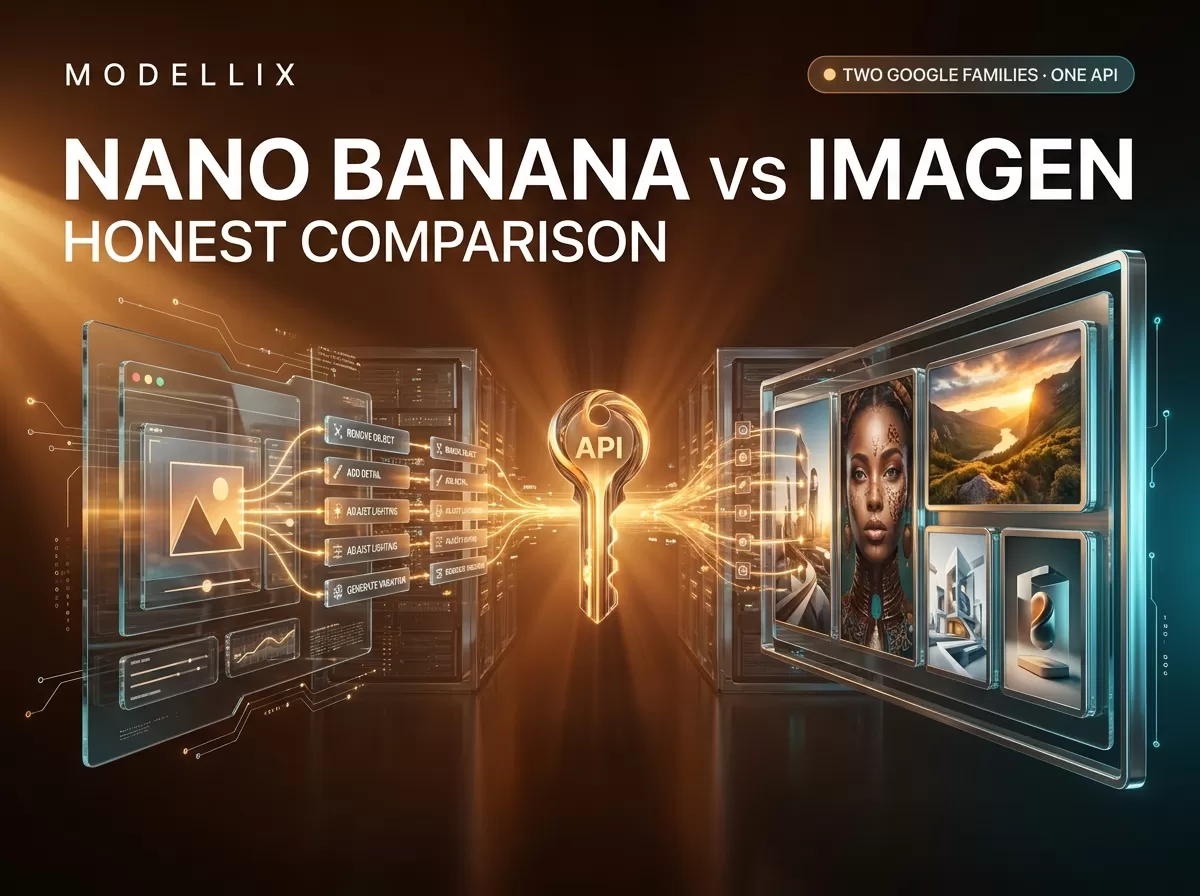
Illustrative concept art of the two family profiles, generated by Modellix for this article — not a side-by-side benchmark of either model.
Editing: where the Nano Banana family genuinely wins
This is the clearest functional difference in the whole comparison, and it is structural rather than stylistic. Imagen 4 is text-to-image: prompt in, image out, no image input. The Nano Banana family accepts existing images and edits them conversationally — change the background, remove an object, add text, merge two images — over multiple turns without regenerating the frame. Google’s docs position the Gemini image models around exactly this “prompt to prototype” workflow, and the Modellix catalog reflects the same split: the Nano Banana family includes edit variants, while the Imagen 4 entries are generate-only.
For teams producing product variations, social assets, e-commerce scenes, or UI mockups, that difference decides the tool. Editing pipelines that would otherwise be prompt-engineering exercises become a series of small, directed changes — cheaper, faster, and easier to keep consistent. If consistency across a campaign (same product, same character, same style across dozens of assets) matters more than winning a one-shot beauty contest, the Nano Banana family is the better fit, and Nano Banana Pro is where Google targets that commercial-grade repeatability.

Illustrative concept art of a multi-turn editing workflow, generated by Modellix for this article — not a product screenshot.
Pricing: per image, verified August 18, 2026
Both families bill per image on Google’s side, which makes this comparison cleaner than most model-vs-model pricing exercises. What differs is the mechanism: Imagen 4 is a flat per-image price per tier, while the Nano Banana family is priced by output size (via tokens), so the same tier costs more at higher resolutions. All prices below were read from Google’s Gemini API pricing page on August 18, 2026 (HTTP 200); treat them as a same-day snapshot — Google changes these numbers without notice. One caveat that matters for any decision you make from this table: all three Imagen 4 IDs are deprecated — Google’s deprecations page schedules their shutdown for August 17, 2026, with gemini-3.1-flash-image as the suggested replacement — so treat the Imagen prices as the tail end of that family’s life, not a long-term commitment.
| Model | Price per image (Google, Aug 18, 2026) | Modellix (same day) |
|---|---|---|
Imagen 4 Fast (imagen-4.0-fast-generate-001) |
$0.02 | On model page |
Imagen 4 Standard (imagen-4.0-generate-001) |
$0.04 | On model page |
Imagen 4 Ultra (imagen-4.0-ultra-generate-001) |
$0.06 | On model page |
Nano Banana (gemini-2.5-flash-image, deprecated — sunset Oct 2, 2026) |
$0.039 per 1024×1024 image | $0.0336/img |
Nano Banana 2 (gemini-3.1-flash-image) |
$0.045 (0.5K) · $0.067 (1K) · $0.101 (2K) · $0.151 (4K) | $0.0403–$0.1248/img |
Nano Banana 2 Lite (gemini-3.1-flash-lite-image) |
$0.0336 per 1K image | — |
Nano Banana Pro (gemini-3-pro-image) |
$0.134 (1K/2K) · $0.24 (4K) | $0.1265–$0.2093/img |
Sources: Google Gemini API pricing page and Modellix model pages (nano-banana, nano-banana-2, nano-banana-pro, imagen-4), all accessed August 18, 2026. Modellix lists Imagen 4 (including Ultra) in its catalog; per-image pricing is shown on each model page. Dash = not listed on Modellix.
A few honest observations on this table:
- Imagen 4 is the budget generation path — $0.02–$0.06 flat per image, no resolution multiplier, which makes it the predictable choice for high-volume text-to-image work.
- Nano Banana 2 Lite undercuts everything at $0.0336 per 1K image, but it is the “efficiency specialist” — great for high throughput, not the quality ceiling.
- Nano Banana Pro is the expensive end at $0.134–$0.24, and it buys the 4K output, grounding, and pro controls — not raw volume economics.
- On the models Modellix carries, our prices are in the same band as Google’s — this is not a claim that Modellix beats Google’s first-party rates on every model; the gaps are small and you should check both before committing to a route.
For the full Nano Banana price matrix across every resolution tier, our Nano Banana pricing breakdown goes tier by tier with the same same-day verification discipline.

Illustrative concept art of the two billing mechanisms (flat per-image tiers vs per-resolution scale), generated by Modellix for this article — no live prices are shown on the artwork on purpose, since they change.
Building with them: the API picture
For developers — the readers this comparison is usually missing — the naming debate collapses into a much shorter question: which model ID do I call, and what does it cost per call? Both families sit on the Gemini API, so a single Google API key reaches every tier above. The model IDs are the ones in the tables: imagen-4.0-*-001 for Imagen 4, gemini-*-*-image for the Nano Banana family. Google’s API docs cover both, with SDK support and the same async request/response pattern you already know from other Gemini models. Imagen 4’s status matters operationally: all three IDs are deprecated GA models (sunset August 17, 2026) — Google’s pricing page still warns they “may change before becoming stable and have more restrictive rate limits,” and the shutdown date is the binding constraint for production plans.
The per-call cost picture is where the two families diverge for budgeting: Imagen 4 gives you a flat per-image price you can multiply; the Nano Banana family requires you to know the output resolution before you can predict the price. For batch workloads that difference is small — you control resolution — but for user-driven generation it changes how you estimate bills.
And if you would rather not maintain Google-only routing, both families are available through aggregation layers. Modellix carries the Nano Banana family (including edit variants) and Imagen 4 in one catalog, behind a single pay-as-you-go API key, alongside 210+ other image and video models from 12 providers — with per-call cost logs so each generation’s actual price lands in your console. It is a distribution layer: Modellix does not train or own these models, and it does not host LLMs — we route Google’s models (and others) through one consistent async task API. Our Imagen 4 API guide and Google provider page cover the integration details on both sides.
When to pick Imagen — and when to pick Nano Banana
Match the family to the job, not to the hype.
Pick Imagen 4 if: you generate from text prompts at scale and want a flat, predictable per-image price ($0.02–$0.06); you need polished first-pass photorealism (hero images, product shots, editorial work); you want to keep billing math trivial; or you are fine with generation-only — no image input, no multi-turn editing. If your workload is “high volume, text in, image out,” Imagen 4 is genuinely the stronger trade, and it is cheaper per image than the Nano Banana mid tiers. One condition: Imagen 4 is on a deprecation schedule — all three IDs shut down August 17, 2026 per Google’s deprecations page, with gemini-3.1-flash-image as the suggested replacement — so pick it only if you can plan the migration by then.
Pick the Nano Banana family if: your workflow starts with existing images — editing, background swaps, object removal, product variations, multi-image composition; you need consistent characters or objects across many outputs; you render text inside images and want the family Google positions as the text-rendering specialist; you need 4K output or pro controls (Nano Banana Pro); or you are building interactive experiences where generation speed feels like product quality (Nano Banana 2 Lite).
If your answer is “both,” you do not have to choose. Both families run on the Gemini API, so a single Google key reaches all seven tiers. The Nano Banana alternatives guide puts this pair in the wider landscape of Google image models, and how to use Google Imagen walks through the Imagen side step by step if you want the generation-first route spelled out.
The third route: one key across both families (and when to go direct)
There is a third option that sidesteps the either/or entirely: route both families through an aggregator. That is what Modellix is for — one key, one bill, and per-call cost logs across the Nano Banana family, Imagen 4, and 200+ other models, with the same submit-and-poll lifecycle for every provider. For teams whose workloads span many models — a campaign that mixes product renders, edit variations, and video — the aggregation layer is where integration and cost accounting stop being per-vendor projects.
When to go direct instead: if your workload is one model, just call Google’s API — an aggregator adds nothing but a hop; if you need Gemini-specific features you cannot get through a reseller (Google Search grounding, the “Thinking” process, tightest preview access), go direct; if you need custom model deployment or fine-tuning, neither route applies — that is a platform like Vertex or a dedicated inference host. And one boundary worth repeating: Modellix is a distribution layer for models Google built — it owns none of them.
If you want to test both families against your workload before deciding, every Modellix model page has a browser Playground, and you can start with a free API key and run the same prompt on Imagen 4 and Nano Banana models side by side, comparing the per-image price on the bill.
FAQ
Which is better, Nano Banana or Imagen?
Neither, universally. Imagen 4 wins on generation-first quality and flat per-image pricing ($0.02–$0.06); the Nano Banana family wins on conversational editing, consistency, and text rendering. Choose by workflow: prompt-to-image polish vs iterative control.
Are Imagen 4 and Nano Banana the same model?
No. Nano Banana is Google’s nickname for its Gemini image model family (gemini-2.5-flash-image through gemini-3-pro-image). Imagen 4 is Google’s separate, specialized text-to-image family (imagen-4.0-generate-001, fast, and ultra variants). Both are served through the Gemini API, which is why the names get tangled.
Is Nano Banana cheaper than Imagen?
It depends on tier and resolution. Imagen 4 Fast ($0.02) and Standard ($0.04) are cheaper than the Nano Banana mid tiers; Nano Banana 2 Lite ($0.0336 per 1K image) undercuts Imagen 4 Standard; Nano Banana Pro ($0.134–$0.24) is the most expensive of all seven tiers. Prices verified August 18, 2026.
Is Nano Banana free?
Not through the API. Google’s image models are paid-only on the Gemini API (the free tier is not available for them), and Modellix bills per image with pay-as-you-go pricing. Free options you see online are consumer apps with their own quotas, not API access.
Which is better for editing existing images?
The Nano Banana family. It accepts image input and supports multi-turn conversational edits — background changes, object removal, text overlay, multi-image composition — while Imagen 4 is text-to-image only.
Can I use Nano Banana and Imagen through one API?
Yes, twice over. Both families are on Google’s Gemini API behind one Google key, and both are available through aggregators like Modellix, which serves the full Nano Banana family and Imagen 4 behind a single key with per-call cost logs.
What is Imagen 4?
Imagen 4 is Google’s dedicated text-to-image model family, with Fast, Standard, and Ultra tiers on the Gemini API — all deprecated GA models (sunset August 17, 2026). It is positioned for high-quality generation from prompts — not for editing input images — and bills a flat price per image.
Prices and model availability verified August 18, 2026, from Google’s Gemini API pricing page, Google’s image generation and Imagen docs, and Modellix’s model pages (links above). Google changes model names, tiers, and prices frequently; validate against the live pricing pages before committing. Modellix is an AI model API aggregator and has a commercial interest in this comparison — it owns none of these models and is a distribution layer for them.
Cover and body illustrations: illustrative Modellix artwork; they are not Google product screenshots or source evidence.