OpenAI shut down Sora’s consumer service in April 2026. The calculation was simple: compute costs were unsustainable, and the pivot to enterprise AGI meant consumer video generation no longer fit the roadmap.
That left a real gap. And the most prepared beneficiary is a model most Western developers have underestimated: Kling AI, from Kuaishou.
As of April 2026, Kling is the most actively maintained video generation model family with a public API. It spans over 30 variants across text-to-image, image-to-image, text-to-video, image-to-video, avatar, and video effects. Kling V3 now supports multi-shot storyboard generation. Kling V2.6 generates synchronized audio and video in a single API call, with no separate TTS step required.
This guide covers the complete Kling model lineup, how pricing is structured by version and mode, which variant fits which use case, and how to start generating in under 10 minutes.
The Kling AI Model Family: 30+ Variants Explained
Most developers who have heard of Kling think “video generation.” That is accurate but incomplete. The Kling family covers five distinct capability categories, each with multiple model generations.

Text-to-Video (T2V). From Kling V1 T2V, which generates 5 to 10 second clips with camera motion presets (pan, tilt, zoom), to Kling V3 T2V, which supports multi-shot storyboard generation with 3 to 15 seconds per clip. Kling V2.5 Turbo T2V delivers 1080p output starting at $0.050/s (standard mode), a fraction of V2.1 Master T2V at $0.320/s, making it the default choice for high-volume workloads.
Image-to-Video (I2V). Kling V1.6 I2V introduced first-and-last frame control, letting developers define both the opening and closing frame of a clip for precise narrative transitions. Kling V1.6 MI2V takes up to 4 reference images and fuses them into a single cohesive video sequence. Kling V2.6 I2V is the first model in the family to natively output synchronized audio and video in one API call.
Text-to-Image and Image-to-Image. Kling V3 T2I supports 1K and 2K output with improved prompt adherence over V2.1. Kling V3 Omni Image generates up to 4K resolution with support for up to 4 reference images. At the 2K tier they are increasingly competitive with Flux and Seedream.
Avatar and Talking-Head Video. Kling Avatar generates realistic talking-head videos from a reference image and audio input. It supports precise lip synchronization, expressive gestures, and multiple languages. Audio input is either a TTS-generated audio ID or a direct sound file (MP3, WAV, M4A, AAC, up to 5MB, 2 to 300 seconds).
Creative Effects and Utility Models. Kling Video Effects applies 212 preset creative effects to person images. Kling Image Expansion extends images in any direction with prompt-guided generation. Kling Image Recognize segments image content into object, head (with hair), face (without hair), and clothing categories, useful for downstream masking workflows.
Kling API Pricing: How the Cost Structure Works
Most write-ups on Kling API pricing are either outdated (still quoting V1 rates) or incomplete (covering only one model version). Here is how to think about pricing as of April 2026.

Pricing scales with model generation and quality mode.
Every Kling video model offers two modes: standard (std) and professional (pro). Standard mode is the default. Professional mode produces higher visual quality at a higher cost per request. Most production workloads start with standard mode and upgrade selectively for user-facing output.
Kling V2.5 Turbo is the price-performance sweet spot.
Kling V2.5 Turbo T2V and V2.5 Turbo I2V deliver cinematic 1080p output starting at $0.050/s (standard mode). V2.1 Master T2V runs at $0.320/s , the Turbo tier sits well below that while maintaining the same output resolution and physics-accurate motion. For teams running thousands of generations per month, this difference compounds fast. The turbo designation refers to cost efficiency, not a quality reduction.
V3 pricing is higher, but V3 unlocks capabilities V2 cannot deliver.
Kling V3 supports multi-shot storyboard generation (chaining coherent shots with per-scene prompts), extended duration up to 15 seconds per clip, and V3 Omni formats for 4K image output and video-to-video with element references. These are not incremental improvements. If your workflow requires narrative video with consistent characters across scenes, V3 is the only option in the Kling family.
Per-request pricing, no monthly minimums.
Kling API access through Modellix uses per-request pricing. You pay for what you generate. There are no seat fees or monthly minimums. Rate limits are 100 requests per minute across Kling endpoints, with rate limit headers returned on each response (X-RateLimit-Limit, X-RateLimit-Remaining, X-RateLimit-Reset).
For current per-second and per-clip rates, check Modellix pricing directly. Rates change, and stale numbers are worse than no numbers.
Kling 3.0 API: What Changes at V3
Kling V3 (referred to as Kling 3.0 in Kuaishou’s consumer product) is the most significant capability upgrade since V2. Three things change materially.
flowchart LR
    STORY["Storyboard prompts"] --> SHOT1["Shot 1
Establish scene"]
    STORY --> SHOT2["Shot 2
Add motion"]
    STORY --> SHOT3["Shot 3
Close with transition"]
    REFS["Shared character and element references"] -.-> SHOT1
    REFS -.-> SHOT2
    REFS -.-> SHOT3
    SHOT1 --> SHOT2 --> SHOT3 --> OUT["One coherent multi-shot video"]

    classDef accent fill:#eef2ff,stroke:#6366f1,color:#111827,stroke-width:1px;
    classDef node fill:#ffffff,stroke:#94a3b8,color:#111827,stroke-width:1px;
    classDef success fill:#ecfdf5,stroke:#10b981,color:#111827,stroke-width:1px;
    class STORY,REFS accent;
    class SHOT1,SHOT2,SHOT3 node;
    class OUT success;
Multi-shot storyboard generation. Kling V3 T2V and I2V both support storyboard-based multi-shot workflows. Instead of a single prompt producing a single clip, you define a sequence with separate prompts per shot. Kling V3 maintains character and scene consistency across shots. This is the mechanism behind the consumer product’s “long-form video” feature: multiple coherent shots assembled into a longer narrative.
Duration range: 3 to 15 seconds per clip. Kling V1 and V2 cap at 10 seconds per clip. V3 raises the ceiling to 15 seconds and introduces a new 3-second minimum, useful for short motion loops where V1’s fixed 5-second minimum wasted generation budget.
V3 Omni formats. Kling V3 Omni Image generates up to 4K with support for up to 4 reference images for character and element consistency. Kling V3 Omni Video extends this to video-to-video: prompts, storyboard segments, image references, and element references combine to produce a synthesized output. This is purpose-built for creative productions that require fine-grained control over every element in frame.
Kling V2.6: Native Audio and Video in One API Call
Kling V2.6 I2V and V2.6 T2V are the first models in the Kling family to generate synchronized audio and video in a single pass.
Before V2.6, a talking-head or avatar workflow required three steps: generate audio via a TTS API, animate a reference image with Kling Avatar, then sync audio and video in post. With Kling V2.6, these collapse into one call.
flowchart LR
    subgraph BEFORE["Before V2.6: 3 separate API calls"]
        direction TB
        A1["1. TTS API
Generate audio"] --> A2["2. Kling Avatar
Animate image"] --> A3["3. Post-processing
Sync audio and video"]
    end

    subgraph AFTER["After V2.6: 1 API call"]
        direction TB
        B1["Image + voice_ids
sound: on"] --> B2["Kling V2.6 I2V
Async request"] --> B3["Video output
Dialogue + lip-sync + SFX"]
    end

    BEFORE -.->|"Collapse into one API call"| AFTER

    classDef before fill:#fff1f2,stroke:#ef4444,color:#111827,stroke-width:1px;
    classDef core fill:#eef2ff,stroke:#6366f1,color:#111827,stroke-width:1px;
    classDef after fill:#ecfdf5,stroke:#10b981,color:#111827,stroke-width:1px;
    class A1,A2,A3 before;
    class B2 core;
    class B1,B3 after;
The model accepts voice_ids (up to 10 voice IDs for audio generation) and a sound parameter. Set "sound": "on", pass your voice IDs, and the model outputs a video clip with dialogue, sound effects, lip-sync, and motion already embedded. No post-processing step required.
For localization pipelines and short-form content at scale, this is a meaningful reduction in engineering complexity and per-clip latency.
Which Kling API Version Should You Use?
| Use case | Recommended model | Why |
|---|---|---|
| High-volume T2V at lowest cost | Kling V2.5 Turbo T2V | $0.050/s std, same 1080p as Master |
| High-volume I2V at lowest cost | Kling V2.5 Turbo I2V | $0.050/s std, vs $0.320/s for Master |
| Best single-clip I2V quality | Kling V2.1 Master I2V | Recommended quality tier in V2.1 series |
| Multi-shot narrative video | Kling V3 T2V or V3 I2V | Only V3 supports storyboard generation |
| Talking-head with external audio | Kling Avatar | Audio file or TTS ID input, lip-sync |
| Talking-head with native audio | Kling V2.6 I2V | Audio synthesis embedded in one call |
| 4K image generation | Kling V3 Omni Image | Up to 4K, 4 reference images |
| Multi-image video fusion | Kling V1.6 MI2V | Up to 4 reference images fused into video |
| Creative effects on person images | Kling Video Effects | 212 preset effects |
| Longest established track record | Kling V1 T2V | Most widely deployed, lowest per-clip cost |
Standard mode is appropriate for most production workloads. Upgrade to professional mode when output quality directly affects end-user experience: B2C video products, marketing assets, client deliverables.
How to Access the Kling AI API via Modellix
This section is for developers and technical buyers who need API access details after comparing Kling pricing and model fit. Non-technical readers can start with Playground; implementation teams can use this section to plan authenticated API calls.
Kling is a Kuaishou product. Direct access to Kuaishou’s developer API requires a Chinese business account with regional verification, which blocks most international developers from accessing even V1. Modellix routes access to all Kling models under a standard Bearer token, with no Kuaishou developer account or Chinese business verification required.
Here is a minimal Python example for Kling V2.5 Turbo T2V:
1 | import requests |
To switch to Kling 3.0 (V3 T2V), change the endpoint path:
1 | "https://api.modellix.ai/api/v1/kling/kling-v3-t2v/async" |
All authentication headers and JSON parameter keys stay consistent across model versions. Switching models is a one-line change.
For Kling V2.6 I2V with native audio synthesis:
1 | json={ |
Kling API vs fal.ai vs WaveSpeed: What Each Platform Actually Covers
| Platform | Kling V1 | Kling V2.x | Kling V2.6 (audio) | Kling V3 | Avatar | Image models |
|---|---|---|---|---|---|---|
| Modellix | All variants | All variants | Yes | Yes | Yes | Yes |
| fal.ai | V1 I2V only | Partial | No | No | No | No |
| WaveSpeed AI | Partial | Partial | Unknown | Unknown | No | No |
fal.ai’s Kling listing covers Kling V1 image-to-video standard. WaveSpeed AI covers selected Kling models but is primarily optimized for inference speed on a smaller model set.
Neither covers V3 multi-shot storyboard, V2.6 native audio synthesis, Kling Avatar, Kling Video Effects, or the full image generation family (T2I, I2I, Omni). If your requirement is a single Kling V1 endpoint, fal.ai is a valid option. If you need the full Kling model family under one integration, from V1 T2V to V3 Omni, with Avatar and image capabilities included, the only gateway that currently covers all variants is Modellix.
Kling is not the only model worth considering. Google Veo 3.1 currently leads on Artificial Analysis for overall cinematic quality, and Seedance 2.0 from ByteDance remains a strong option for image-to-video workflows with competitive pricing. Both are available on the same Modellix integration, so teams can test across models without managing separate accounts.

Access the Full Kling Model Family via a Single API
Modellix provides unified access to all Kling variants from V1 T2I to V3 Omni, plus Kling Avatar, Video Effects, Image Expansion, and image recognition. One API key, one consistent endpoint pattern, transparent per-request pricing. No Kuaishou developer account or Chinese business verification required. Veo 3.1, Seedance 2.0, Wan 2.6, and other leading models are available under the same integration.

Modellix collection
Turn One Approved Image Into Video Variants
Compare image-to-video models for product motion, ad concepts, and reference-led creative production.
Good first tests: Seedance 2.0 I2VWan 2.7 I2VHappyHorse 1.1 I2V
Explore the collectionHow to Test Kling Before API Integration
Most readers should not start with code. Use the Modellix Playground to run one real Kling job first, then move to API, Skill, or CLI only after the prompt, settings, cost, and output format are worth repeating. This keeps the guide useful for creators, product teams, and technical buyers, while developers still get a clean implementation path.
Quick start guide
Choose the right entry point for Kling
Playground: Best for most readers and first-time tests. Open the Kling model page and test the prompt length, motion style, and resolution tier you plan to use: https://www.modellix.ai/models/kling/kling-v3-t2v.
API docs: Use this when a developer is ready to turn the validated prompt into a backend, batch, or product workflow. Start with Kling request parameters, model variants, and API access: https://docs.modellix.ai/kling/kling-v3-t2v.
Skill: Use the Modellix Skill when an AI agent should create media from your workspace without hand-writing every request: https://docs.modellix.ai/ways-to-use/skill.
CLI: Use the CLI for repeatable terminal commands, local scripts, or scheduled generation jobs: https://docs.modellix.ai/ways-to-use/cli.
The links above are the routing layer. The walkthrough below is the practical path for the main audience: create an account, use the included credit, run one Playground job, and only then decide whether an API key is necessary.
Step 1: Create or Sign In and Use the Included $1 Credit
Create or sign in to a Modellix account before you test Kling video models. New users can use the included $1 credit to validate model behavior, prompt quality, output download, and request logging without committing to a full integration.
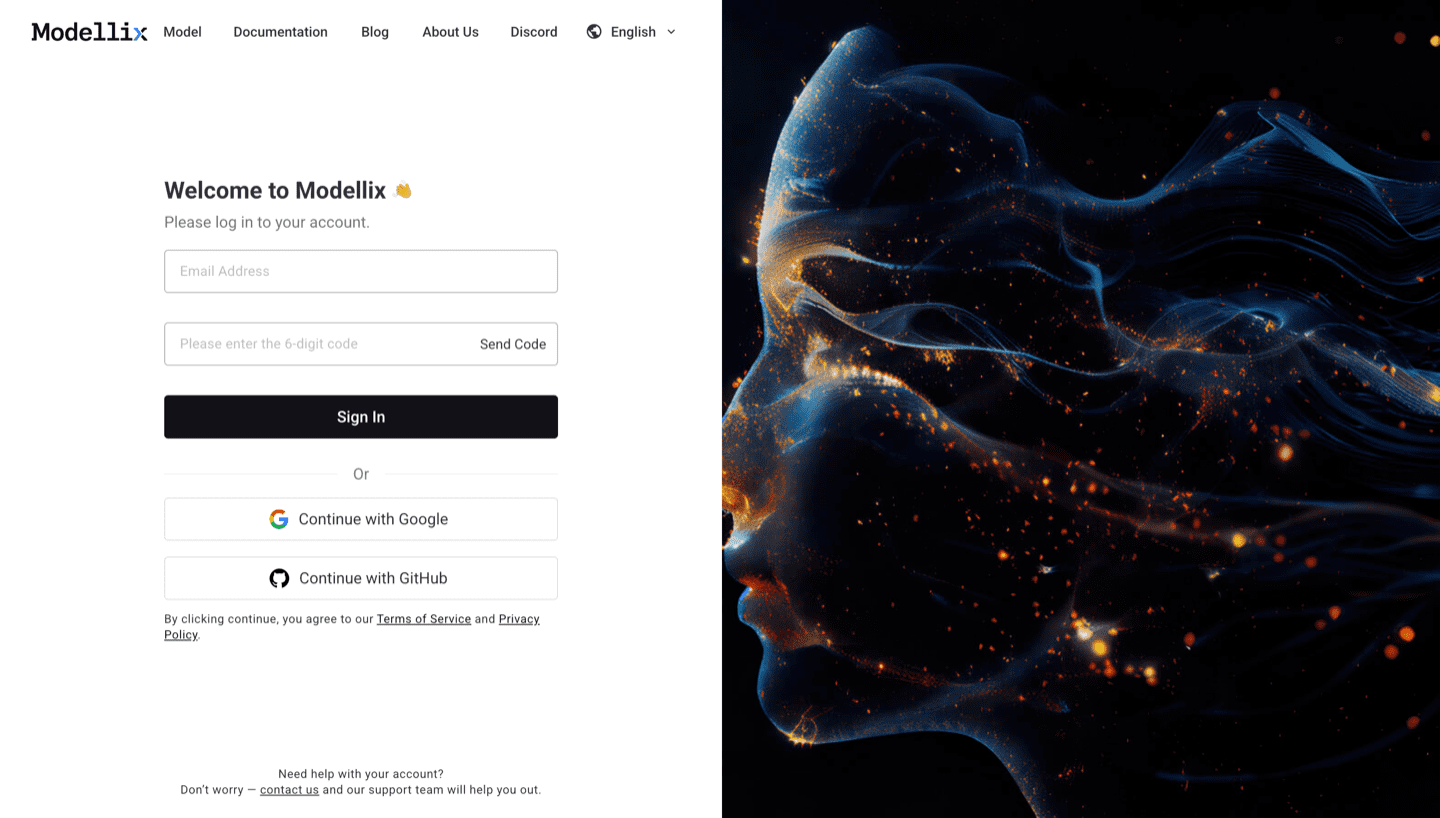
Step 2: Open the Model Page and Run One Prompt
After login, use the dashboard shortcuts or the Modellix model catalog to open Kling V3 T2V model page. For video models, start with a short clip, then check aspect ratio, duration, resolution, motion quality, and whether the output is worth repeating. This step is the fastest way to learn whether the model fits before you read more code.
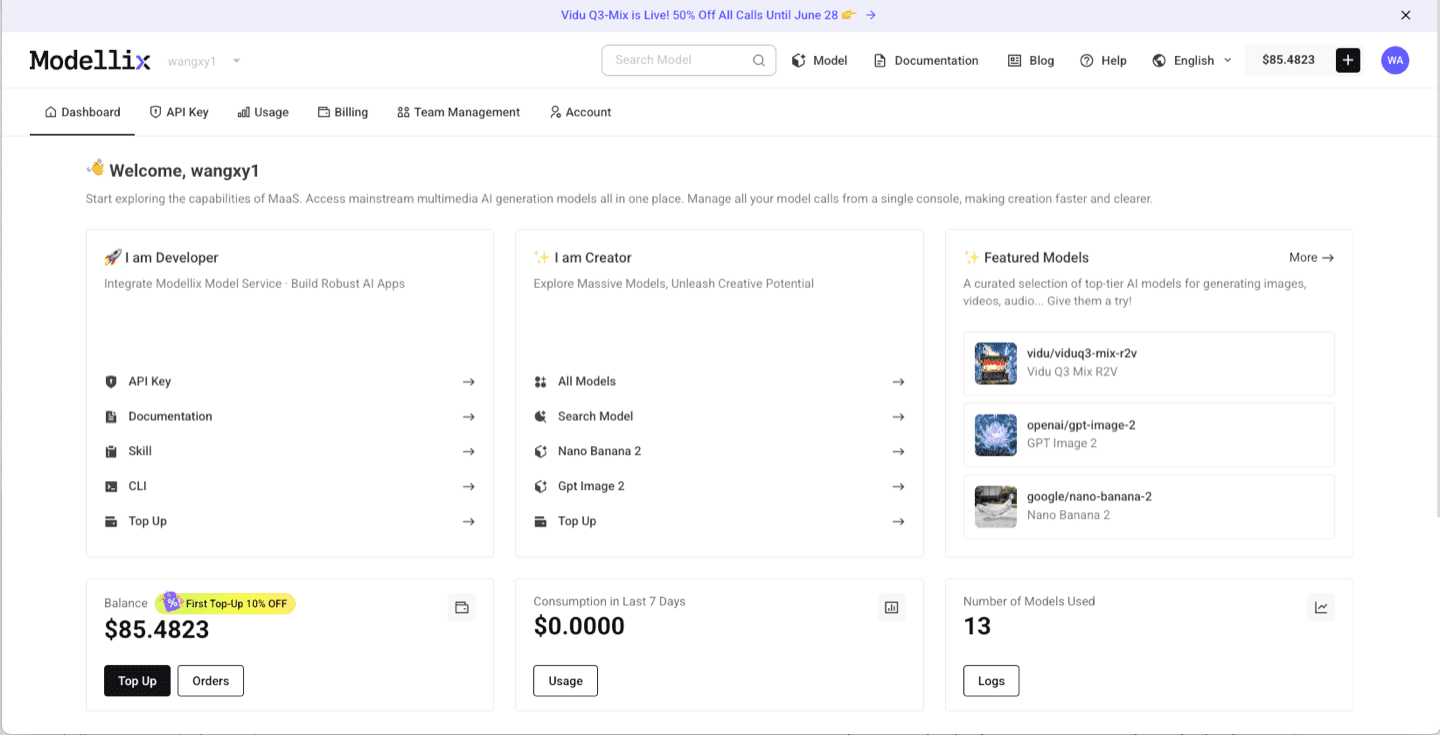
Step 3: Optimize the Prompt and Review the Output
Before you automate anything, improve the prompt and inspect one real output. The example below uses Vidu Q3 Mix R2V, but the same Playground pattern applies across Modellix model pages: write the prompt, use prompt enhancement when the brief is too thin, run the job, and review the generated media before creating an API workflow.

After the run finishes, check whether the result matches the prompt, motion, framing, and output format you need. A real preview is the conversion point: if the result works, move to API key, Skill, or CLI; if it does not, iterate in Playground before spending engineering time.

Step 4: Create an API Key Only When the Test Needs to Repeat
Stay in Playground for one-off exploration. Create an API key when a backend service, agent, batch script, or CLI workflow needs to repeat the same prompt pattern. This keeps the mainstream testing flow simple while giving developers a clean handoff point.
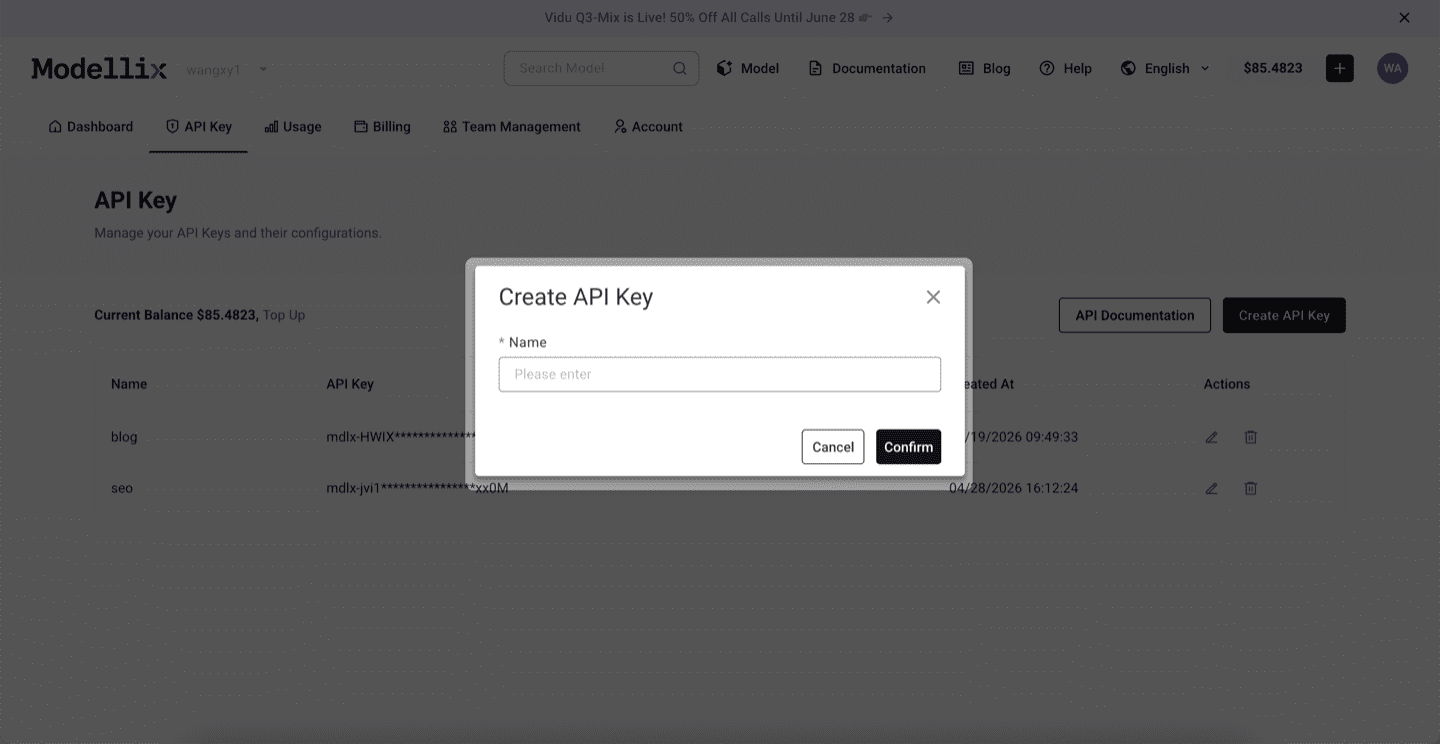
Step 5: Check Logs and Save the Result Before Scaling
Before scaling from one manual run to repeated API, Skill, or CLI usage, review request history. Logs confirm the model slug, API key name, task status, request time, and result retention window, which makes the workflow easier to debug after it leaves Playground.
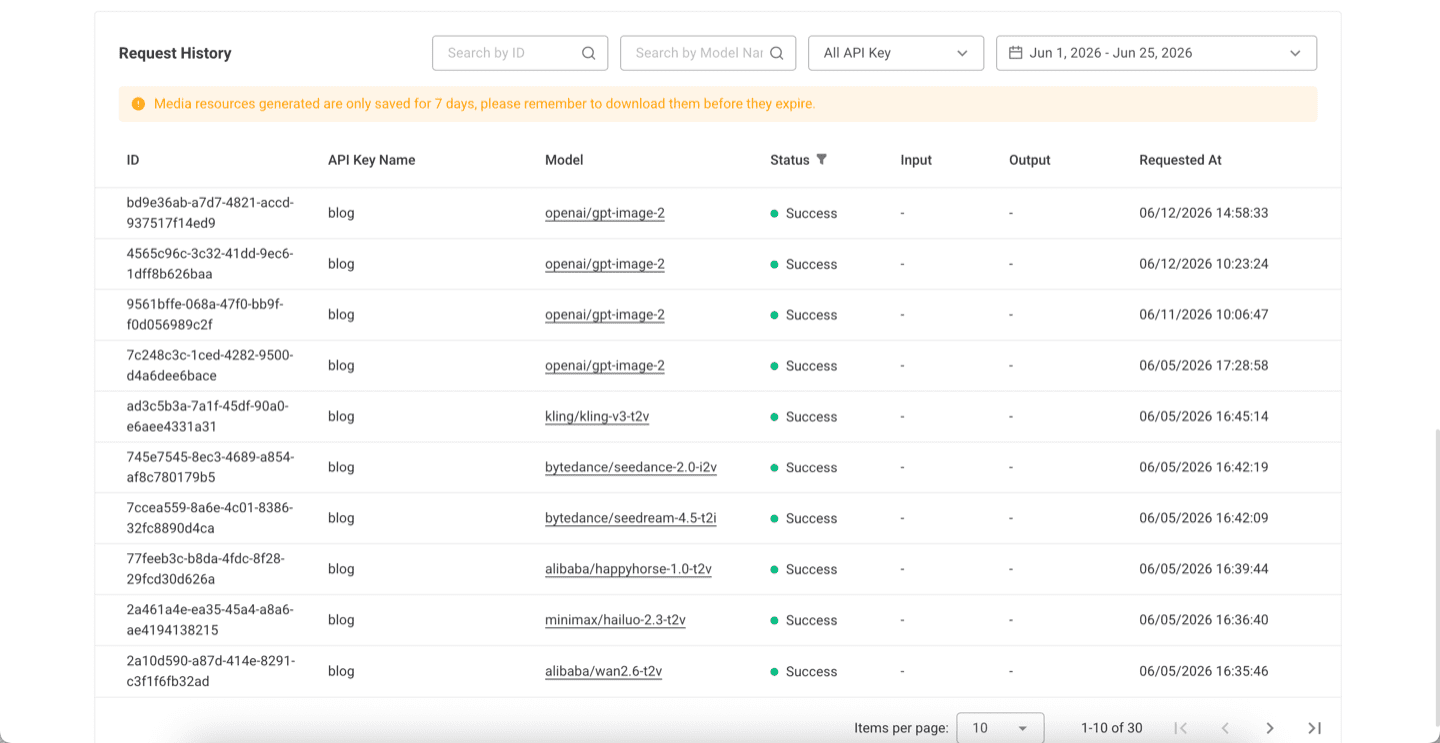
Try Kling Next
The practical next step is to run one real job from the official site, not to copy a complex code sample too early. Start from the Modellix console, open the Kling V3 T2V model page, and move to API, Skill, or CLI only after the output is good enough to repeat.
Run Kling once before you model the cost curve
Open the official Kling model page, test one prompt with the included credit, and compare the result with the pricing section before you scale volume.
Frequently Asked Questions About Kling AI API (April 2026)
Does Kling AI have an API?
Yes. Kling AI is developed by Kuaishou and has a developer API. However, direct access requires a Kuaishou developer account with Chinese business verification, which restricts international access. Developers outside China typically access Kling through a third-party gateway such as Modellix, which provides all Kling V1 through V3 models under a standard Bearer token with no regional restrictions.
How much does Kling AI API cost?
Kling API pricing varies by model version and generation mode. Standard mode is lower cost than professional mode. Kling V2.5 Turbo is approximately 30% cheaper than standard Kling V2.1 Master at the same 1080p resolution. V3 is priced higher than V2 to reflect additional capabilities. Modellix uses per-request pricing with no monthly minimums. Current per-clip rates are listed at docs.modellix.ai/get-started/pricing.
How much is the Kling 2.5 Turbo API?
As of April 2026, Kling V2.5 Turbo T2V starts at $0.050/s (standard) and $0.082/s (pro). V2.5 Turbo I2V is priced identically. For comparison, V2.1 Master T2V and I2V both run at $0.320/s , the Turbo tier is purpose-built for production volume where per-clip cost matters. Output is still cinematic 1080p with physics-accurate motion. Current rates are listed at docs.modellix.ai/get-started/pricing.
What is Kling 3.0 API and what does it add over V2?
Kling V3 (Kling 3.0 in the consumer product) adds three material capabilities: multi-shot storyboard generation for narrative video sequences, extended clip duration from 3 to 15 seconds (V2 maxes at 10 seconds), and V3 Omni formats supporting up to 4K image output and video-to-video with element references. V3 also delivers improved prompt adherence compared to V2.1.
Can the Kling API generate audio and video together?
Yes, starting with Kling V2.6. Both V2.6 T2V and V2.6 I2V support native synchronized audio and video generation in a single API call. Pass voice_ids and set sound: on, and the model outputs a clip with dialogue, sound effects, and lip-sync already embedded. No separate TTS pipeline required.
What is the rate limit for Kling API on Modellix?
Kling endpoints via Modellix are rate-limited at 100 requests per minute. Rate limit status is returned in response headers: X-RateLimit-Limit, X-RateLimit-Remaining, and X-RateLimit-Reset.
Is Kling API a good replacement for Sora?
Sora’s consumer service was shut down by OpenAI in April 2026. For developers who need a production video generation API, Kling is among the most actively maintained alternatives, with a broader model family and a well-documented API. For the highest cinematic quality, Veo 3.1 from Google leads on Artificial Analysis benchmarks as of April 2026. Seedance 2.0 from ByteDance is a strong alternative for image-to-video with competitive pricing. All three are available via Modellix under one integration.
How do I switch between Kling model versions without rewriting my integration?
Via Modellix, switching Kling model versions requires changing one value: the endpoint path. Changing /kling-v2.5-turbo-t2v/async to /kling-v3-t2v/async switches from V2.5 Turbo to V3. Authentication headers, parameter keys, and response parsing stay identical. No architectural changes required.
Access all Kling variants (V1 through V3, Avatar, Effects, Image) alongside Seedance 2.0, Veo 3.1, Hailuo, Wan, and every other major AI media model through a single API key at modellix.ai.