Search for the MiniMax API URL and you get one answer, repeated: https://api.minimax.io/v1. That string is real — it is MiniMax’s OpenAI-compatible base URL — but it is only one of the addresses a working integration needs. Change the protocol and the host stays, the path prefix changes. Change the modality and you are on v2/query/video_generation. Route the same model through an aggregator and the host changes entirely, because the aggregator splits media, text, and tools across three different domains.
This page is the URL and endpoint reference for all of those cases, read first-party on September 13, 2026. One disclosure: Modellix runs this blog and is an aggregator, so we have a commercial interest in the second half of this page. The MiniMax side is quoted from MiniMax’s own documentation with read dates; where we could not verify something first-party, this page says so rather than filling the gap.
The MiniMax API URL, endpoint by endpoint (verified September 13, 2026)
MiniMax publishes a single primary international API host and separates the protocols by path rather than by domain — the one exception is a second host for latency-sensitive speech, noted below. These are the endpoints we could verify in MiniMax’s API reference on September 13, 2026:
| What you are calling | Base URL and path | Source page |
|---|---|---|
| OpenAI-compatible text (Chat Completions) | https://api.minimax.io/v1 → POST /v1/chat/completions |
OpenAI SDK |
| Anthropic-compatible text (Messages) | https://api.minimax.io/anthropic → POST /v1/messages |
Anthropic SDK |
| OpenAI-compatible text (Responses) | https://api.minimax.io/v1 → POST /v1/responses |
Create Response |
| Video generation (asynchronous) | POST https://api.minimax.io/v2/video_generation |
Create video task |
| Video result lookup | GET https://api.minimax.io/v2/query/video_generation/{task_id} |
Query task |
| Image generation | POST https://api.minimax.io/v1/image_generation |
Text to image |
| Speech synthesis (T2A) | POST https://api.minimax.io/v1/t2a_v2 |
T2A over HTTP |
| File upload (inputs for other calls) | POST https://api.minimax.io/v1/files/upload |
File management |
Two details inside that table cause most of the copy-paste errors we see. The Anthropic base URL has no /v1. Set ANTHROPIC_BASE_URL=https://api.minimax.io/anthropic and let the SDK append the Messages route; appending /v1 yourself produces a 404 that looks like a model problem and is not one. Speech has a second host. Alongside POST https://api.minimax.io/v1/t2a_v2, MiniMax documents https://api-uw.minimax.io/v1/t2a_v2 as an “Alternative Endpoint, Reduced Time to First Audio (TTFA)” — a latency trade, not a regional requirement.
One thing we could not verify, and will not invent. The mainland-China API host: third-party guides publish a separate api.minimaxi.com base URL, but the MiniMax pages we read that day — eight API reference and guide pages plus the documentation index — contain api.minimax.io only. If you registered on the China-region platform, take the base URL from that console rather than from a blog. The protocol surface, by contrast, is documented and we corrected our own draft on it: MiniMax publishes three protocol surfaces on api.minimax.io — Chat Completions, Anthropic Messages, and the OpenAI Responses API (POST /v1/responses, plus POST /v1/responses/input_tokens for token estimation).

MiniMax’s own OpenAI SDK page, captured September 13, 2026: the base URL is set as an environment variable, not as a full chat-completions URL. That distinction is the difference between a working client and a 404.
The same models behind a different base URL: how an aggregator splits one vendor across three hosts
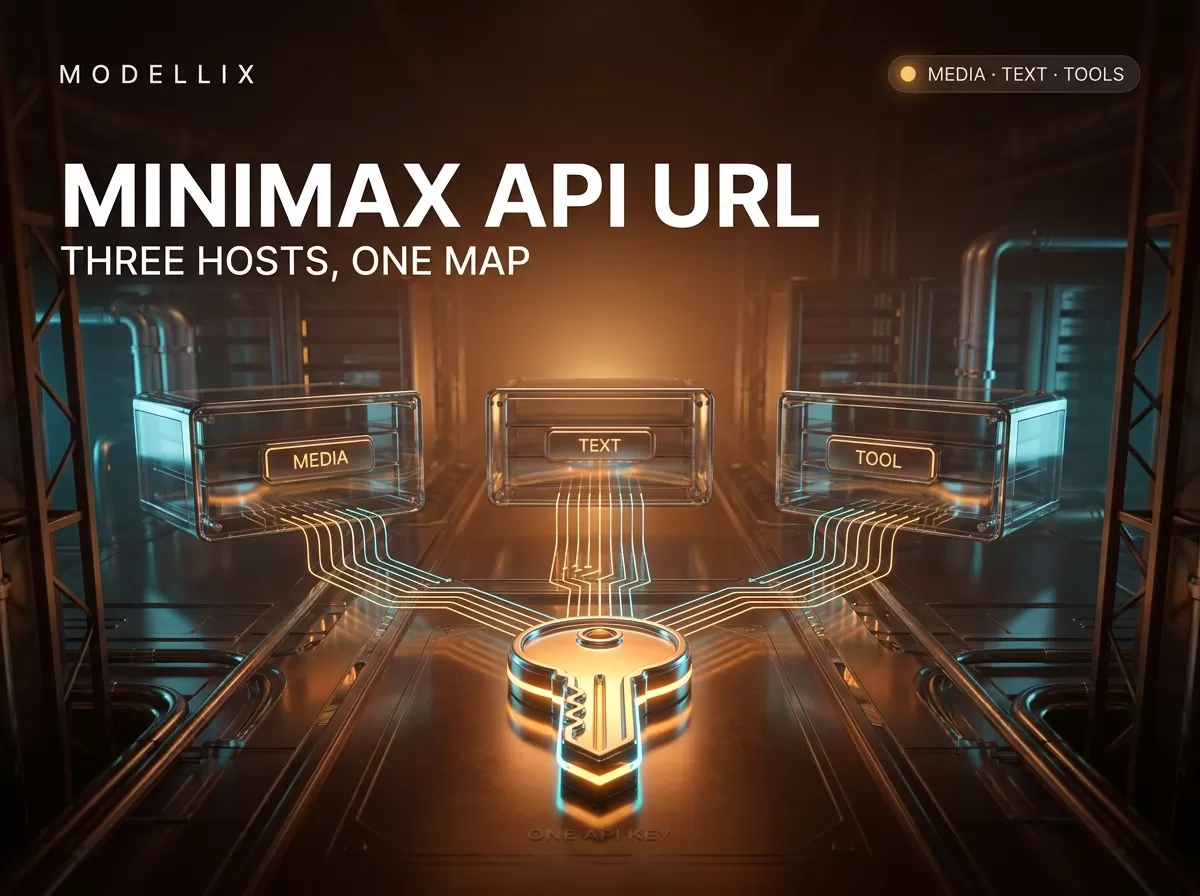
If you reach MiniMax through an aggregator instead of a MiniMax account, the base URL is not a swap — it is a split. Modellix, the aggregator behind this blog, runs three hosts, and each one answers a different kind of request:
| Host | What it serves | Path shape |
|---|---|---|
https://api.modellix.ai |
Asynchronous media generation — image, video, speech | POST /api/v1/minimax/hailuo-2.3-t2v → returns a task_id; GET /api/v1/tasks/{task_id} for the result |
https://llm.modellix.ai |
Text, synchronous, optional SSE streaming | POST /v1/chat/completions and POST /v1/responses (OpenAI-style); POST /v1/messages (Anthropic-style) |
https://tool.modellix.ai |
Web Search and Web Fetch | POST /v1/web-search, POST /v1/web-fetch |
The one rule that matters more than any individual path: do not mix them. Modellix’s LLM API documentation puts it flatly — media generation “uses https://api.modellix.ai and async tasks. Do not mix that host with the LLM gateway.“ The gateway host also carries the base-URL asymmetry: OpenAI-compatible clients use https://llm.modellix.ai/v1, while Anthropic-compatible clients use https://llm.modellix.ai with no /v1, because the SDK appends /v1/messages itself.

Modellix’s LLM API page, captured September 13, 2026. Both auth headers are accepted; the base URL differs by client type — /v1 for OpenAI-style clients, no /v1 for Anthropic-style clients.
Now the part most aggregator pages skip: which MiniMax models actually sit behind those URLs. On the Modellix side the current MiniMax catalogue is 13 model pages, all video or speech — H3 in T2V, I2V, FL2V and V2V variants; Hailuo 2.3 and Hailuo 02; and the speech routes (speech-2.8-hd, speech-2.8-turbo, a voice-clone endpoint), grouped on our MiniMax speech series page — read from the MiniMax provider page on September 13, 2026. The /llm price table that same day listed Anthropic, DeepSeek, Google, Moonshot, OpenAI, Qwen, xAI and ZAI prefixes, and no minimax/* model IDs at all. So MiniMax’s M-series text models are not reachable through the Modellix gateway — for those, the base URL in the first section is the one you want. Aggregators cover a vendor unevenly — MiniMax’s M3 text model, for example, is served by other aggregators rather than by this one (OpenRouter’s M3 page is one instance) — and we would rather say that than let you discover it after planning around the wrong URL.
To be clear about our own trade-off here: three hosts behind one key is a convenience, not a superiority claim. It means one credential, one bill, and per-request logs across media and text — and it also means one more hop between your request and the model, and a catalogue that changes week to week. Check the URL before you build on it.
The /async suffix is gone: the path to write, and the one that still works
Here is the change that makes half the tutorials on the internet look wrong while still working. On June 11, 2026 Modellix removed the /async suffix from model invocation paths. The changelog wording is exact: “We have simplified all model API endpoints by removing the /async suffix. Existing integrations using /async will continue to work seamlessly.” The example it gives is POST /alibaba/qwen-image-edit-plus/async, now simply POST /alibaba/qwen-image-edit-plus, with “full backwards compatibility” stated explicitly.
| Path for a MiniMax video route on Modellix | |
|---|---|
| Current form | POST https://api.modellix.ai/api/v1/minimax/hailuo-2.3-t2v |
| Old form, still accepted | POST https://api.modellix.ai/api/v1/minimax/hailuo-2.3-t2v/async |
This is why documentation can look internally inconsistent: Modellix’s own REST tutorial still shows /async in its curl examples as of September 13, 2026, and both forms return a task_id. Copying from a page written before June 2026 is not a bug — but new code should write the current path, so the next refactor does not have to remove a suffix you added on purpose. The full entry is in the product changelog.
The version segment is the other half of the lesson. MiniMax’s video creation endpoint sits at v2 (POST https://api.minimax.io/v2/video_generation) with its query at GET /v2/query/video_generation/{task_id}. Take versions from the live API reference, not from a tutorial — we will not claim a URL you copy today resolves next quarter, on either host. That is why the dated changelog exists.
Working code for each host
Three calls, one per surface. Substitute your own key in every case; on the MiniMax side it is a MiniMax key, on the Modellix side it is a Modellix key (mdlx-…) — a vendor platform key will not authenticate the gateway, and vice versa.
1. MiniMax, video, direct. Create the task, then poll content.url for the finished file:
1 | # Create — fields per MiniMax's Create Video Generation Task reference |
2. Modellix, media, asynchronous. The same shape as any Modellix media route — one prompt is the only required field for Hailuo 2.3 T2V, per the public schema, and the REST API tutorial documents the task_id handshake. Note the path has no /async:
1 | curl -sS https://api.modellix.ai/api/v1/minimax/hailuo-2.3-t2v \ |
3. Modellix, text, synchronous. Same key, different host, and — because this is the OpenAI-compatible surface — the base URL carries /v1:
1 | from openai import OpenAI |
That third block is deliberately not a MiniMax model ID: the text gateway’s model list is provider/name, and MiniMax text models are not on it as of September 13, 2026 (see the provider section above). If you need MiniMax text, the base URL in the first block is the one you want.
Modellix REST API Reference
See every media path, task query, webhook, and file endpoint before you wire the call up.
View DocsFinding any model’s exact URL without an API key
Guessing paths is avoidable. Modellix publishes a public schema endpoint that returns the exact inference base URL for a model, no credential required: GET https://www.modellix.ai/models/{provider}/{model}/api_schema. The response includes servers[0].url — the generate URL for that slug — plus the request body schema, so you can see required fields before writing them. One interpolation gotcha from the docs: keep the slash as a literal path separator, do not encode it as %2F.
The same data is available from the command line, and this is the part worth remembering when an agent or a CI job needs it (modellix-cli on npm):
1 | npm install --global modellix-cli |
modellix-cli model get-schema was added September 4, 2026 and is documented as not requiring an API key — the changelog notes the Modellix Skill and Plugin use it “instead of guessing fields from documentation pages”. The same CLI has model list for discovery and model batch for JSONL batch submissions, if you are queueing work rather than calling once; the command set is in the CLI documentation.

The public schema endpoint, captured September 13, 2026. It returns the model’s own inference base URL and request schema without an API key — the fastest way to stop guessing paths.
For enumerating what exists rather than what you already know about, GET /api/v1/models returns the active model list with slug, type, documentation URL and description; featured=true narrows it to featured models. Between those two endpoints you rarely need to read a documentation page again to build a path.
Auth headers, uploads, and the two defaults that bite
Authentication does not vary by path on either side. Modellix accepts Authorization: Bearer <key> or x-api-key: <key> and the docs state they are equivalent — “if both are sent, they must be the same key”, and mismatched values return 401. MiniMax’s headers follow the same convention in its own examples, and its keys come from the pay-as-you-go API Keys page described in the platform prerequisites, with a separate subscription key for the Token Plan billing track. Get the Modellix key from Modellix’s console, not from a vendor platform: a MiniMax key will not work on api.modellix.ai.
The two defaults that catch people are retention windows, and they are both about seven days.
Uploads are not billed and expire. Modellix’s File API (POST /api/v1/media/files, multipart, field name file) accepts images, videos and audio, is not billed, and is retained for about 7 days as the default — with a 16 MB max file size, 10 files per team, and 2 concurrent uploads. It returns a file_id and a url that you pass into prediction calls, so you do not have to host inputs yourself; you also should not treat it as storage. Generated results carry the same warning: Modellix saves them for 7 days, and MiniMax’s own query endpoint only serves tasks from “the last 7 days”. Whatever you produce, persist it on your side.
If you would rather not poll at all, Modellix’s media host supports push delivery: send X-Webhook-URL on a media prediction request and Modellix posts the result to that HTTPS endpoint once the task reaches success, failed or canceled, with event headers such as X-Modellix-Event: prediction.task.succeeded. MiniMax’s own video create endpoint takes an optional callback_url: MiniMax first sends a verification request carrying a challenge field, then POSTs a status update (queued, running, succeeded, failed or cancelled) to that URL whenever the task changes — so push delivery exists on both sides, expressed differently. For cost reconciliation, media logs live at GET https://api.modellix.ai/api/v1/logs, text logs at https://llm.modellix.ai/v1/logs, and tool logs at https://tool.modellix.ai/v1/logs; all three cap the window at 30 days, and the media and text logs accept an end-user identifier set with X-Mdlx-User-Id so you can attribute spend per customer. Two smaller endpoints worth knowing: GET /api/v1/apikey/validate to check a key without spending anything, and GET /api/v1/team/balance for the balance in USD. The key-handling mechanics — which key type to create, what each error code means — belong to our MiniMax API key guide, and the account-level view of keys, billing tracks and the console sits in our MiniMax API platform overview; neither belongs to this page.
What each URL bills in, and what is not a discount
Billing follows the endpoint, not the account, and the units differ per modality — which is why a URL reference should tell you the unit next to the path. For the MiniMax media routes Modellix currently lists, the units and price ranges as of September 13, 2026 are:
| Modellix route | Billed by | Price range |
|---|---|---|
minimax/minimax-h3-t2v, -i2v, -fl2v |
second | $0.0800–$0.1300 / sec |
minimax/minimax-h3-v2v |
second | $0.1600–$0.2600 / sec |
minimax/hailuo-2.3-t2v, -i2v, hailuo-02-t2v, -fl2v |
second | $0.0504–$0.0738 / sec |
minimax/hailuo-2.3-fast-i2v |
second | $0.0288–$0.0495 / sec |
minimax/hailuo-02-i2v |
second | $0.0153–$0.0738 / sec |
minimax/speech-2.8-hd |
million characters | $100.0000 / M chars |
minimax/speech-2.8-turbo |
million characters | $60.0000 / M chars |
minimax/minimax-voice-clone |
million characters | $60.0000–$100.0000 / M chars |
Ranges are ranges because resolution and duration sit in different price tiers within one model — the same URL bills differently at 768P and 2K. Every figure was read from the individual model pages listed on the MiniMax provider page on September 13, 2026; prices here move, so re-check before you budget. On the text side the same gateway bills in USD per 1M tokens from the request’s token usage, with input-context tiers listed in the LLM price table. Our MiniMax pricing breakdown owns the vendor comparison; this section only fixes which unit each URL answers in.
Two things that get conflated, so we will separate them. The first: a model’s discount column is a unit price, not an account perk — when a model page shows a lower rate, that is the per-second or per-million-character rate you pay. The second: Modellix currently offers a 10% discount on your first top-up in each tier, up to six times, per the top-up documentation; that is an account-level credit on a deposit, and it changes nothing about the unit rates above. Keeping those two straight is the difference between an accurate cost model and a surprise invoice.
Start calling MiniMax models
Log in to run Hailuo, H3 and MiniMax speech routes on the same key as 200+ other media models.
LoginFrequently Asked Questions About the MiniMax API URL
What is the base URL for MiniMax? For OpenAI-compatible clients it is https://api.minimax.io/v1; for Anthropic-compatible clients it is https://api.minimax.io/anthropic, with no /v1 appended. Video, image, speech and file endpoints live on the same api.minimax.io host under their own paths, listed in the table above.
Is the MiniMax API URL different if I use an aggregator? Yes, and not only the domain. Modellix answers media requests at https://api.modellix.ai, text at https://llm.modellix.ai, and web tools at https://tool.modellix.ai, and its documentation warns against mixing those hosts or their request fields.
Do I have to remove /async from my existing integration? No. Modellix removed the suffix from model paths on June 11, 2026 and states that existing integrations using /async “will continue to work seamlessly”. Write the current form in new code; leave working code alone until you touch it for another reason.
Is there a free MiniMax API? Not as an automatic allowance. MiniMax’s own documentation does not publish a standing free tier for the API, and Modellix ended its signup credit on August 19, 2026 — new registrations no longer receive a complimentary $1 credit. The only free line items MiniMax documents are bundled allowances inside its paid video packages (its pay-as-you-go page marks an Audio row Free under MiniMax-H3), not a free API tier, and the three free music endpoints it did document were discontinued from August 20, 2026. Trial credit is requested by emailing support@modellix.ai, and neither host’s free-ness should be assumed when you budget; our MiniMax free API guide keeps the two sides separate.
How do I find the exact URL for one specific MiniMax model? Call GET https://www.modellix.ai/models/minimax/<model>/api_schema — it is public, needs no API key, and returns servers[0].url plus the request body schema. From a terminal, modellix-cli model get-schema minimax/<model> --quiet prints the same inference URL.
How long do uploads and generated files stay available? About seven days by default on Modellix — uploads through the File API and generated results both. MiniMax’s video query endpoint likewise only serves tasks from the last seven days. Treat both as transit, and copy anything you need to keep.
Which auth header should I send? Either Authorization: Bearer <key> or x-api-key: <key> works on the gateway; send one, or send both with identical values. Use a Modellix key for Modellix hosts and a MiniMax key for MiniMax hosts — they are not interchangeable.
Base URLs, paths, limits and prices were read from MiniMax’s documentation, the Modellix documentation site, the product changelog, and live Modellix model pages on September 13, 2026. Both platforms change endpoints, catalogues and pricing without notice; this page is a dated snapshot, not a guarantee that a URL you copy today will resolve next quarter. Modellix operates this blog and is an aggregator, so we have a commercial interest in the routes described above — verify against each provider’s live documentation before you commit. Modellix exposes image, video and speech models, including the MiniMax media routes above, behind a single API key at modellix.ai.