The First AI Feature Film Cost $25,000. That Was the Easy Part.
This is an analysis of two stories that landed within a day of each other this week. Read together, they describe the actual state of AI production better than either one does alone — and the gap between them is where production planning for the next two quarters should start.
The first: on September 16, Fountain 0 released Odysseus: The Fall, a 135-minute, almost entirely AI-generated feature made largely by one person on a budget reported somewhere in the tens of thousands of dollars. The second: Dainik Bhaskar, India’s largest-circulated Hindi daily, told analysts it is now producing AI-generated micro-drama series built from its own news reporting, running on its app and on YouTube.
One is a cost story. The other is a distribution story. Neither is really about quality — and that distinction is the thing worth carrying into next quarter’s production plan.
The Numbers Behind the First AI Feature Film
Fountain 0 announced Odysseus: The Fall in July, timed pointedly against Christopher Nolan’s roughly $250 million adaptation of the same epic. The studio’s own release announcement priced the film at $9.99 to rent in a browser and described it in the language you would expect: the first completely AI-generated film produced “at the level of a big budget Hollywood movie.”
The budget is where reporting gets interesting, and where you should be careful before quoting any single figure — because the sources do not agree. Variety and The Hollywood Reporter both put production in the “mid-five figures,” and one secondary breakdown places that nearer $50,000–$75,000. On Fox Business’s Claman Countdown on September 16, director Ash Koosha himself described producing the film on a budget of about $25,000 — and named AI video generation alongside Claude and Gemini as the tools involved. When he spoke to CBC News in July, he declined to give an exact figure. Both numbers describe the same film; only one comes from the filmmaker.
Koosha told CBC News he made the film part-time over about three months, working mainly on cloud token credits, and that the point was what a conventional budget would never buy him: “I would never be able to get a budget to display a monster in the sea and a cyclops in a cave.”
That is the headline claim, and it holds up. The cost of attempting a feature has fallen by two to three orders of magnitude. What has not fallen is the cost of making that attempt watchable.
One Person, Three Months, and a Cost Basis You Can Actually Model
Run the creator-side math and the production model becomes legible. Three months of part-time work by a single person, with compute billed as tokens rather than crew, locations, or VFX vendors. The largest budget line is inference, not labor. Against the ~$25,000 budget figure, that works out to roughly $185 of compute per finished minute (my own arithmetic: $25,000 ÷ 135 minutes) — absurd by cinema standards, unremarkable by volume content standards. Treat that number as an order-of-magnitude anchor, not a precise figure: it depends entirely on how much of the budget was spent on generation versus retries, and none of that breakdown has been published.
For teams that already run AI pipelines commercially, this is familiar territory: production has been shifting from craft work toward orchestration for several quarters, and the labor concentrates at the two ends of the pipeline — shot planning upstream and QC review downstream. What Fountain 0 demonstrates at the extreme end is that the human bottleneck is no longer generation capacity. It is decision-making about shots, and review of what came back.
One detail in the coverage deserves attention beyond the novelty. Koosha cast his own likeness as Odysseus, and the production relied on likeness and voice participation. That is a legal posture as much as a creative one, and it is the part of this experiment most likely to be standardized by studios rather than by individual creators.
The Ceiling Is AI Video Consistency, Not Cost
The reception to Odysseus: The Fall converges on one thing, and it is worth reading the professional review rather than the trailer.
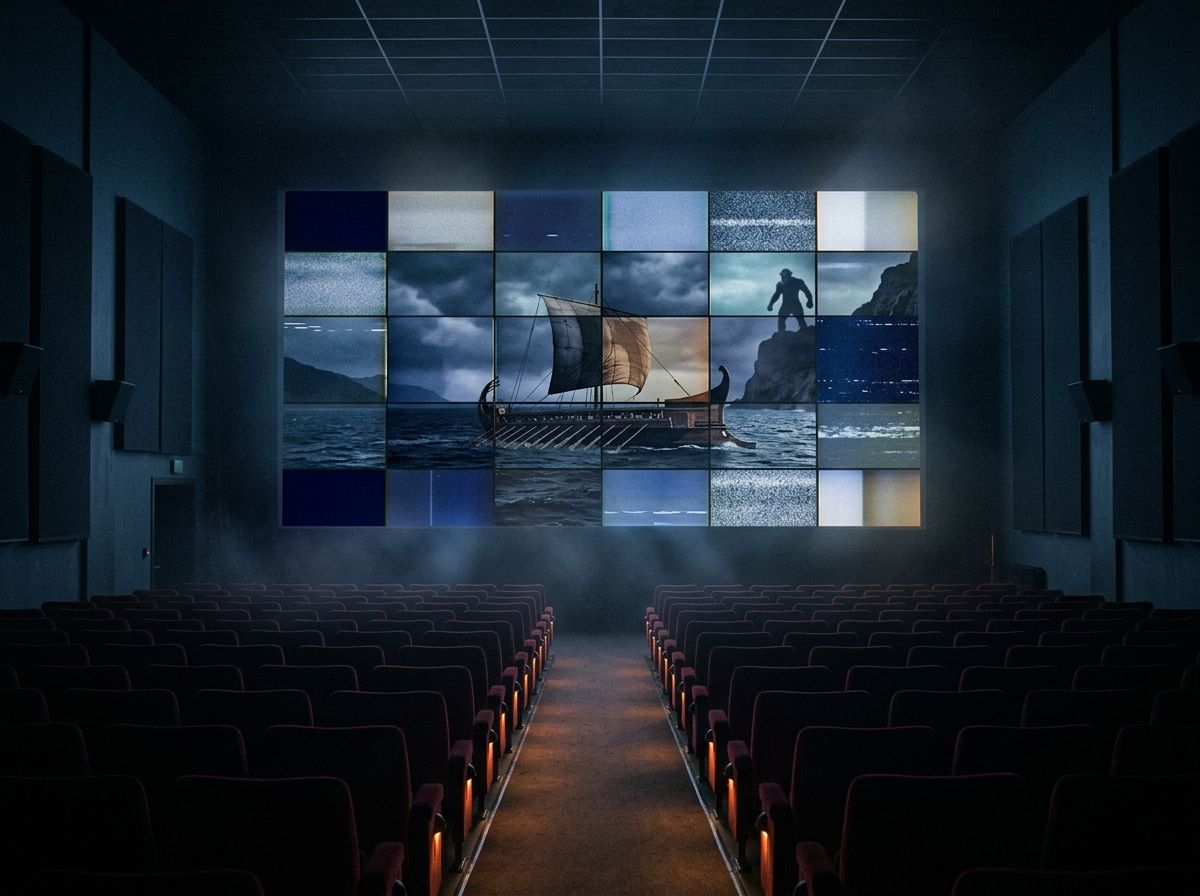
It is worth noting upfront that this film has no real critical consensus yet: as of writing, Rotten Tomatoes lists no critic reviews and no audience score for it. The most detailed professional account available is The Verge’s September 16 review, which identified the mechanism precisely: current models generate coherent scenes lasting only a few seconds, so a feature-length runtime “feels like a disjointed collection of moments from the odyssey that have been stitched together with little rhyme or reason.” The specific failures it documents are the ones any QC pass would flag — the cyclops’s height changing from shot to shot, waves moving against the wind, oars bending as sailors row, mouths out of sync with dialogue, one boat in a fleet inexplicably moving sideways, and both “Odysseus” and “Zeus” mispronounced. The review also notes characters that look hyperreal sitting beside monsters that read as “shabby stop-motion creatures from the 1930s.”
Key Takeaway: The failure mode is structural, not stylistic. A long runtime multiplies generation events, and every generation event is a chance for identity, lighting, and geometry to drift.
The numbers behind that drift are concrete. Across the current model field, native single-generation ceilings sit at roughly 8 seconds for Veo 3.1, about 15 seconds for Kling 3.0, and 30 seconds for ByteDance’s Seedance 2.5, which generates that in a single pass rather than by stitching. Extension chains push further, but chaining is precisely where drift accumulates — each segment conditions on the last, and small errors compound.
A 135-minute runtime at a 15-second average is several hundred generation events. Consistency work at that scale is not a prompt problem; it is an engineering discipline, and the two routes moving the ceiling today attack it from different directions. Reference-to-video conditioning holds a fixed character or environment image across many shots, so identity is re-anchored on every generation instead of inferred from the previous clip. Multi-shot generation, by contrast, asks the model to plan coverage for several shots inside one window — a tool like PixVerse’s multi-shot mode plans that coverage internally, so the editor never has to reconcile a seam. The trade-off is real: reference conditioning constrains the model’s freedom and can flatten performance, while multi-shot generation keeps the model unconstrained but caps how much story fits in one window.
The cost-per-finished-minute picture explains why this matters commercially even if you never touch a feature:
| Production route | Cost per finished minute | Basis |
|---|---|---|
| Feature-length AI film, single creator | ~$185 per minute ($25,000 across 135 minutes) | Author’s arithmetic on the Fox Business budget figure and reported runtime |
| High-end AI short drama / polished AI video | ~$30–$100 per minute in generation cost; ~$150–$500 all-in at indie-studio quality | Documented production data (sincosphere, ogunstudios); a New York Times figure cited via C21Media puts the optimized low end near $30/min |
| Conventional live-action episodic | $1,000–$10,000 per minute | Published US production rate cards |
Source: Fox Business / Claman Countdown, Variety, industry production data (sincosphere, ogunstudios), and published US production rate cards, retrieved September 17, 2026. The first row is an order-of-magnitude calculation, not an audited figure.
Those first two lines are not the same job, and the comparison is deliberately unfair: a feature carries continuity demands across 135 minutes that a two-minute episode simply does not. The useful question is not “which is cheaper per minute” but “where does your format sit on the continuity curve.” Most commercial formats sit far below feature length, which is exactly why the second story works.
Dainik Bhaskar Turns Its Newsroom Into an AI Micro-Drama Studio
If Odysseus: The Fall shows where the ceiling is, Dainik Bhaskar shows the volume that fits comfortably underneath it.
According to MediaNama’s September 16 report, the publisher disclosed on its July 20 earnings call that it had already begun producing “a couple of micro dramas” with AI for its own platform, distributed through the Dainik Bhaskar app and YouTube. Director Girish Agarwal set the constraint bluntly: “Our dramas, our serials have to be based on the news. We can’t do fiction.”
That constraint is the interesting design decision. A news-based AI series gives up fictional range and in exchange gets something most AI content pipelines are short of: a supply of verified, dated, already-editorialized story inputs, and a reason for an existing audience to open the app. The company said it would keep expanding the count after a good response on the app.
The market context makes the move legible. India’s micro-drama category crossed roughly $300 million in 2025 with about 450 million downloads and 100 million monthly active users, per Lumikai’s State of India Interactive Media Report, covered by the Times of India, with projections to $4.5 billion by 2030. That is not a single-source estimate: the FICCI-EY media and entertainment report pegs the same 2025 market at roughly INR 6.5 billion and sees it growing over 50% annually through 2028. Two independent research houses, same conclusion. Sensor Tower’s 2026 tracking puts cumulative short-drama downloads in India past 800 million. A Meta–Ormax study from March 2026 found viewers spend a median of 3.5 hours a week on the format, and that 89% of them discovered it through social feeds.
Monetization is still the open question. Redseer’s August 2026 report, covered by Moneycontrol, projects ad revenue in the category growing from roughly ₹24 crore in FY26 to ₹5,000–5,500 crore by FY32 — a bet on advertising paying for serialized short video at a scale subscription has not reached in that market.
This is not an isolated experiment. Amazon’s MX Fatafat, ShareChat’s QuickTV, Zee’s partnership with Bullet, and funded startups like Flick TV, ReelSaga, and Chai Shots have all pushed into the same format since early 2025. Publishers entering now do it with editorial supply rather than content rights, which is a structurally cheaper position: they already own the raw material and the audience, so their marginal cost is production rather than licensing.
What Both Stories Mean for a Team Shipping Every Week
Strip away the film-vs-news framing and the same rule shows up twice: AI video consistency is a function of format length, and format length is a deliberate choice about where you sit on the curve.
Odysseus: The Fall did not fail because the budget was small. It pushed an order of magnitude past the range where today’s models hold together, and the review record of what broke — height drift on the cyclops, oars bending mid-stroke, dialogue out of sync — is unusually specific and, importantly, reproducible: those are failure modes any team can watch for in its own output. Dainik Bhaskar is making the opposite bet: that two-to-five-minute episodes already sit inside that range, and that the constraint is worth accepting in exchange for a supply of stories nobody else has.
Pro Tip: Audit for seams the way you audit for latency. Track identity drift per shot, lighting continuity across cuts, and dialogue-to-mouth sync as separate QC categories, and measure them per episode. A defect rate you can chart is a defect rate you can price into a client quote.
Three things to watch over the next two quarters:
- Real numbers on the feature model. No verified revenue or viewership figure for Odysseus: The Fall has been published, and the ~1.2 million first-week figure circulating in secondary coverage is single-sourced. Treat the economics of feature-length AI as unproven until someone publishes a real figure.
- Whether publishers monetize news-based series differently. If Dainik Bhaskar’s news micro-dramas outperform its fiction-adjacent competitors on retention, the “no fiction” constraint stops looking like a limitation and starts looking like a moat.
- Whether tooling makes consistency a setting. Reference-driven and multi-shot generation are the two routes currently moving the ceiling. When consistency becomes a parameter rather than a QC process, the curve shifts and longer formats stop being artisanal projects.
The through-line for anyone shipping AI video at volume is unglamorous: pick a format length that sits inside the model’s consistency range, build QC around the specific failure modes you can measure, and treat the cost curve as a planning input rather than a headline. The two stories this week simply put a number and a newsroom on either end of that curve.
Analysis based on publicly available sources — Variety, The Hollywood Reporter, The Verge, Fox Business, CBC News, MediaNama, Lumikai via Times of India, and Redseer via Moneycontrol — all retrieved September 17, 2026. Budget figures for Odysseus: The Fall are disputed between sources; all figures are directional estimates, not audited production costs.